Is It Safe To Walk In Wroclaw At Night?
A practical answer to whether Wroclaw, in southwestern Poland, is safe to walk around at night, which areas stay busy after dark, and how to get home.
Wroclaw, the largest city in Lower Silesia (Dolnoslaskie voivodeship) in southwestern Poland, is a city that genuinely lives in the evening. The old town's bars run late, students from the city's universities fill the riverside islands in warm months, and the main squares stay lit until well past midnight in summer. That said, "safe at night" is a question about streets, transport and habits, not a single yes or no, so this page walks through what a night on foot in Wroclaw actually involves.
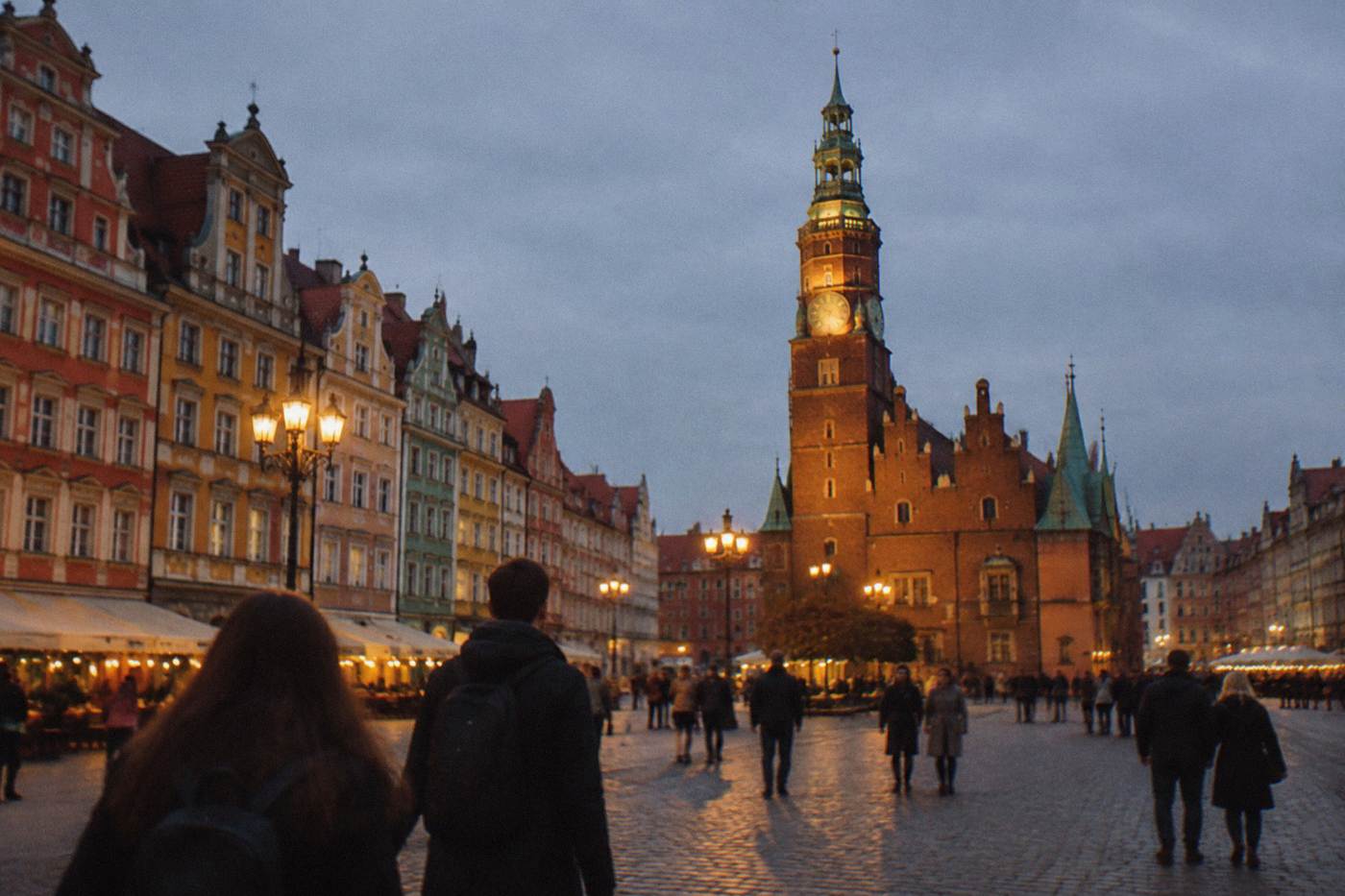
Is It Safe To Walk In Wroclaw At Night?
Yes, walking in Wroclaw at night is generally safe for visitors, and the city's core is one of the more relaxed nighttime environments in Poland. The old town, Ostrow Tumski and the main student areas stay lit and populated late, violent crime against tourists is rare, and the usual precautions are about pickpocketing and getting home, not about avoiding whole districts after dark.
That is a broad statement, and it deserves unpacking honestly. No crime statistic or safety ranking for Wroclaw was sourced in the research behind this page, so this article does not quote one; nothing here should be read as a measured claim about crime rates. What can be said with confidence is structural: Wroclaw's population of 672,601 (GUS, 31 December 2025) makes it a large city, and it behaves like a Central European university city after dark, meaning plenty of foot traffic on main routes, restaurants and bars open late, and a public transport network that keeps running into the small hours on core lines.
The honest caveat is that "safe" is uneven, as in any city of this size. The medieval core around the Rynek, the riverside islands like Slodowa Island, and the streets between the market square and the National Forum of Music are busy, well-lit and usually full of people until late. Peripheral residential districts and some of the farther housing estates are quieter, less lit, and offer a walker less company, which is a different experience even if the actual risk is not dramatically different. A sensible rule of thumb for a first-time visitor: the streets where you would happily walk at 2 p.m. are, by and large, the streets where you will happily walk at 11 p.m.
The Wroclaw Travel Guide homepage covers the full range of what the city offers by day, which is worth knowing because the safest night routes are simply the busiest day routes.
Which Parts Of Wroclaw Feel Safest After Dark?
The safest-feeling parts of Wroclaw at night are the old town around the market square, Ostrow Tumski, the Odra riverbank and islands, and the nightlife streets north of the Rynek, all of which stay pedestrian-busy and lit late. Quieter areas lie farther out, where lighting and foot traffic thin, so visitors walking at night mostly stay inside the central ring.
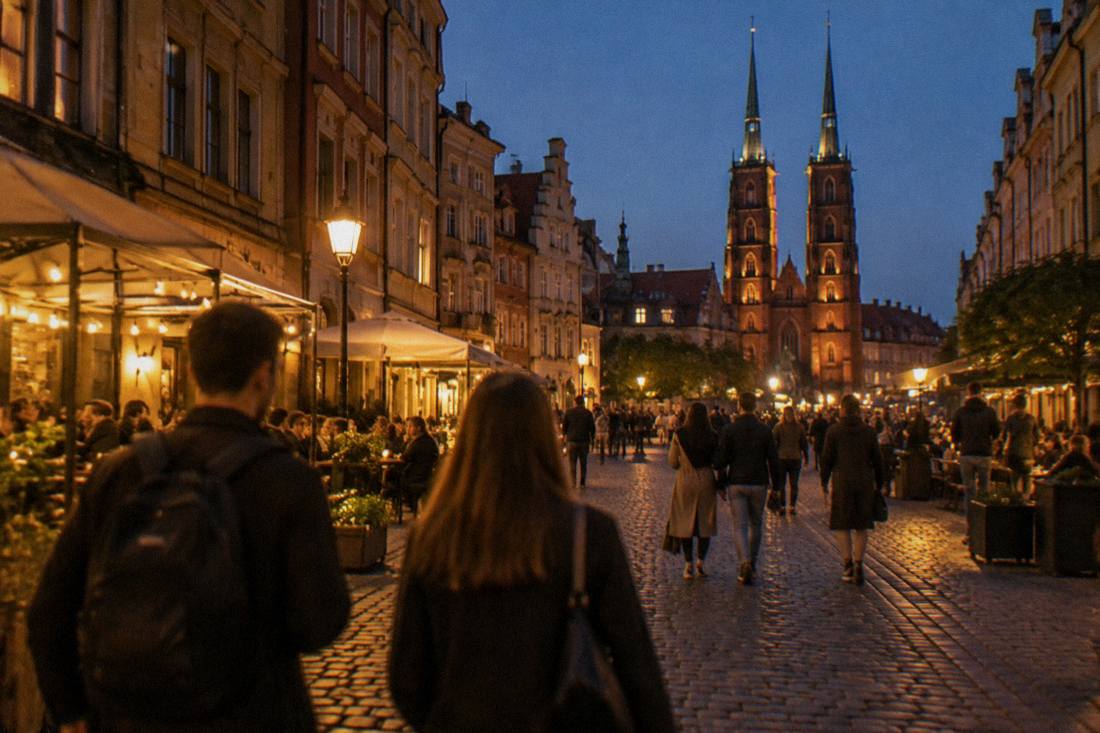
Start with the Rynek, the market square. It is the city's focal point, ringed with bars and restaurants that keep tables out in warm weather, and it is the place where foot traffic lasts longest. From there, the routes north and east stay lively: the bar streets running toward Swidnicka and the riverside, and the bridges leading to Ostrow Tumski, the cathedral island. Ostrow Tumski after dark is a particular Wroclaw experience: quiet, gas-lit in parts, and, famously, one of the few places in Europe where a municipal lamplighter still lights lamps by hand, a tradition covered in Which Cities Still Have Lamplighters?. A quiet lane with a lamplighter walking it twice an evening is about as low-stress as night walking gets.
Slodowa Island and the neighboring river islands are the student heart of the city in the warmer half of the year, with people sitting on the banks late into the night. This is also the area to be realistic about: crowds of students drinking outdoors are lively rather than menacing, but the island lawns are dark at the edges, so walk the lit main paths rather than the riverbank shortcuts.
Beyond the center, Nadodrze, the district just north of the old town, has been transformed over the past decade into the city's recognized creative quarter, with community-driven street art and courtyard revitalization projects. Its reputation has changed a great deal, but at night it is still calmer and less lit than the Rynek to the south, so it is better treated as a daytime or early-evening destination unless you know the route.
A practical way to build night-route confidence is to learn the city's geography by day first. A guided walk such as the Old Town Wroclaw guided walking tour covers exactly the streets you will later walk at night, and knowing which lane leads where removes most of the uncertainty after dark. Check availability if that sounds like a useful first afternoon.
How Do You Get Home Safely In Wroclaw After Dark?
Wroclaw's night safety net is its public transport: MPK trams and buses run on a regular night network, a 15-minute ticket costs 4.60 zl (2.30 zl reduced), and a taxi or ride-hailing car ordered by app from a bar or hotel is the standard fallback for the small hours. Walking is a choice in the center, not a necessity, after the trams thin out.
The transport detail matters because "is it safe to walk" often really means "will I have to walk". In Wroclaw, usually not for long. The city's fare structure, published on the city's official portal, is short-hop friendly, and the tiers are priced so that a late tram ride home does not require planning or a big spend.
| MPK ticket | Normal | Reduced |
|---|---|---|
| 15-minute | 4.60 zl | 2.30 zl |
| 30-minute | 7.00 zl | 3.50 zl |
| 24-hour (city) | 15.00 zl | 7.50 zl |
For a night out, buy a 30-minute or single ticket before you leave or via the ticket machine on board, and check the last and first tram times for your route on the city's transport pages rather than assuming; this page does not carry a timetable and will not invent one. Between roughly midnight and 5 a.m., most routes switch to a reduced night schedule, and the wait gets longer, which is exactly when the app-ordered car option earns its place. The currency for any of this is the zloty (PLN), never the euro: Poland is in the EU and Schengen, but it does not use the single currency, so a card charged in zloty is what you should expect from a driver or a ticket machine.
One habit worth adopting: keep your phone charged and your accommodation's address saved in Polish, because showing a driver a street name in Polish is faster and clearer than pronouncing it. If you are weighing how much time you even need in the city, How Many Days In Wroclaw Is Enough? has the answer, and the short version is that a compact center means most night walks back to a central hotel are short.
What Should You Watch Out For On A Night Out In Wroclaw?
The realistic night risks in Wroclaw are pickpocketing in crowded bars and around the market square, overcharging in a small number of tourist-oriented venues, and ordinary tram-stop waiting, not violent crime or no-go districts. Standard city habits, keeping bags closed, agreeing prices before you order, and using official transport, cover nearly all of it.
Crowds are the main thing. The Rynek on a Friday or Saturday night, and the streets around it, are dense, and dense crowds are where petty theft happens in any European city. Do not leave a phone on a café table unattended, and treat a sudden friendly stranger with the same mild caution you would in any unfamiliar city; distraction is the oldest technique there is. On drinks: Wroclaw's nightlife scene, including what to wear and how Polish clubs work generally, is covered in What Is The Dress Code In Wroclaw Nightlife? and Which City In Poland Has The Best Nightlife?. The bar-and-club core near the old town is heavily frequented by locals and students, which is itself a stabilizing factor.
Alcohol in public spaces is illegal in Poland outside licensed areas, so the riverside drinking on Slodowa Island happens in a tolerated gray zone on the banks rather than in the streets; behave as the crowd around you behaves and you will not stand out. The legal drinking age is 18, and ID checks at clubs are routine.
Beyond behavior, there is weather, and weather is a night-walking variable that visitors underestimate. Wroclaw's climate normals (IMGW 1991-2020, station 12424) put the July mean at 19.7C, the warmest month, and the January mean at 0.0C, the coldest, with an annual mean of 9.7C. That range translates directly into how pleasant a midnight walk is.
| Season | Mean temperature (IMGW 1991-2020) | What it means for night walking |
|---|---|---|
| January | 0.0C | Freezing nights; ice on cobbles, dress warmly |
| April | 9.7C | Cool evenings, mostly comfortable |
| July | 19.7C | Warm nights, riverside crowds out late |
| October | 9.6C | Cold by late evening, quieter streets |
Winter nights in Wroclaw are dark from late afternoon and cold, but they are also the season of the Christmas market on the Rynek, which keeps the square busy and lit into the evening; the trade-off between atmosphere and warmth is covered in Is Wroclaw Worth Visiting At Christmas?. Cobblestones and tram tracks can be slick in freezing weather, so winter night walking is a footwear decision as much as a safety one.
The emergency number in Poland, as across the EU, is 112, and it works in English. No specific police-response or crime statistic for Wroclaw is quoted here; the absence of a number is honesty, not evasion.
Is Wroclaw Safe At Night For Solo Travelers And Women?
Yes, solo travelers and women generally report walking in central Wroclaw at night without problems, and the center's density of people, late-opening venues and reliable night transport is the reason. The same advice applies as everywhere: stick to lit, busy routes, keep a charged phone, and trust the same street instincts you would use in any European city of this size.
The structural point is that Wroclaw's night economy is concentrated in a small, walkable core. Bars, clubs and restaurants cluster around the old town, so a solo visitor out at midnight is rarely alone on the street for long stretches between venue and transport. A solo night out usually means the following pattern: walk a lit central street to a bar, walk back to a tram stop on the same street, ride home. Every leg of that is public.
There are two honest nuances. First, quieter peripheral areas after dark are less about danger than about discomfort: an empty, dimly lit street is stressful even when it is objectively uneventful, and solo visitors are entitled to simply prefer the busy route. Second, drink spiking and harassment are not Wroclaw-specific risks but universal bar risks; watch your drink being poured, and the standard advice applies here exactly as it does anywhere.
For travelers who want a deeper sense of the city before wandering it at night, Is Wroclaw Worth Visiting? and What To Avoid In Wroclaw? cover the broader case for and against the city, and the dedicated Wroclaw safety guide collects the day-and-night practicalities in one place.
Common Questions About Walking In Wroclaw At Night
Is it safe to walk in Wroclaw at night?
Yes. Central Wroclaw stays lit, busy and well served by night transport, and the realistic risks are pickpocketing in crowds and the small inconveniences of a late night, not violent crime. No verified crime statistic for the city is quoted on this page, so the answer rests on the practical picture: a compact, populated, student-heavy center where night walking is normal.
Is Wroclaw safe at night for solo female travelers?
Generally yes, in the center. The old town, riverside and main nightlife streets have continuous foot traffic late, and trams and buses provide a regular way home. The usual bar-and-transport precautions apply as in any comparable European city.
What is the emergency number in Wroclaw?
112, the EU-wide emergency number, which works across Poland and is answered in English. It covers police, ambulance and fire services from any phone.
Do trams and buses run all night in Wroclaw?
Core MPK lines run on a reduced night schedule rather than shutting down entirely, with longer waits in the small hours. Check the city's official transport pages for the specific night timetable on your route; this page does not publish one. A 15-minute ticket costs 4.60 zl, a 30-minute ticket 7.00 zl.
Is the Old Town in Wroclaw well lit at night?
Yes, the old town around the market square is one of the best-lit and busiest parts of the city after dark, with late-opening bars and restaurants keeping foot traffic continuous. Ostrow Tumski is quieter and partly gas-lit, atmospheric rather than dark-feeling, and a lamplighter still tends its lamps.
Are there areas of Wroclaw to avoid at night?
There is no no-go district in the practical sense that a visitor needs to worry about. The realistic guidance is about comfort rather than danger: peripheral residential districts are quieter and less lit, so stay within the central ring and the main routes between the old town, the river and your accommodation.
Walking at night in Wroclaw is, in the end, one of the pleasures of the city: a lit market square, a gas-lit cathedral island, riverbank crowds in summer, and a tram home for 4.60 zl. Go, enjoy it, and keep your phone charged like you would anywhere.