Which Christmas Market Is Better, Krakow Or Wroclaw?
An honest comparison of the Christmas markets in Krakow and Wroclaw, Poland: square sizes, crowds, costs in zloty, winter temperatures and how to choose between the two cities.
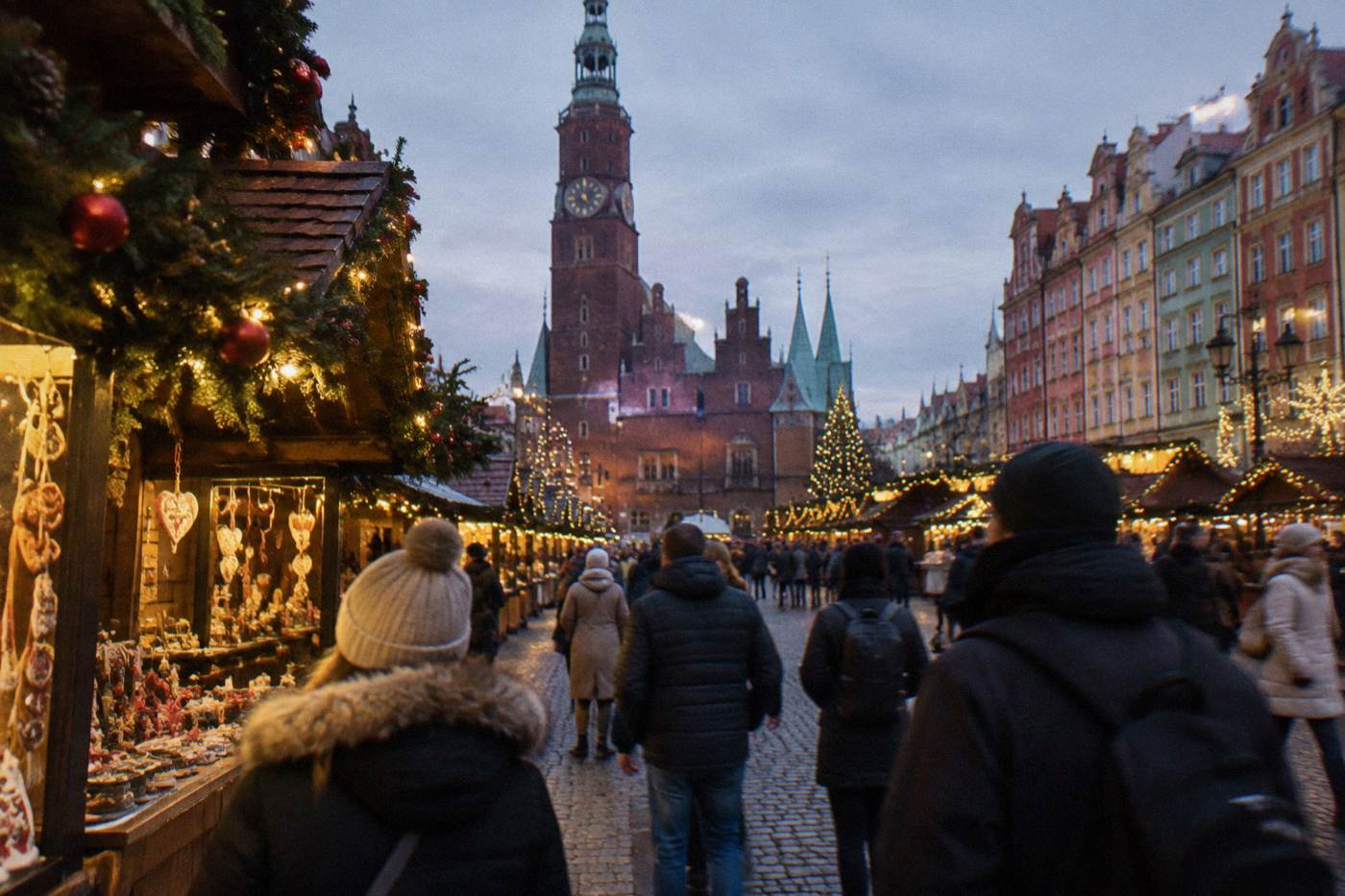
Wroclaw, the largest city in Lower Silesia (Dolnoslaskie voivodeship) in southwestern Poland, runs its Christmas market on the Rynek, the old main square, while Krakow, some distance to the east, runs the most famous one in the country on the Rynek Glowny. Travelers planning a winter city break in Poland increasingly ask which of the two deserves the trip, and the honest answer depends on what kind of Christmas atmosphere you want: raw spectacle or a compact, walkable old town wrapped around a smaller market. This page compares the two cities on the facts that can actually be verified, from the size of each square to the temperature you should pack for, and it flags the claims that circulate online but could not be confirmed.
Which Christmas Market Is Better, Krakow Or Wroclaw?
Neither market is objectively better: Krakow's Christmas market is the larger and more famous event, set on the Rynek Glowny, the largest medieval town square in Europe, while Wroclaw's market on the Rynek is smaller and more compact, wrapped in a walkable Old Town of dwarf statues, bridges and river islands. Krakow wins on spectacle and name recognition; Wroclaw wins on intimacy, lower crowd pressure and variety within a short stroll.
The comparison keeps coming up because the two cities are the two most obvious winter city breaks in southern Poland, and because both markets share a format: wooden stalls selling mulled wine, grilled oscypek-style cheese, handicrafts and hot food, clustered around a decorated tree on the main square. The difference is everything around the stalls. Krakow gives you a monumental square, a castle-adjacent old town and one of Europe's most visited historic centers at its busiest. Wroclaw gives you a slightly smaller square, a dozen islands and footbridges along the Odra river, the dwarf-hunt game that families treat as the city's signature activity, and short queues for the city's headline museums on cold afternoons.
One warning before the details. Online lists love to repeat that Wroclaw's Rynek is "the second-largest square in Europe." That claim was checked against official sources and could not be independently confirmed, so it is not stated as fact here. What the sources do confirm, from GUS, Poland's statistics office, and from square-size measurements, is that Krakow's is the larger of the two, on both population and square size, and that is the direction the comparison runs throughout this page. The fuller head-to-head, including a look at whether Wroclaw is even the right base for Krakow, is in the Wroclaw vs Krakow comparison guide.
How Do The Two Market Squares Compare?
Krakow's Rynek Glowny is the larger square by every measure: roughly 4 hectares, about 200 by 200 metres, against Wroclaw's Rynek at roughly 3.64 to 3.79 hectares, about 204 by 169 to 170 metres. Krakow is also the larger city, 816,614 residents against Wroclaw's 672,601, both GUS figures for 31 December 2025. Krakow's square is the largest medieval town square in Europe.
That size gap is the single most practical difference between the two markets. A bigger square means more stalls, more room for the crowd to spread, and a tree-and-crib layout that reads as a grand spectacle from every corner. A smaller square means you cross Wroclaw's market in a few minutes rather than circling it, which sounds like a drawback until the peak evenings of the season, when the compactness becomes comfort: you are never far from a side street, a quiet courtyard or one of the bridges off the Rynek.
| Measure | Wroclaw | Krakow |
|---|---|---|
| Population, 31 Dec 2025 (GUS) | 672,601 | 816,614 |
| Main market square area | approx. 3.64-3.79 ha | approx. 4 ha |
| Square dimensions | approx. 204 x 169-170 m | approx. 200 x 200 m |
| Voivodeship | Dolnoslaskie (Lower Silesia) | Malopolskie (Lesser Poland) |
Wroclaw's square trades a little size for a distinctive shape and setting. The Rynek sits at the heart of the old town centre with the Odra's branches a short walk away, and its two-level layout, with stalls and cellars ringing the inner block, gives the market a natural edge to wander even when the center is busy. Krakow's Rynek Glowny is a single vast open plane, unmatched for scale, and its stalls fan out from the cloth hall in the middle. Neither setting is a copy of the other, which is why plenty of winter travelers end up doing both cities in one trip rather than choosing. The question of which city is actually bigger gets asked on its own, and the answer is always Krakow, in both population and square size.
What Sets Wroclaw's Christmas Market Apart?
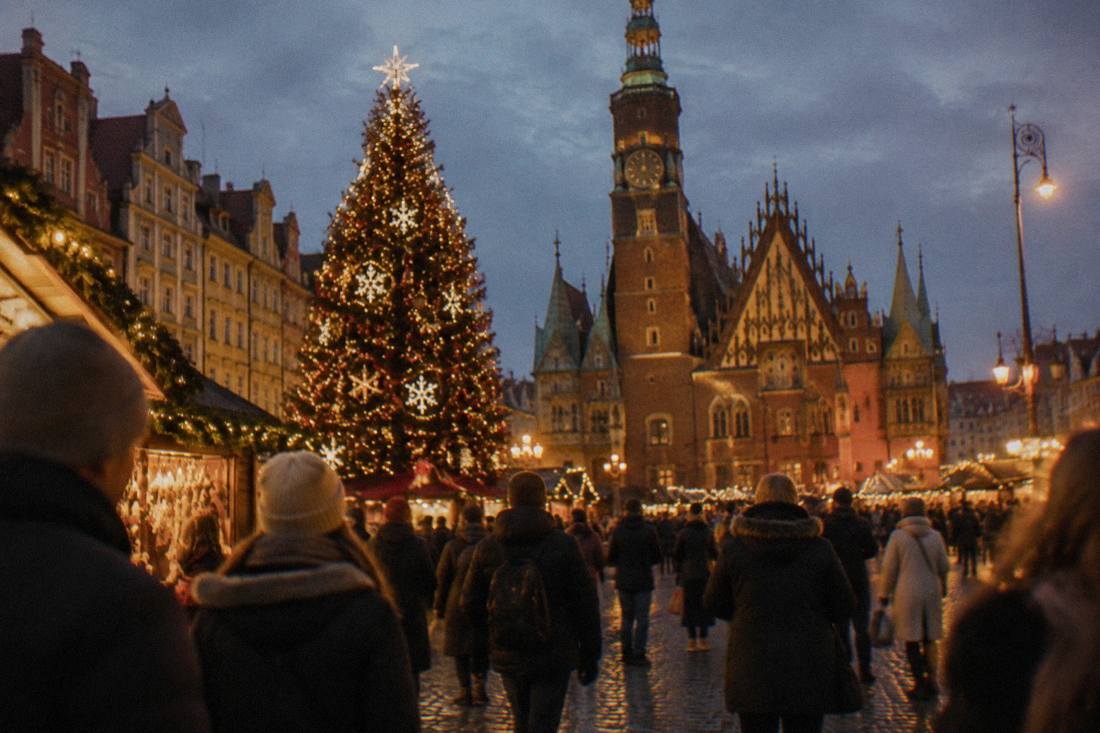
Wroclaw's market stands apart through its compact, walkable setting: the stalls gather on the Rynek in the old town centre, minutes from the Odra's river islands, the scattered dwarf statues that give the city its signature treasure hunt, and a cluster of major museums on one combined ticket. It is a market you experience as part of a small, dense, riverside old town rather than on a monumental open plane.
The dwarf hunt is the part no other Polish Christmas city can copy. Hundreds of small bronze figures are scattered across the streets around the market, and hunting them turns a cold afternoon between mulled-wine stops into a game for the whole family. Families planning around this should also look at the Christmas itinerary for Wroclaw, which sequences the market, the islands and the indoor options for a short winter break. On the coldest days, the city's indoor anchors sit close to the square, and one ticket to the Panorama Raclawicka, 50 zl for an adult, also covers the National Museum's permanent exhibitions, the Ethnographic Museum and the Four Domes Pavilion within three months of the visit date, per the museum's own ticket page. The National Museum's own site lists a standalone permanent-exhibition ticket at 20 zl adult, with free entry to permanent exhibitions every Saturday.
The setting matters at Christmas because December light in this part of Poland is short and cold. IMGW's 1991-2020 climate normals for the Wroclaw station give a December mean of 1.1 C and a January mean of 0.0 C, so a winter visit here is a proper cold-weather city break: plan for gloves, and plan for the indoor interludes the city makes unusually easy. The market itself is the evening center of gravity; the islands, the bridges and the dwarf hunt are what fill the daylight hours around it, and the full rundown of stalls, timing strategy and sidetrips lives in the Wroclaw Christmas market guide.
What Makes Krakow's Christmas Market The Bigger Draw?
Krakow's market is the bigger draw on sheer scale: it fills the Rynek Glowny, the largest medieval town square in Europe, in a city of 816,614 people, and its international fame pulls larger crowds and more foreign visitors than any other Polish Christmas market. The trade-off is exactly that fame, since the square and the streets feeding it get packed at the holiday peak.
Krakow's advantages compound each other. The square is bigger, so the market is bigger. The city is bigger and better known, so the audience is bigger. The old town around the square is one of the most visited historic centers in Central Europe, so everything that already works for Krakow in summer is simply dressed for winter: the same walkable core, the same castle at the end of the street, now under lights and in front of a tree. For a first-time visitor to Poland who wants zero risk that the Christmas atmosphere under-delivers, Krakow is the safe pick, and that is a reasonable way to choose a winter trip. More of these guides are collected on Wroclaw Travel Guide.
The cost of that safety is crowd density and demand. Peak-season evenings on the Rynek Glowny are shoulder-to-shoulder, accommodation near the old town books out early, and the most photogenic corners come with queues. Wroclaw is busy too in December, but its smaller international profile keeps the pressure lower, and its compact old town means the crowd thins a few streets out rather than a long walk away. Travelers weighing the two cities against each other in more depth, including the "is it worth it" question, can also read whether Wroclaw is worth visiting at Christmas or whether the two cities really differ as much as their reputations suggest.
What Does A Winter City Break In Wroclaw Cost?
A winter break in Wroclaw keeps all its costs in zloty, not euros, and the headline attractions are inexpensive by western European standards: the Panorama Raclawicka is 50 zl adult, the National Museum is 20 zl with free permanent exhibitions every Saturday, and the zoo's own price table lists online adult tickets from 69 zl against 99 zl at the gate, with the Afrykarium included in the standard ticket.
None of those figures is a market figure; they are the verified till prices for the attractions that surround a Wroclaw Christmas visit, and together they sketch why the city works as a budget-conscious winter base. The pattern repeats across the city's paid sights: strong public institutions, modest official prices, and at least one free-access rule (the National Museum's free Saturdays) worth building a day around. The zoo's own site also confirms the zoo is open every day of the year, including holidays, with grounds closing at 16:00 across November and December, which makes it a reliable cold-day fallback for families.
| Wroclaw attraction | Adult | Reduced | Notes from the official source |
|---|---|---|---|
| Panorama Raclawicka | 50 zl | 35 zl | 30-minute screening; ticket also covers three other National Museum branches within 3 months |
| National Museum, permanent exhibitions | 20 zl | 15 zl | Free entry to permanent exhibitions every Saturday |
| Wroclaw Zoo, online | from 69 zl | from 59 zl | Afrykarium included in the standard ticket |
| Wroclaw Zoo, at the gate | 99 zl | 89 zl | Open every day of the year, including holidays |
A guided walk with a local guide is a natural add-on on a winter itinerary, and the featured option on this site pairs the old town with a local's eye for the quieter corners that cold weather rewards. The full details, including what the current listing carries, are on the page for the guided city tour with a local, and live pricing and availability for the same walk can be checked via Check availability at the operator's live listing.
One rule of thumb keeps winter budgets honest: prices inside the market stalls are stall prices, set by each vendor, and no verified public tariff exists for them, so treat food and drink at the stalls as variable and pay attention rather than expect a published rate. What is published, and verified above, is everything around the stalls, and Wroclaw's version of that list is short and cheap.
Which City Is Easier To Reach And Get Around?
Wroclaw is the more compact base: its market square, old town and riverside islands all sit within a short walk of each other, and a 15-minute MPK tram or bus ticket costs 4.60 zl normal and 2.30 zl reduced, per the city's official fare page. Krakow is larger and busier, so you trade some compactness for the bigger spectacle, and both cities are linked by regular trains operated by PKP Intercity.
Both cities are easy by Polish standards, but easy in different ways. Wroclaw's Christmas geography is genuinely walkable: the Rynek, the Odra islands and Ostrow Tumski connect on foot, and public transport exists mostly for the airport run and the outliers. MPK's official fare tiers rise from the 15-minute ticket to longer bands, up to a 24-hour city ticket around 15.00 zl normal, so a family that does want the tram between cold-weather stops pays little for it. Krakow's old town is also walkable, but bigger, and its December crowds push visitors toward off-center hotels and more tram rides, which Krakow's own system handles well at similarly low fares.
| MPK Wroclaw ticket tier | Normal | Reduced |
|---|---|---|
| 15-minute ticket | 4.60 zl | 2.30 zl |
| 30-minute ticket | 7.00 zl | 3.50 zl |
| 24-hour city ticket (band) | approx. 15.00 zl | approx. 7.50 zl |
On travel between the two, the honest position is this: PKP Intercity operates the route, and fares and journey times vary by date, so check live times and prices at the operator's own site rather than trusting a number quoted in a blog. The practical planning guide for the connection is the Wroclaw to Krakow train guide, and travelers considering making Krakow the day trip rather than the destination can weigh the Krakow day trip from Wroclaw as an alternative to moving hotels.
How Do You Choose Between Wroclaw And Krakow At Christmas?
Choose Krakow if you want the largest and most famous Christmas spectacle in Poland and accept the crowds and early booking that come with it; choose Wroclaw if you prefer a smaller, walkable market with river islands, a dwarf hunt and lower crowd pressure, in a city that is cheaper to move around. Doing both in one trip is a realistic option, since PKP Intercity links the two cities.
A few patterns from travelers help sharpen the choice. Photographers and first-time Poland visitors lean Krakow, for the scale and the guaranteed atmosphere. Families lean Wroclaw, because the dwarf hunt gives children a reason to walk a cold city, and the zoo, open every day of the year, gives them a warm-weather-proof fallback. Repeat visitors to Poland, and anyone who has already seen Krakow's square, often prefer Wroclaw precisely because it is the less obvious pick, with a dense old town that rewards a second and third evening. Budget-conscious travelers do well in both, since Poland's till prices stay in zloty everywhere, but Wroclaw's compactness keeps transport spending close to zero: the 4.60 zl short-hop fare covers what walking does not.
The last practical note is about timing within the day. Whichever market you choose, the square changes character between the afternoon, the evening rush and late evening, and the difference between a relaxed stroll and a packed one is often just a couple of hours. The best time of day for the market square covers that pattern in detail, and it applies to both cities, not just Wroclaw.
Common Questions About Wroclaw And Krakow Christmas Markets
Which Christmas market is better, Krakow or Wroclaw?
There is no objective winner. Krakow's market is larger and more famous, set on the largest medieval town square in Europe; Wroclaw's is smaller and more compact, in a walkable riverside old town with the dwarf hunt and cheaper verified attraction prices around it. Choose spectacle or intimacy, and both are legitimate Christmas trips.
Is Krakow's market square bigger than Wroclaw's?
Yes. Krakow's Rynek Glowny is roughly 4 hectares, about 200 by 200 metres, while Wroclaw's Rynek is roughly 3.64 to 3.79 hectares, about 204 by 169 to 170 metres. Krakow is also the larger city by population, 816,614 against 672,601, per GUS figures for 31 December 2025.
How cold is Wroclaw at Christmas?
Cold but not extreme. IMGW's 1991-2020 climate normals for the Wroclaw station give a December mean of 1.1 C and a January mean of 0.0 C, with July, at 19.7 C, the warmest month of the year. Pack for winter city weather: gloves, a proper coat, and indoor stops planned between market rounds.
Is Wroclaw worth visiting at Christmas?
Yes, for a compact winter city break: a walkable old town, a market on the Rynek, river islands, the dwarf hunt, and verified low till prices at major attractions such as the Panorama Raclawicka at 50 zl adult. The fuller answer, including what the format suits best, is in is Wroclaw worth visiting at Christmas.
Can you visit both Krakow and Wroclaw in one trip?
Yes. PKP Intercity operates trains between the two cities, and fares and journey times vary by date, so check the operator's own site for live times rather than a quoted figure. Many winter travelers base themselves in one city and visit the other, and the Wroclaw to Krakow train guide covers the practicalities.
Does Wroclaw have the second-largest market square in Europe?
That claim circulates widely online but was not independently confirmed against official sources, so it should not be treated as fact. What is confirmed is that Krakow's square is the larger of the two and is the largest medieval town square in Europe.
Whichever city wins your December, the planning sequence is the same: book early for the peak weeks, keep costs in zloty, and build each day with the cold in mind, one warm indoor anchor for every round of the stalls. Wroclaw makes that balance unusually easy to strike, and Krakow makes the spectacle side of it as big as it gets in Poland.