Milk Bars In Wroclaw (Bar Mleczny)
The bar mleczny is Wroclaw's cheapest dining institution, a cafeteria serving Polish home cooking at prices locals actually pay. This guide covers how the system works, what to order, and how to fit a milk bar stop into a day of sightseeing.
Short answer
A milk bar (bar mleczny) in Wroclaw is a self-service cafeteria serving traditional Polish dishes such as pierogi, soups and potato pancakes at low prices. You order at the counter, pay by cash or card depending on the venue, and carry your tray to a shared table. This guide explains how to find one, what to expect, and what a day around it costs.
Wroclaw, the largest city in Lower Silesia in southwestern Poland, runs on cheap cafeteria food the way other university cities run on coffee. The bar mleczny, literally "milk bar", is the institution behind it: a self-service canteen serving pierogi, soups, potato pancakes and other Polish home staples at prices aimed at students, pensioners and workers rather than tourists. For a visitor on a budget, a milk bar lunch is one of the highest-value meals in the city, and it comes with a slice of everyday Polish life that no themed restaurant reproduces. This guide, from the editorial desk behind Wroclaw Travel Guide, explains what a bar mleczny is, how the ordering system works, what the food is like, and how to fit one into a day of sightseeing around the Market Square, Ostrow Tumski and beyond.
What Is A Bar Mleczny In Wroclaw?
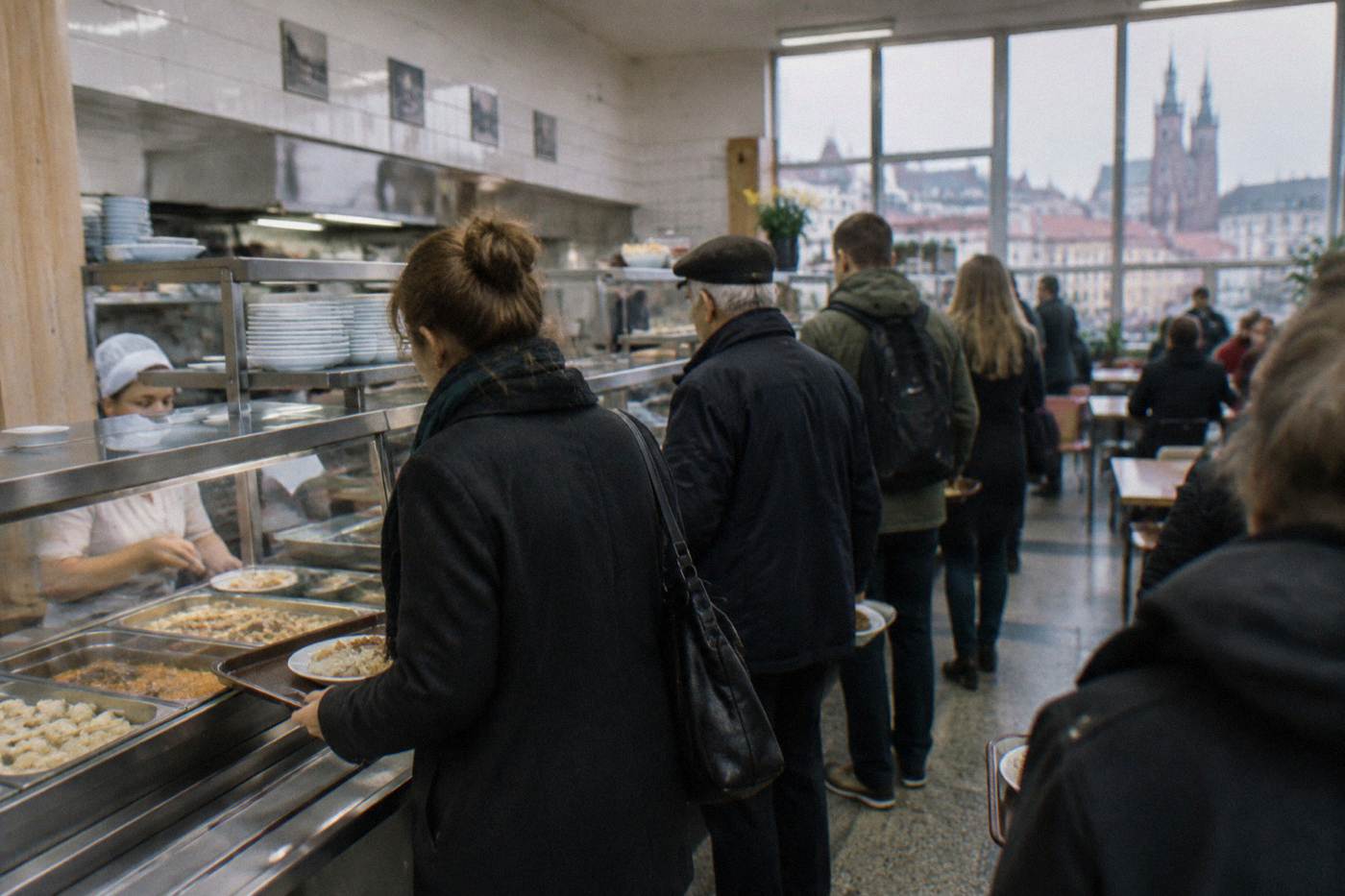
A bar mleczny in Wroclaw is a self-service cafeteria selling traditional Polish dishes such as pierogi, borscht-style soups, potato pancakes and milk-based desserts at prices set for local budgets rather than visitors. The format is cafeteria, not restaurant: you queue at a counter, order from a printed menu, pay a cashier, and carry a tray to whatever table is free. The name comes from the dairy-focused menus of the format's early decades, when milk drinks and cheese dishes dominated.
That dairy origin explains the name even though modern menus are far broader. Walk into a bar mleczny in Wroclaw today and the menu leans on flour, potatoes, cheese, eggs and seasonal vegetables, with meat dishes present but not always the focus. Portions are generous, because the format was built to feed workers properly, and the cooking is unapologetically homestyle rather than refined.
The bar mleczny sits outside Poland's restaurant culture in a second way: it is not designed for lingering. Tables are plain, service ends when you hand over your tray, and the turnover is quick. If your plan for a Wroclaw evening is a long dinner with drinks, a milk bar is the wrong venue; the city's restaurant scene handles that far better. If your plan is a fast, filling, honest lunch between the Market Square and the cathedral, it is exactly right.
It is also worth being clear about what this guide can and cannot tell you. Dish-by-dish prices at individual milk bars are not published in a stable, official form, so this site does not print them. What can be verified, from official sources, is the cost of everything around the meal: transport fares, museum tickets, zoo admission. Those figures appear later in this guide, in the tables under the cost and planning sections.
Where Do You Find Milk Bars In Wroclaw?
Milk bars in Wroclaw cluster where students and office workers concentrate: the streets ringing the Market Square and Old Town, the areas around the university buildings, and the renewed inner districts such as Nadodrze. The reliable method is not a map of specific venues but a rule of thumb: look for the words "Bar Mleczny" on plain signage, often with a printed menu taped in the window, one or two streets back from the square.
The reason is commercial. Rents on the Market Square itself favor restaurants that can charge visitors; a block or two out, in the lanes between the Rynek and the university quarter, cafeteria economics still work. That geography is good news for sightseeing, because most of Wroclaw's headline sights sit within an easy walk of a milk bar district.
If your day is built around the Old Town and Cathedral Island, plan lunch on the boundary between them. The Old Town walking routes around the Rynek put dozens of cafeterias within easy reach on foot, and the same is true of the approach to Ostrow Tumski. A walking tour is the most efficient way to see that geography, and there is a cheap way to do it: several free, tip-based walks cover the Old Town, and Old Town Wroclaw by Walkative! is a long-running option with a large review history on See This Free Tour On GuruWalk. A guided walk in the morning and a milk bar lunch after it is a classic Wroclaw budget day.
Solo among the paid options, a small-group Old Town walk is the natural pairing with lunch, since it finishes in the middle of the cafeteria belt:
How Much Does A Meal At A Wroclaw Milk Bar Cost?
This site does not print milk bar dish prices, because no official or stable public price list exists for them and inventing a figure would be dishonest. What can be stated with confidence is the structure: a bar mleczny exists to be the cheapest hot meal in its neighborhood, and its prices are aimed at the same budgets that make students and pensioners its core customers. Check the printed menu before ordering.
That restraint is deliberate. A number copied from memory, or from a rival guide, would date the moment it was typed. The window menu is the primary source for a milk bar, in the same way that the National Museum's own pricing page is the primary source for a museum ticket.
What this guide can verify is the cost of the rest of the day, from official sources, so you can see how little of a Wroclaw budget the meal has to compete with. The table below collects admission figures that this site has confirmed directly on each institution's own pages.
| Attraction | Adult (zl) | Reduced (zl) |
|---|---|---|
| Panorama Raclawicka | 50 | 35 |
| National Museum in Wroclaw | 20 | 15 |
| Wroclaw Zoo, online | from 69 | from 59 |
| Wroclaw Zoo, at the gate | 99 | 89 |
| Church of Peace in Swidnica | 18 | 15 |
| Ksiaz Castle, castle with audioguide and terraces | 72 | 62 |
The zoo's own price table shows the online-versus-gate gap clearly, and the Afrykarium oceanarium is included in that standard ticket rather than sold separately, so there is no hidden second charge. Ksiaz Castle's tariff is quoted from its own current cennik, effective 6 May 2026. The Church of Peace figure comes from the parish's own visitor page.
For a sense of scale: the National Museum's own pricing page lists a standalone permanent-exhibition ticket at 20 zl for an adult, and free entry to permanent exhibitions every Saturday. A sandwich lunch that costs more than a museum ticket is the level of value a milk bar is competing with, which is why the format survives in a city with a population of 672,601 (GUS, 31 December 2025) and a large student body.
How Does Ordering At A Milk Bar In Wroclaw Actually Work?
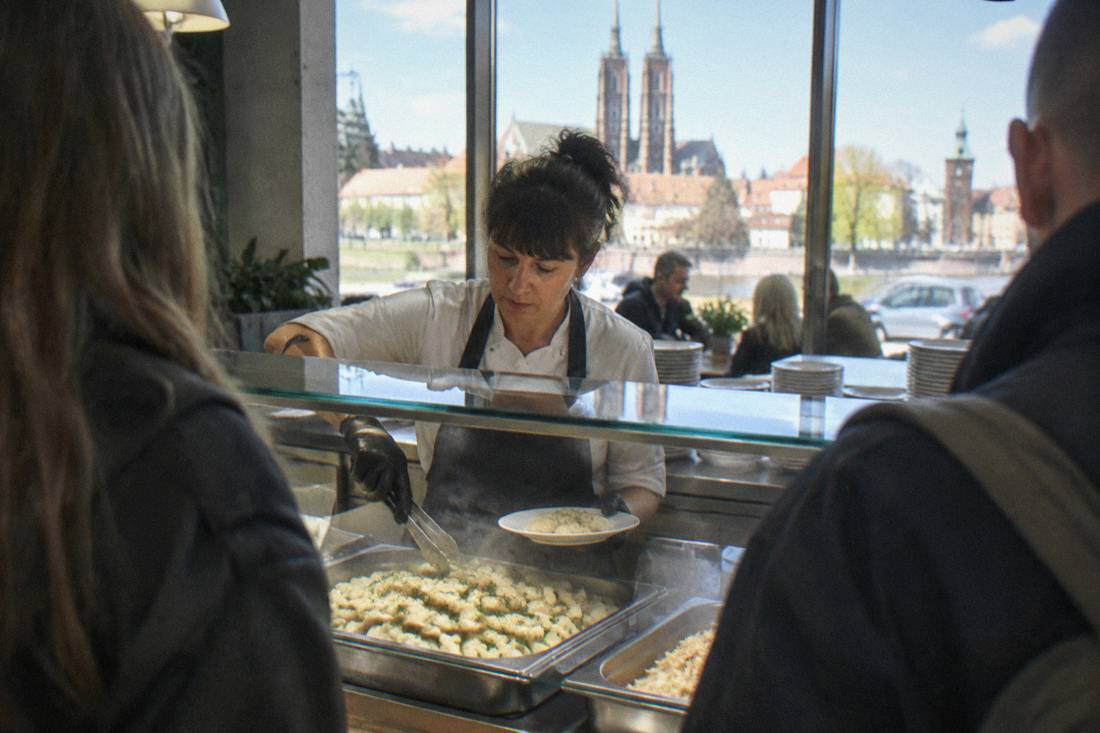
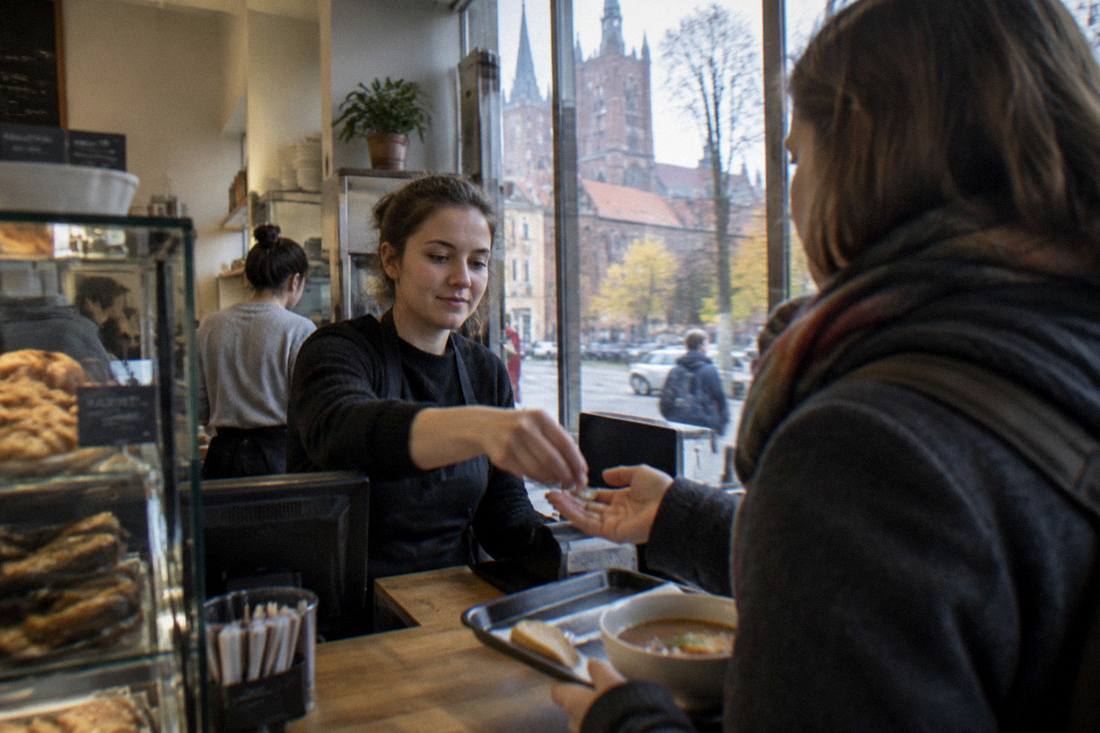
Ordering at a Wroclaw milk bar follows the cafeteria pattern: join the queue, read the printed menu above the counter, order by dish name or number, take a numbered ticket or your tray, and pay the cashier, sometimes before and sometimes after eating depending on the venue. Some bars take card payments, others remain cash-first, so carry some zloty. Dishes often arrive at different times, and you bus your own tray to the return rack when finished. That is the entire ritual.
The system rewards decisiveness. Regulars know their order before they reach the counter, and the queue behind them moves at that speed. A menu taped by the door is common, so use the queue itself as reading time. Polish dish names help: pierogi, zupa (soup), naleśniki (crepes), placki ziemniaczane (potato pancakes) and kompot (a sweet stewed-fruit drink) cover most of a milk bar menu.
Do not expect English menus everywhere. In student-heavy Wroclaw you will often find some English, but the format predates tourism and not every venue has translated anything. Pointing at the display case works, and cash neatly sidesteps any payment friction. If your Polish is thin, the [polite phrases visitors actually need] trade small effort for big goodwill, and milk bar staff respond well to a tried "dzień dobry" and "dziękuję".
One habit worth adopting early: keep the receipt until you have your food. In bars where you pay first, the receipt sometimes doubles as the collection ticket. In others, a numbered marker on your table tells the kitchen where to deliver. Five minutes of watching the room will explain any variant.
What Do Milk Bars In Wroclaw Serve?
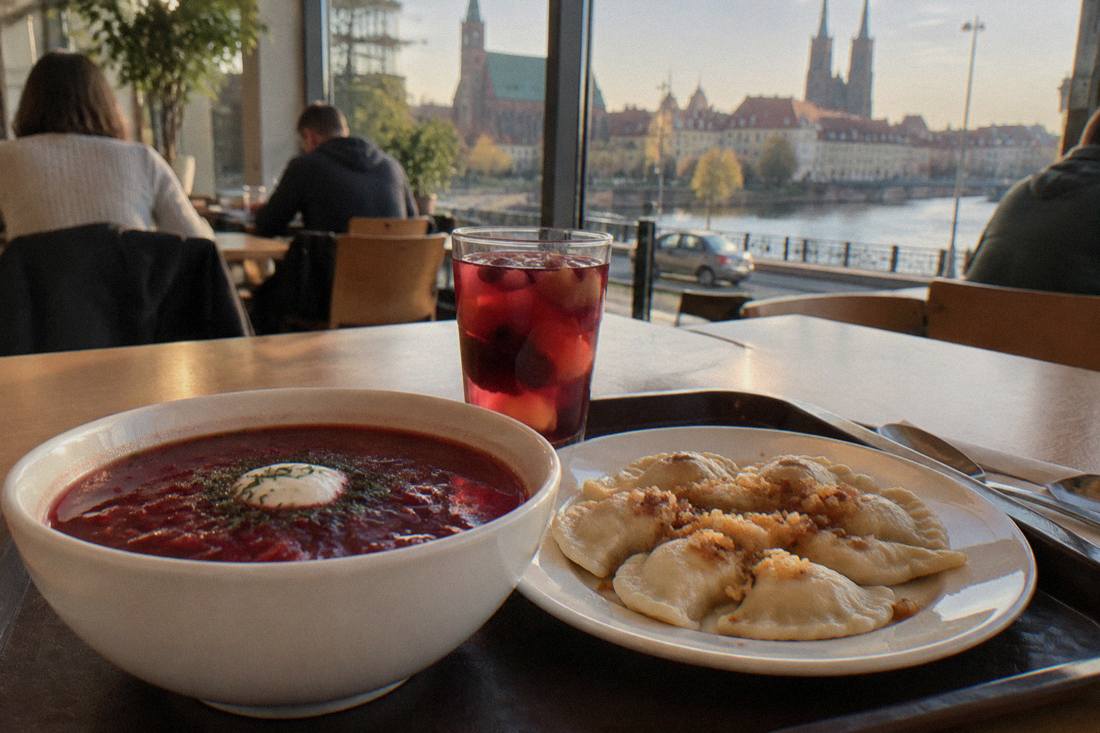
Milk bars in Wroclaw serve the Polish homestyle repertoire: pierogi in several fillings, thick soups such as borscht and broth with noodles, potato pancakes, crepes filled with sweet cheese or fruit, buckwheat and barley groats with egg or goulash, and simple milk-based desserts and drinks. Vegetarian dishes form a large share of any menu, a legacy of the dairy emphasis the name implies. Fruit kompot, a lightly sweet stewed-fruit drink, is the standard beverage.
The pierogi alone justify the stop, and Wroclaw's dumpling culture runs deeper than any single cafeteria; this site's dedicated pierogi guide covers the fillings, the seasons and where the dumpling tradition fits in the city's food life. A milk bar is simply the cheapest way to eat that dish well.
Beyond the dumplings, the menu is comfort food by design. Soups are a meal in themselves, served with bread. Potato pancakes come with sour cream or a stew. Sweet cheese crepes dusted with sugar are a common dessert, and a glass of kompot usually costs less than any bottled drink in a restaurant. Breakfast items, eggs and sausages, appear at bars that open early; the format is flexible and menus shift with the kitchen.
For street-side comparison, the city's street food scene covers the newer end of cheap eating, from food trucks to market halls. The milk bar is the older, indoor, sit-down counterpart, and the two compete for the same lunch budget rather than the same customer.
Are Milk Bars In Wroclaw Good For Vegetarians And Vegans?
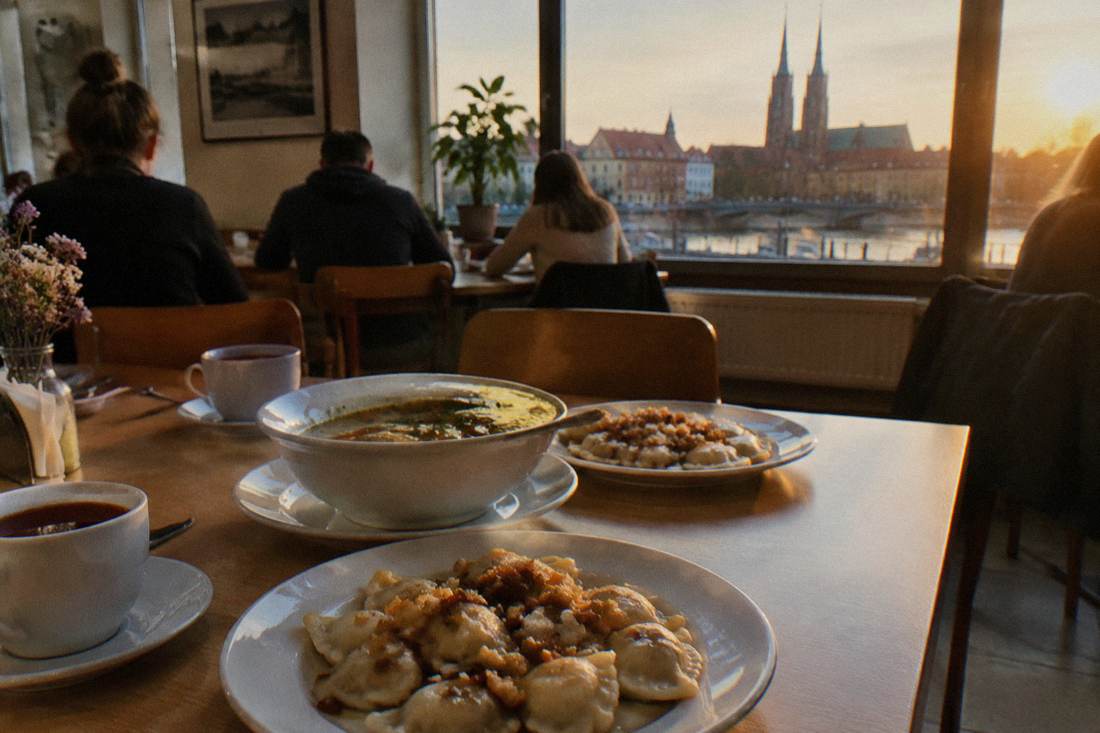
Milk bars are among the easiest places in Wroclaw for vegetarians to eat cheaply, because cheese-filled pierogi, potato pancakes, groats, soups and sweet cheese crepes fill much of the standard menu without any modification. Vegans have a narrower but real selection, typically potato dishes, some soups and vegetable pierogi, though dairy and eggs run through the format's DNA, so asking about ingredients is wise. Honest conclusion: strong for vegetarians, workable for vegans with questions.
Be specific about what that does and does not mean. Wroclaw has a solid, compact plant-based dining scene, and this site covers it honestly, without inflated rankings. Poland's most internationally noted vegan hub is Warsaw, and no current national ranking crowns Wroclaw "the most vegan city in Poland", so treat that phrase with suspicion if a guide offers it. What Wroclaw genuinely has is a well-developed everyday scene: dedicated restaurants, bakeries and reliable supermarket options, alongside a cafeteria tradition that happens to be vegetable- and dairy-heavy.
For a visitor, that makes the milk bar a surprisingly good vegetarian lunch: cheap, fast and filling. Ask at the counter about stock if a soup looks vegetable-based, because meat broth is common in Polish home cooking, and the format does not advertise ingredients the way a modern restaurant menu does.
How Do You Fit A Milk Bar Into A Day Of Wroclaw Sightseeing?
The most efficient shape of a milk bar day in Wroclaw is: sightsee the Old Town and Ostrow Tumski in the morning, eat lunch at a cafeteria one or two streets off the Market Square, then spend the afternoon at one ticketed attraction such as the Panorama Raclawicka or the National Museum, both of which sit minutes from the cafeteria belt. The Panorama's screening lasts 30 minutes, and the museum's hours keep it open through the afternoon, so lunch slots naturally between them.
Two verified facts make this pairing unusually good value. First, a Panorama Raclawicka ticket, 50 zl for an adult, does not just buy the 30-minute screening: the museum's own information page states that the same ticket also covers the National Museum's permanent exhibitions, the Ethnographic Museum and the Four Domes Pavilion, within three months of the visit date. Second, the National Museum's own page lists free entry to its permanent exhibitions every Saturday, and a "Museum for a zloty" ticket of 1 zl for students and pupils under 26.
| Venue | Winter Hours (1 Oct - 31 Mar) | Summer Hours (1 Apr - 30 Sep) |
|---|---|---|
| Panorama Raclawicka | Closed Monday; Tue-Fri 9:30-16:00, Sat 9:30-17:00, Sun 9:30-16:00 | Daily 8:30-19:00 |
| National Museum in Wroclaw | Closed Monday; Tue-Fri 10:00-16:00, Sat-Sun 10:00-17:00 | Closed Monday; Tue-Fri 10:00-17:00, Sat-Sun 10:30-18:00 |
Both close on Mondays in winter, which quietly shapes the week: a Monday visit in the colder half of the year means the cafeteria belt and the Market Square carry the day. In summer the Panorama runs daily, and the longer evenings let a second walking loop, perhaps along the Odra towards Slodowa Island, close the afternoon.
If the day stretches further, the zoo's own hours page shows the scale of the option: it is open every day of the year, including public holidays, with grounds from 9:00 to 18:00 or 19:00 in the April-September season and shorter hours in the colder months. Its price table gives online adult tickets from 69 zl against 99 zl at the gate, so buying ahead is the single largest saving on the list.
| Season | Zoo Grounds, Mon-Thu | Zoo Grounds, Fri-Sun And Holidays |
|---|---|---|
| April - September | 9:00-18:00 | 9:00-19:00 |
| March and October | 9:00-17:00 | 9:00-18:00 |
| November - December | 9:00-16:00 | 9:00-16:00 |
| January - February | 9:00-16:00 | 9:00-16:00 |
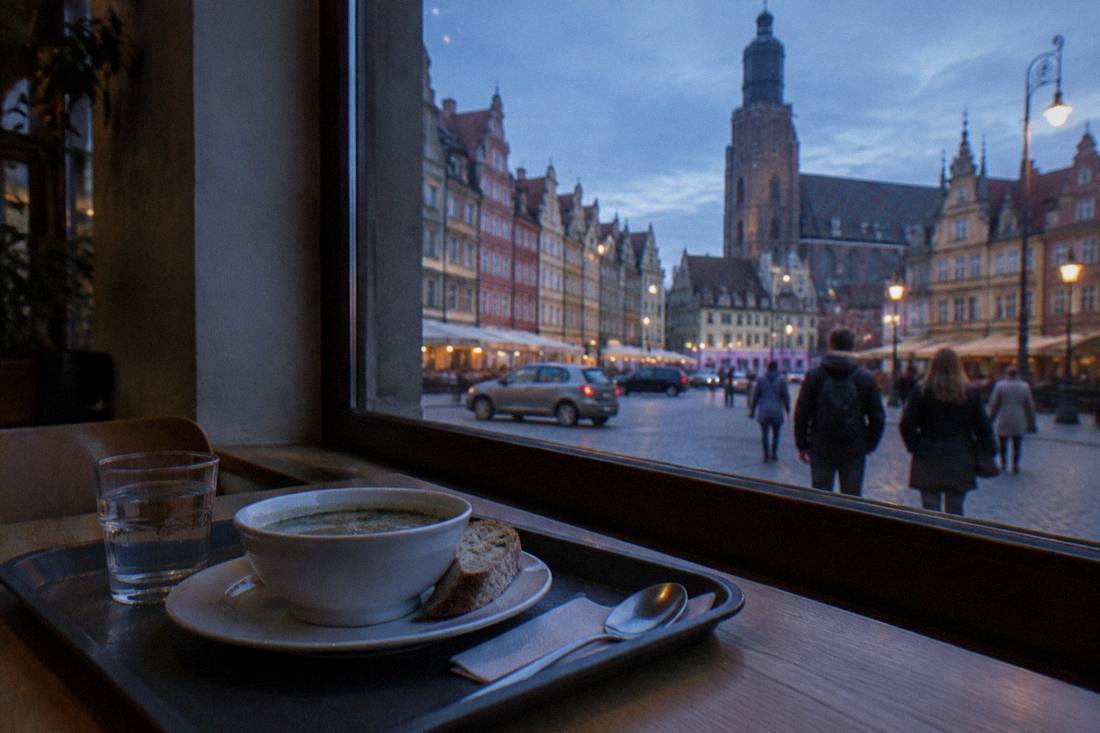
Can You Combine A Milk Bar Lunch With A Guided Wroclaw Tour?
Yes, and the combination is one of the best-value full days in the city: a guided morning walk through the Old Town or Cathedral Island finishes inside the cafeteria belt, so a milk bar lunch costs minutes rather than an hour, and the afternoon stays free for the Panorama or a bike loop along the Odra. Free walks, budget e-car tours and paid small-group walks all end within a short walk of multiple milk bars, which is why local guides eat in them too.
The paid walks below are the ones this site has verified as live products. The Hidden Gems of Wroclaw tour suits travelers who have already seen the Rynek and want the lanes beyond it, which is precisely where the cheaper cafeterias sit, so ask the guide where they eat:
A bike tour stretches the same idea across the river islands and the parks, with the reassurance that lunch waits at the end of it:
For a day that leaves the city, the Church of Peace at Swidnica, a UNESCO World Heritage site inscribed in 2001 as part of the "Churches of Peace in Jawor and Swidnica" listing, pairs with a Lower Silesia drive and returns in time for a late cafeteria dinner:
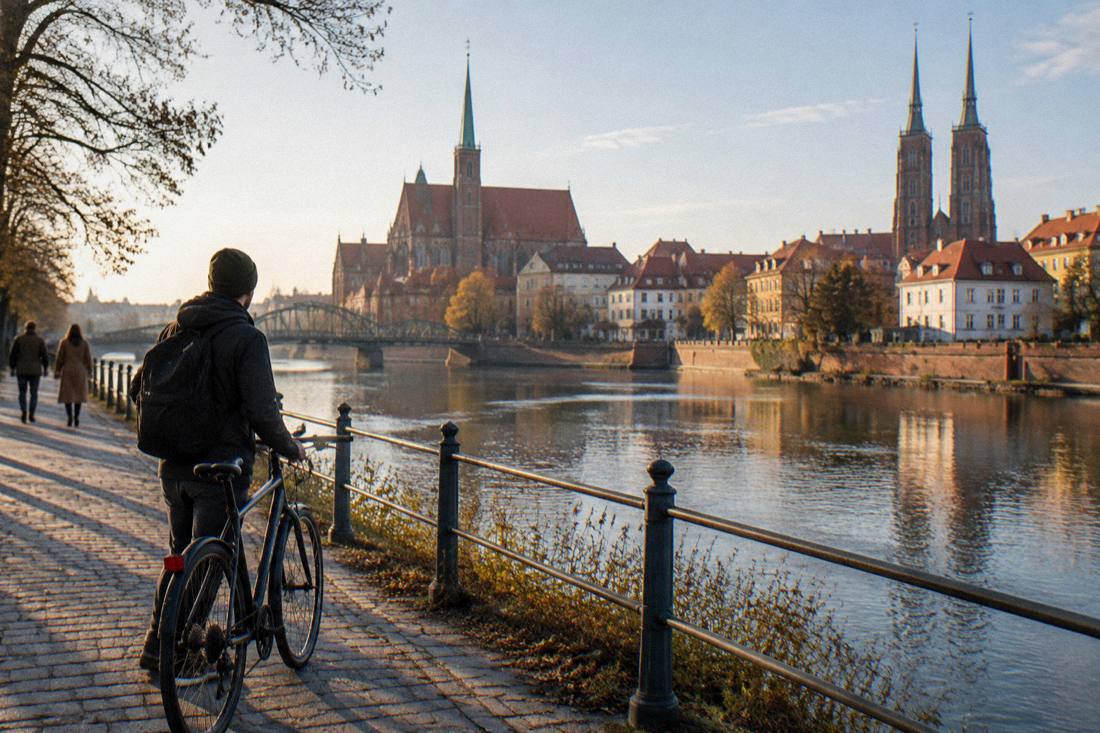
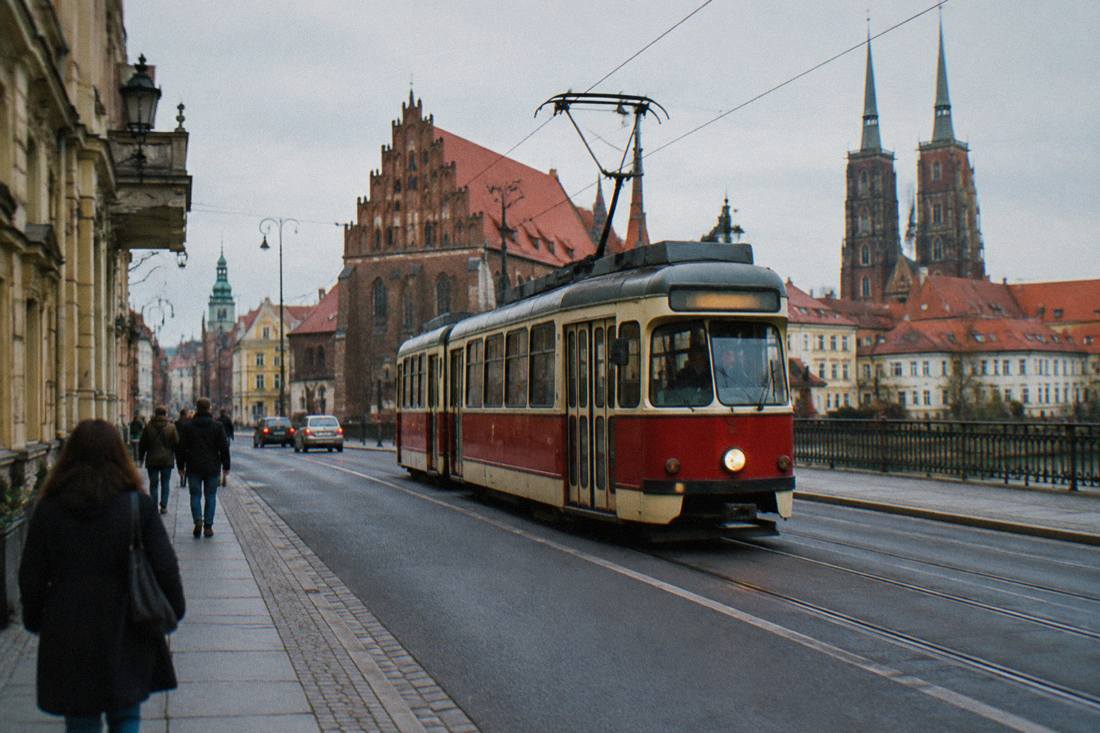
How Do You Get Between Milk Bars And Sights In Wroclaw?
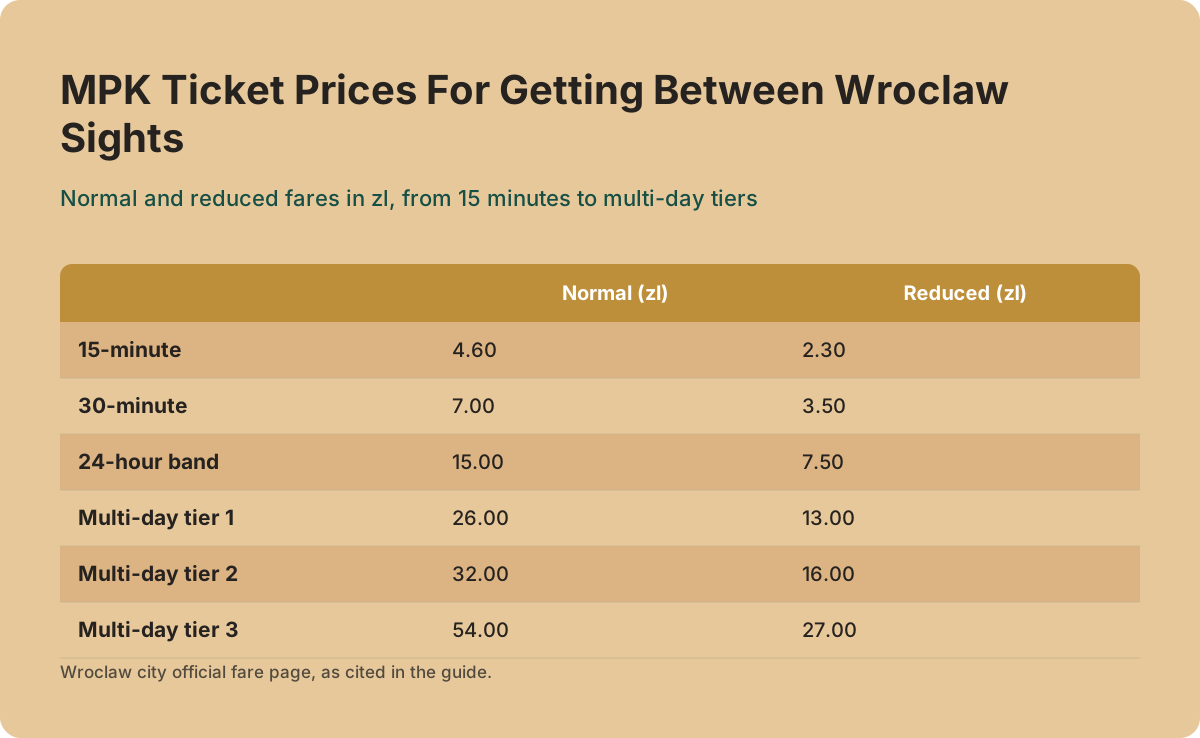
Wroclaw's public transport, run by MPK, sells a base 15-minute ticket at 4.60 zl normal and 2.30 zl reduced, which covers most short hops between the Old Town and the inner districts where cafeterias cluster. The city's official fare page lists rising tiers by duration, from a 30-minute ticket at 7.00/3.50 zl up to 24-hour and multi-day bands. The tram network reaches everything a milk bar day needs.
The full tier structure, from the city of Wroclaw's own ticket page, is worth reading once before you travel, because the jump from single fares to a day pass is where the savings are:
| MPK Ticket | Normal (zl) | Reduced (zl) |
|---|---|---|
| 15-minute | 4.60 | 2.30 |
| 30-minute | 7.00 | 3.50 |
| 24-hour band | 15.00 | 7.50 |
| Multi-day tier 1 | 26.00 | 13.00 |
| Multi-day tier 2 | 32.00 | 16.00 |
| Multi-day tier 3 | 54.00 | 27.00 |
One caution this site states plainly: there is no all-inclusive Go City-style multi-attraction tourist pass sold for Wroclaw. The UrbanCard is a real but transport-focused fare card with resident discounts, and it does not cover museum or attraction admission, so do not buy it expecting a sightseeing pass. Individual tickets and the Panorama's own three-month multi-venue rule are the real bundles here.
Honest scale matters too, because transport planning depends on it: Wroclaw's population is 672,601 as of 31 December 2025 (GUS), which makes it Poland's fourth-scale of city rather than a rival to Krakow's 816,614. Krakow is bigger, and its Rynek Glowny, at roughly 4 hectares, outmeasures Wroclaw's roughly 3.64-3.79-hectare Rynek. Wroclaw's compactness is the asset: the cafeteria belt, the Panorama and the National Museum all sit within a walkable core. This site's getting around guide covers the network in full.
When Is The Best Time To Visit Wroclaw For A Milk Bar Trip?
Any month works for a milk bar, since the cafeterias are indoor and year-round, but the pleasant months for the walking around them run from April through September, when IMGW's 1991-2020 climate normals for the Wroclaw station give monthly means from 9.7C in April to a July peak of 19.7C. July is also the wettest month at 91.4 mm of precipitation, so May, June and September combine warmth with less rain. January, at a 0.0C mean, is the coldest.
The climate normals, from the IMGW station table for Wroclaw (station 12424), give the full picture in one view:
| Month | Mean Temp (C) | Precipitation (mm) |
|---|---|---|
| January | 0.0 | 28.3 |
| February | 1.1 | 25.6 |
| March | 4.3 | 35.0 |
| April | 9.7 | 31.2 |
| May | 14.3 | 59.6 |
| June | 17.7 | 65.4 |
| July | 19.7 | 91.4 |
| August | 19.3 | 59.5 |
| September | 14.5 | 48.4 |
| October | 9.6 | 37.6 |
| November | 4.8 | 31.4 |
| December | 1.1 | 27.9 |
Read the table before generalizing: July is both the warmest and the wettest month, and April is drier than the summer despite being cooler. A milk bar lunch is in fact a good July plan for the same reason it is a good January plan: it is the cheapest warm, dry seat in the city. Winter has its own pull, since the Christmas market season turns the Rynek into an outdoor event and a hot cafeteria soup becomes the natural end to a cold circuit.
For the deeper planning, including month-by-month events and the best time to visit Wroclaw overall, the seasonal guides carry the detail; the weather by month page works from the same IMGW normals.
How Does A Milk Bar Day Fit A Wroclaw Trip Budget?
A milk bar day is the cheapest well-shaped day in Wroclaw this site can verify end to end: base transport at 4.60 zl a hop, a museum with 20 zl adult admission and free permanent exhibitions on Saturdays, a 30-minute Panorama screening at 50 zl that also covers three further venues for three months, and a cafeteria lunch that the window menu prices in the double digits or below. A budget built on those figures leaves room for the zoo or a day trip without strain.
The pattern generalizes. Wroclaw's cost profile favors visitors who mix one ticketed anchor per day with free public space, and the city's compact core makes walking the default between them. The trip cost guide carries the full budget breakdown, and for the evenings, when the cafeterias close and the nightlife guide takes over, the same rule holds: eat cheap at midday, spend where it counts after dark.
One last structural note on the value stack: the Panorama ticket's three-month coverage means a visitor who buys it on a first trip can return to the National Museum, the Ethnographic Museum or the Four Domes Pavilion within three months at no further cost. On a weekend trip that is a small bonus; on a repeat visit it is effectively a second museum season for one 50 zl ticket.
If you would rather have a local handle the planning for at least one day of the trip, the three options below are the pairings this site has verified as live:
Common Questions About Milk Bars In Wroclaw
What is a bar mleczny?
A bar mleczny, or milk bar, is a Polish self-service cafeteria selling homestyle dishes such as pierogi, soups, potato pancakes and sweet cheese crepes at prices aimed at local budgets. You order at a counter, pay a cashier and carry a tray to a shared table. The name comes from the dairy-heavy menus of the format's early decades.
Are milk bars in Wroclaw cheap?
They are built to be the cheapest hot meal in their neighborhood, which is why students and pensioners are their core customers. This site does not print specific dish prices because no official price list exists for individual milk bars; each venue posts its own prices at the counter and in the window, and those menus are the primary source.
Do Wroclaw milk bars take cards?
Some do and some do not. The format predates card payments and cash-first venues still exist, so carry some zloty in coins and small notes. A venue that takes cards will usually display the symbols at the register.
Is there vegetarian food at a milk bar in Wroclaw?
Yes, a large share of a standard milk bar menu is vegetarian by default: cheese and potato pierogi, potato pancakes, groats with egg, sweet cheese crepes and vegetable soups. Vegans have a narrower selection and should ask about ingredients, since dairy and eggs run through the format and meat broth is common in Polish soups.
Where are milk bars in Wroclaw located?
They cluster in the student and office districts one or two streets back from the Market Square, around the university quarter and in inner districts such as Nadodrze. The reliable rule is to look for plain "Bar Mleczny" signage with a printed menu in the window, rather than to rely on any single named venue.
Can you visit a milk bar on a guided Wroclaw tour?
Tours themselves do not include cafeteria meals, but most guided walks of the Old Town and Cathedral Island finish inside the cafeteria belt, so a milk bar lunch slots in immediately after. Free tip-based walks and paid small-group walks both end within a short walk of multiple venues, and asking a local guide for their own milk bar recommendation works well.
The milk bar is not a curated experience, and that is exactly its value: a hot, filling, honest meal at local prices, in a room full of people who live in Wroclaw, between two of the cheapest world-class sights in Central Europe. Walk the Old Town in the morning, eat at the counter at noon, and spend the afternoon at the Panorama or the National Museum with the money you saved.