Grunwaldzki Bridge And The Oder Islands
Grunwaldzki Bridge is one of the defining river crossings of Wroclaw in southwestern Poland, and it links some of the city's best-known islands and waterside districts together into a single walkable chain.
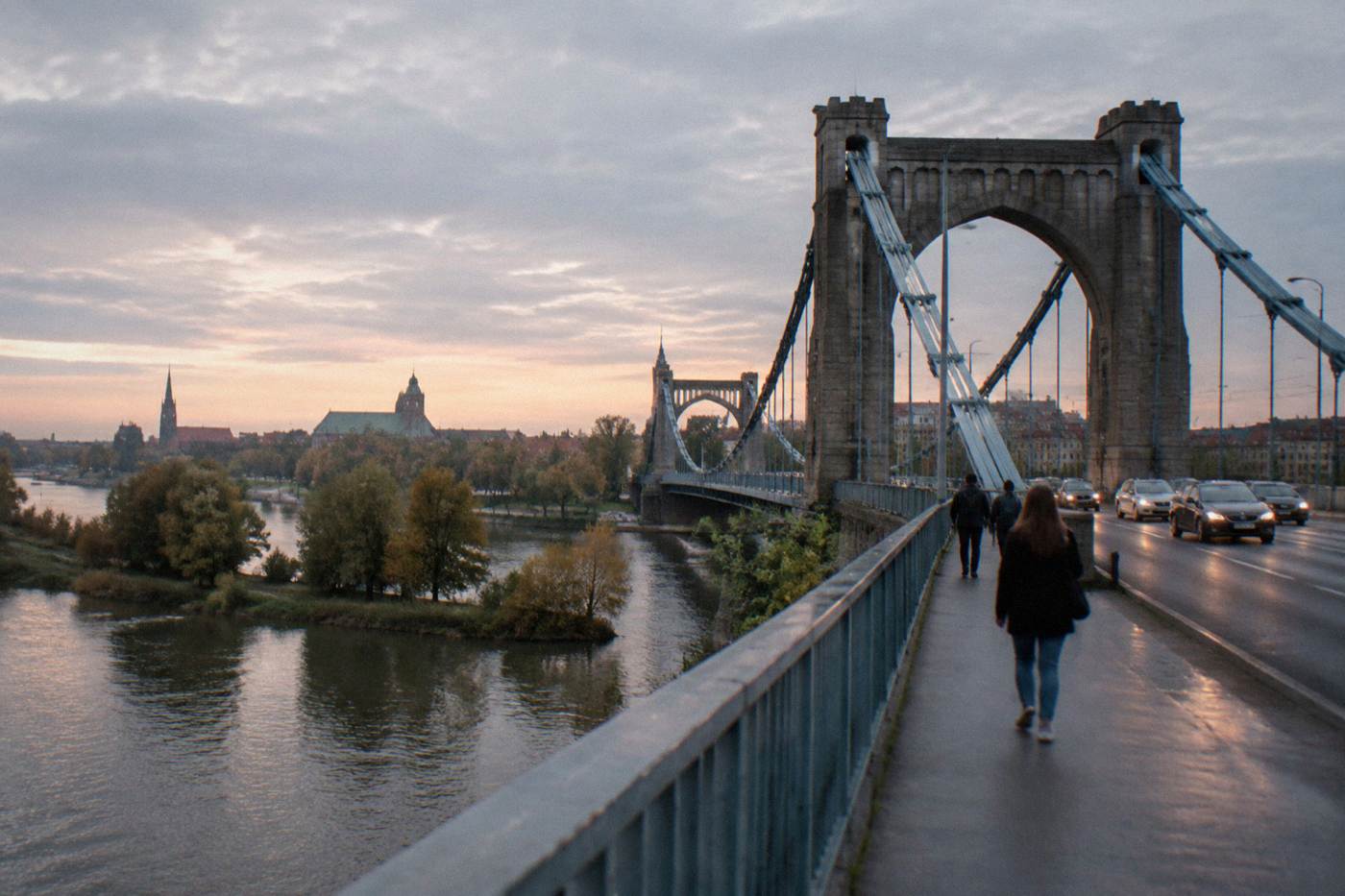
Short answer
Grunwaldzki Bridge is a large steel suspension bridge over the Odra river in Wroclaw, Poland's largest city in Lower Silesia. It connects the northern edge of the Old Town end of the river with the area around the university and Sand Island, and it sits at the centre of a cluster of Oder islands that includes Sand Island, Bishop Island and the university quarter, making it a natural anchor for a walking route through the heart of the city.
Grunwaldzki Bridge, known in Polish as Most Grunwaldzki, carries traffic, cyclists and pedestrians across the Odra (Oder) river in Wroclaw, the largest city in Lower Silesia and the capital of the Dolnoslaskie voivodeship in southwestern Poland. With a population of 672,601 as of 31 December 2025, according to GUS, Statistics Poland, Wroclaw is a city built across a braided river, and its bridges are not decoration but the stitching that holds the whole place together. Grunwaldzki Bridge is one of the most striking of those crossings, a steel suspension structure whose towers and cables have made it one of the most photographed spots on the river, standing between the university quarter on one side and the areas around the Odra's many islands on the other.
The point of visiting Grunwaldzki Bridge is rarely the bridge alone. It is the fact that from its deck you can see, in almost every direction, the chain of river islands that gives central Wroclaw its character: the towers of the cathedral on Ostrow Tumski, the green of the riverside parks, the spires of the Old Town churches, and the pavements of the islands where students, families and picnickers take over in summer. This guide covers the bridge itself, what each nearby island offers, what the surrounding attractions cost in Polish zloty, how to get around on the city's trams and buses, and which guided options exist for travellers who want the area explained rather than just walked. The Wroclaw Travel Guide homepage covers the whole city in overview; this page zooms in on the river.
What Is The Grunwaldzki Bridge In Wroclaw?
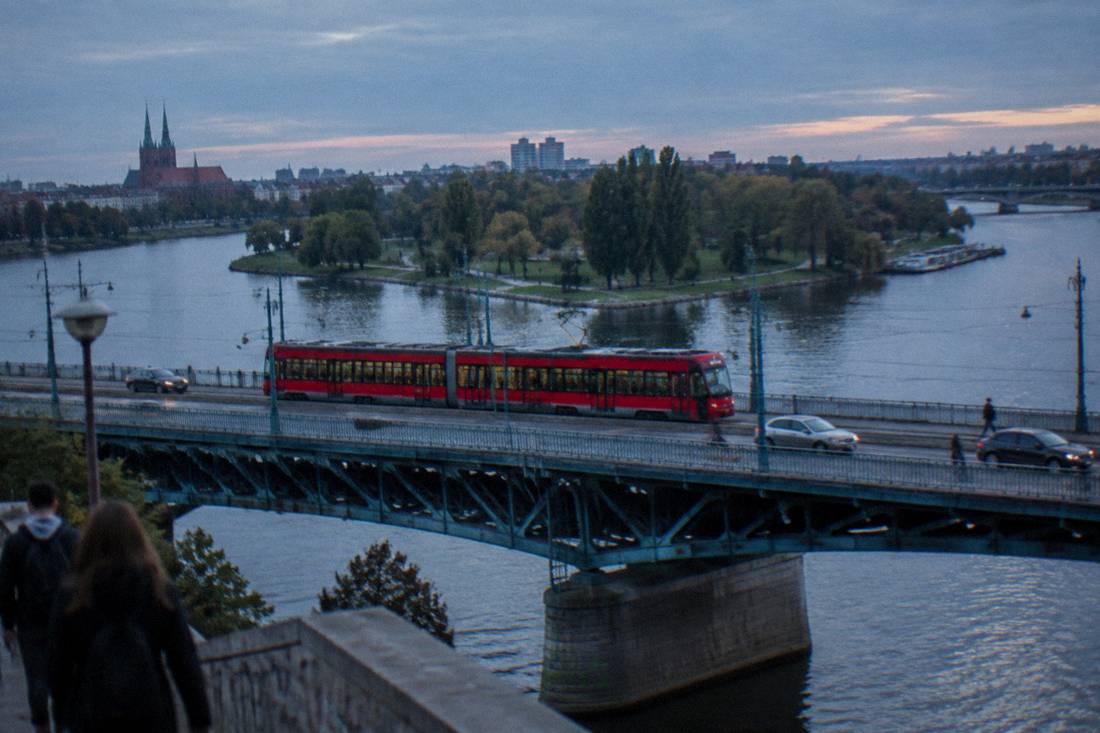
Grunwaldzki Bridge is a large steel suspension bridge over the Odra river in central Wroclaw, Poland, carrying pedestrians, cyclists, cars and trams between the university quarter and the districts north of the river. Its towers and suspension cables make it one of the city's most recognisable pieces of engineering, and its position, close to the Old Town, the cathedral island and the university, puts it at the natural centre of any walking tour of the river.
A few things make the bridge worth planning around rather than simply crossing. First, the view from the deck is one of the few places in central Wroclaw where you can take in the Odra's width, the islands and the skyline in one frame, which is why photographers cluster on the walkways around sunset. Second, the bridge is a working tram crossing, so it is one of the easiest pieces of the city's infrastructure to experience as part of an ordinary tram ride. Third, it sits on a natural line between several islands, so a route built around it can take in Sand Island, Ostrow Tumski and the botanical garden without ever needing a bus or a taxi.
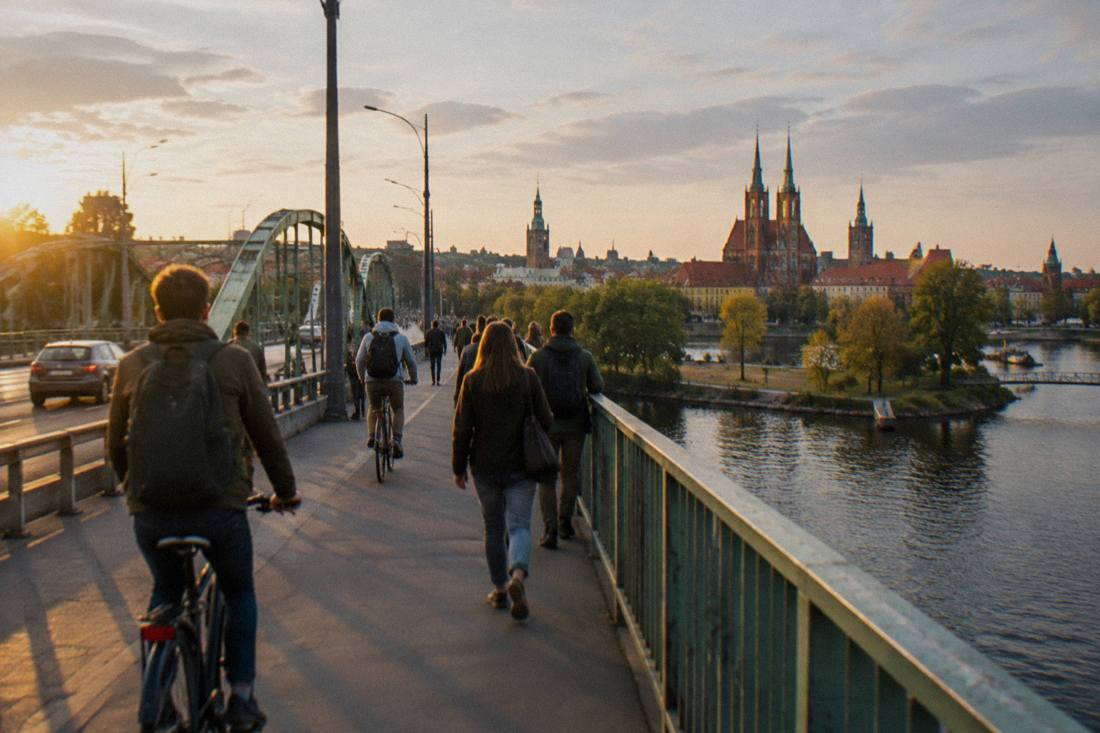
The Polish name, Most Grunwaldzki, refers to Grunwald, and the bridge's naming history, like much of Wroclaw's, reflects the city's complicated past as a city that has changed hands and changed names more than once. This guide deliberately avoids repeating specific construction dates, engineers' names or dimensions that are not carried in this site's verified facts pack, because popular bridge articles routinely get them wrong; what matters for a visitor is what the bridge is and how to use it, and that is what this page sticks to. Anyone who wants the full history can find it in the site's Wroclaw history guide, which traces the city's layered past in detail.
Which Islands And Sights Sit Around Grunwaldzki Bridge?
The islands around Grunwaldzki Bridge include Sand Island (Wyspa Piasek), the cathedral island of Ostrow Tumski, and the student-favourite Slodowa Island, together with the botanical garden and the university quarter immediately on the southern bank. Each island has its own character, and all of them are walkable from the bridge in a single loop that can be completed in a relaxed morning.
Ostrow Tumski, the cathedral island, is the spiritual heart of Wroclaw and the oldest part of the city that still stands as a coherent district. Its two slender cathedral spires are visible from the bridge, and the streets around them are a dense cluster of churches, canons' houses and quiet lanes. The Ostrow Tumski guide covers it fully, including the gas street lamps that a lamplighter still lights by hand each evening, one of the small rituals that makes the island feel different from the rest of the city the moment you step onto it.
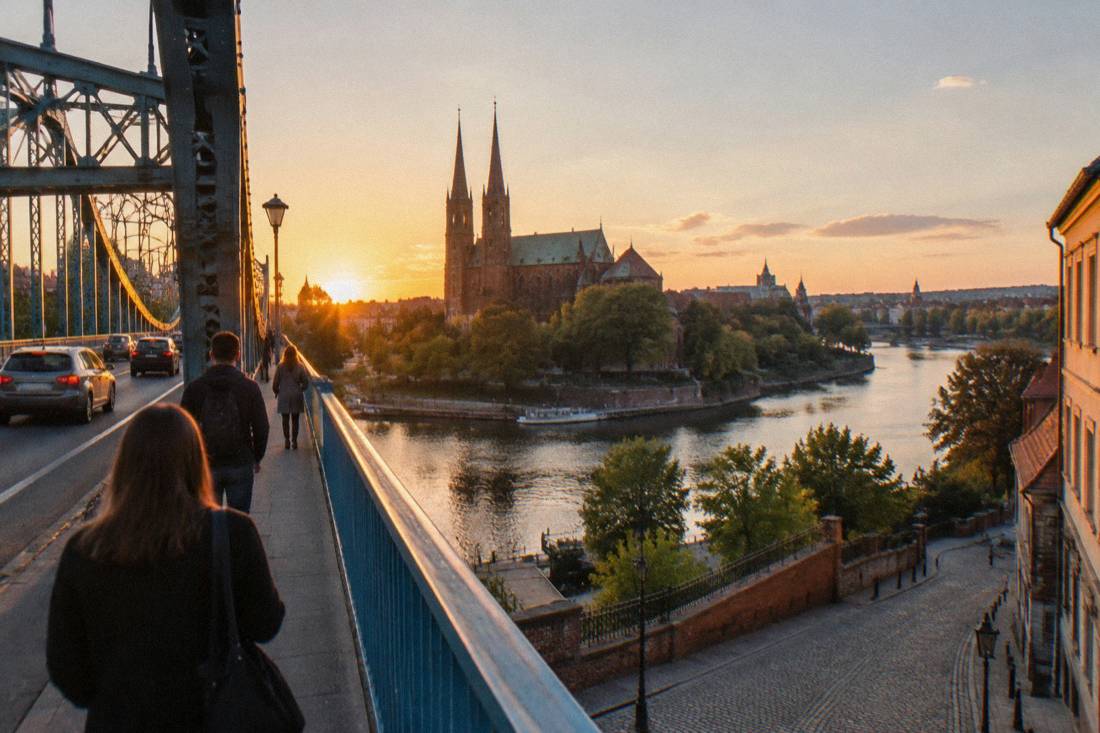
Sand Island, immediately south of the cathedral island, carries one of Wroclaw's most-loved buildings, the small Gothic church of the Blessed Virgin Mary on the Sand, and it works as a calm connector between the Old Town and the islands. Slodowa Island, the "malt island", is the opposite in mood: a bare riverside park where students from the nearby university buildings spread out with guitars, blankets and drinks in warm weather, and where the Slodowa Island guide describes the full riverside scene. The botanical garden sits just off the island chain and is one of the greenest corners of the centre, covered in the botanical garden guide.
The southern end of the bridge puts you within walking distance of the Old Town's main square, described in the Wroclaw Market Square guide, and of the baroque Aula Leopoldina inside the university, whose painted hall is described in the Aula Leopoldina guide. That density is the real argument for anchoring a day around Grunwaldzki Bridge: almost everything first-time visitors come to Wroclaw for sits within a short walk of either end of it.
For travellers who want the layers of the city explained rather than just pointed at, a guided walk is the efficient choice, and one option is a private Jewish heritage walking tour of Wroclaw, a guided walk through the districts and stories that a self-guided visitor usually walks past without noticing; the White Stork Synagogue quarter and the pre-war Jewish community's traces sit partly within walking range of the river, and the tour pairs naturally with an island loop. It can be booked via Check availability through the operator's live listing.
How Much Do The Attractions Near Grunwaldzki Bridge Cost?
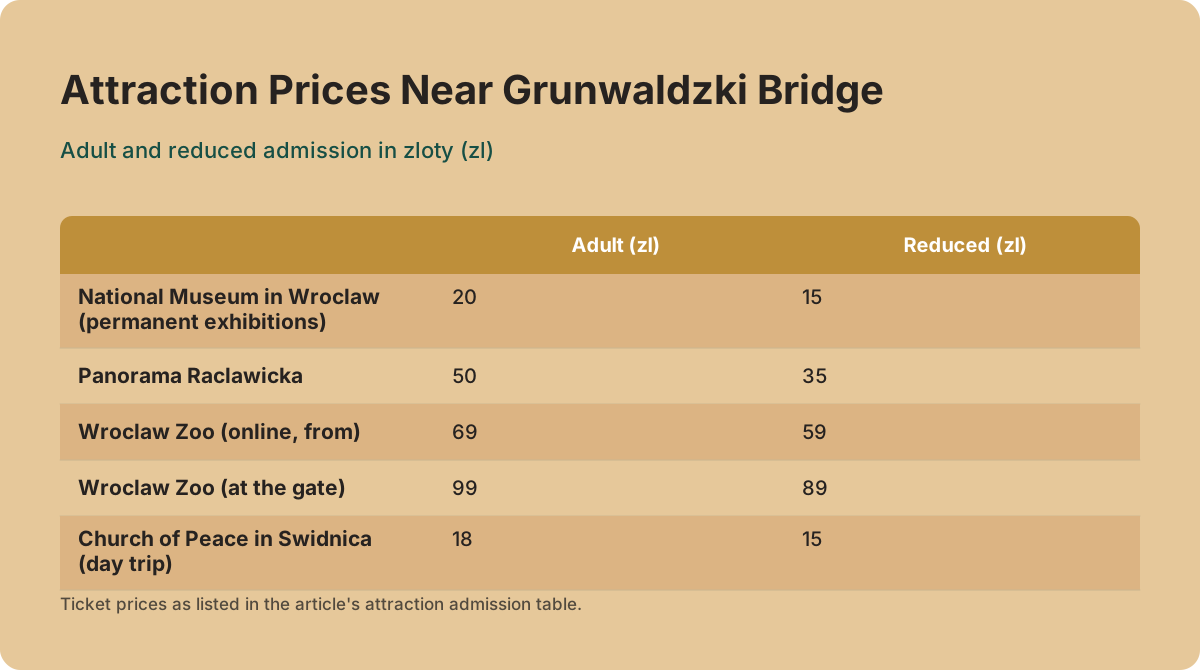
Admission for the main indoor attractions around the river islands runs from free to 50 zl for an adult: the National Museum charges 20 zl adult and 15 zl reduced, the Panorama Raclawicka charges 50 zl adult and 35 zl reduced, and walking the bridges and islands themselves, including Ostrow Tumski, Slodowa Island and the riverbanks, costs nothing at all. Poland uses the zloty (PLN), not the euro, so every figure below is in zl.
The table below gathers the verified admission figures for the attractions most easily combined with a Grunwaldzki Bridge walk. Each figure comes from the institution's own published tariff as recorded in this site's verified facts pack, so the numbers reflect what the venues themselves list rather than a third-party estimate.
| Attraction | Adult (zl) | Reduced (zl) | Notes |
|---|---|---|---|
| National Museum in Wroclaw (permanent exhibitions) | 20 | 15 | Free entry to permanent exhibitions every Saturday; under-7s free; special student ticket 3 zl; "Museum for a zloty" 1 zl for under-26s |
| Panorama Raclawicka | 50 | 35 | 30-minute screening; the ticket also covers the National Museum's permanent exhibitions, the Ethnographic Museum and the Four Domes Pavilion within 3 months |
| Wroclaw Zoo (online, from) | 69 | 59 | At the gate: 99 zl adult, 89 zl reduced; the Afrykarium is included in the standard ticket, not a separate charge |
| Wroclaw Zoo (at the gate) | 99 | 89 | Open every day of the year, including public holidays, per the zoo's own hours page |
| Church of Peace in Swidnica (day trip) | 18 | 15 | UNESCO-inscribed since 2001; family ticket 45 zl; a popular half-day excursion from Wroclaw |
Two of those figures deserve a note. The Panorama Raclawicka, the giant panoramic painting housed in a purpose-built rotunda, is one of Wroclaw's signature sights, and its ticket is effectively a multi-museum pass: the Panorama's own information page states that one ticket also covers the National Museum's permanent exhibitions, the Ethnographic Museum and the Four Domes Pavilion if used within three months. The Panorama Raclawicka guide explains the viewing experience and the practicalities, including the 30-minute screening format and the seasonal hours. The zoo figure is worth checking too, because the zoo's own price table gives a clear online-versus-gate gap, and the Afrykarium, the zoo's celebrated aquarium hall, is included in the standard ticket rather than sold separately, a detail many visitors wrongly budget for as an add-on.
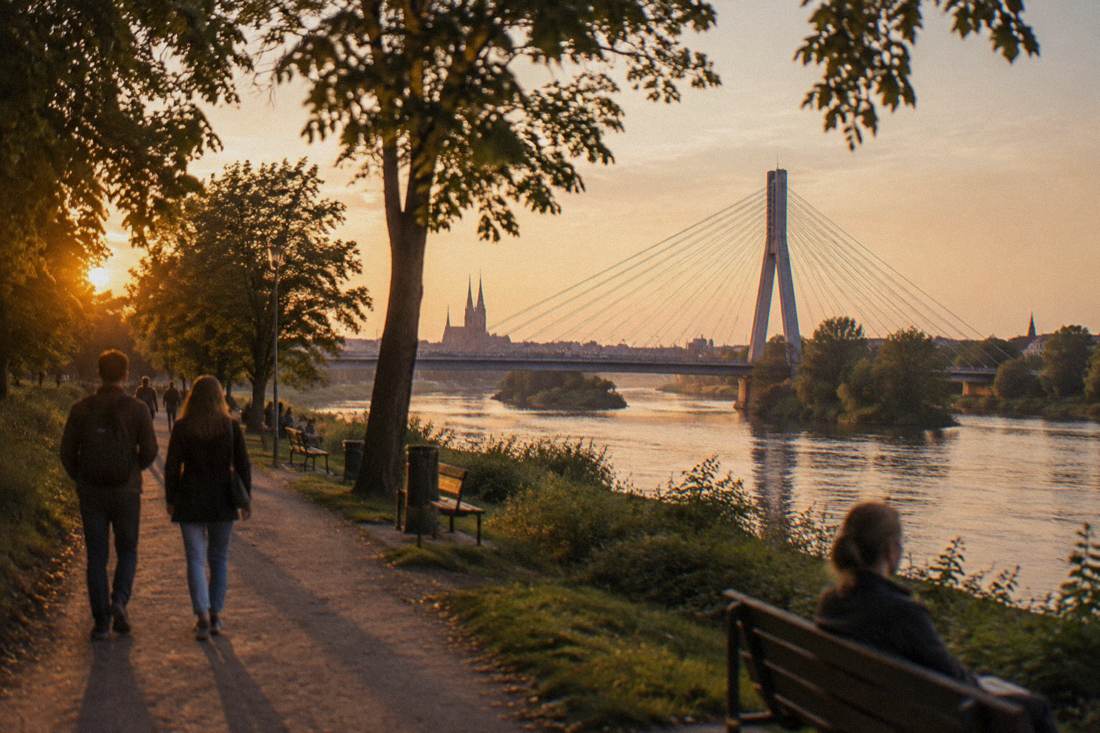
For a broader picture of city spending, including food, accommodation and sightseeing budgets, the Wroclaw trip cost guide breaks the numbers down by travel style, and the Wroclaw currency and tipping guide covers the practicalities of paying in Poland, where cards are widely accepted but zloty is the till currency.
How Do You Get To Grunwaldzki Bridge Without A Car?
Grunwaldzki Bridge is reached by tram, bus, bike or on foot, and Wroclaw's base single ticket costs 4.60 zl for a 15-minute ride, or 2.30 zl reduced, according to the MPK fare structure published on the city of Wroclaw's official portal. The bridge sits within the central tram network, and the islands on both sides are pedestrian-first territory where walking is faster and more pleasant than any vehicle for most visitors.
The city's fare structure, as listed on the official city portal, is tiered by journey length rather than by zone: the 15-minute ticket at 4.60 zl (2.30 zl reduced) is the base short-hop fare, the 30-minute tier is 7.00 zl (3.50 zl), and the bands rise through a 24-hour city ticket at around 15.00 zl (7.50 zl) and further multi-day tiers at 26, 32 and 54 zl. The getting around Wroclaw guide explains the whole system, including how the islands and Old Town fit together on foot, and the public transport fares and opening hours guide collects the seasonal quirks worth knowing.
| MPK Wroclaw ticket tier | Normal (zl) | Reduced (zl) |
|---|---|---|
| 15-minute ticket (base short-hop fare) | 4.60 | 2.30 |
| 30-minute ticket | 7.00 | 3.50 |
| 24-hour city ticket (approximate band) | 15.00 | 7.50 |
For travellers arriving by air, the Wroclaw airport guide covers the route into the city. Wroclaw Airport handled 4,473,945 passengers in 2024, the airport's own release confirms, and it is open and operating normally; a temporary full closure for a runway and operational-area renovation ran in late 2025, was finished, and was followed by new passenger records in 2026, so the airport answer for anyone planning a visit is simply "open". There is no all-inclusive Go City-style tourist pass sold for Wroclaw, and none should be assumed: UrbanCard is a transport-focused fare card aimed at residents, not a sightseeing pass, and no multi-attraction city pass covering museum admission currently exists for Wroclaw.
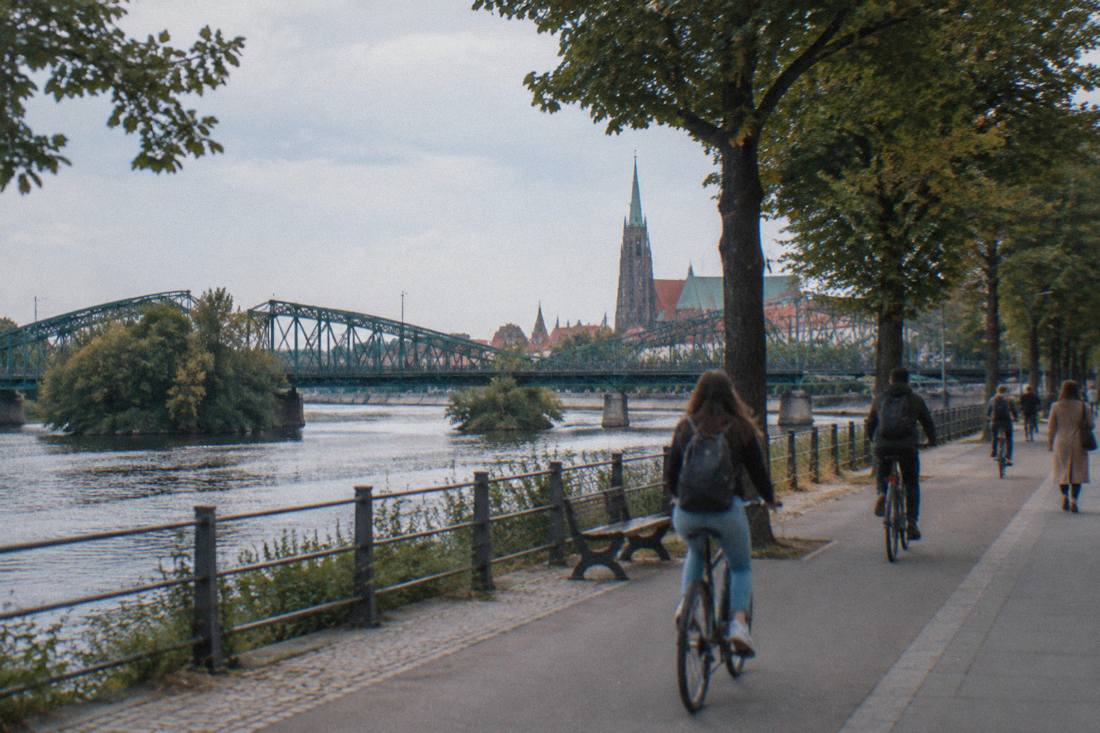
Cycling deserves a mention here too. The Odra islands are flat, the bridge connects into riverside paths, and Wroclaw's city-bike system is covered on a live availability map rather than any figure frozen into an article like this one; check the live feed when you arrive, since dock and bike availability changes by the hour. The three days in Wroclaw itinerary shows how a bike or tram day can be structured once you have the islands done.
What Is The Best Time To Visit Grunwaldzki Bridge And The Islands?
The warmest months in Wroclaw are July at 19.7 C mean and August at 19.3 C mean, per the IMGW 1991-2020 climate normals for the Wroclaw station, and July is also the wettest at 91.4 mm of precipitation, so the classic island-walking window is May through September, with warm evenings, long light and the riverside parks at their busiest. January, the coldest month at 0.0 C mean, is the quietest time and has its own frozen, atmospheric appeal.
The full normals from IMGW, the Polish national meteorological institute, give a useful planning table. Wroclaw's climate is temperate, with an annual mean of 9.7 C, and the winters are among the milder ones for a major Polish city; the best time to visit Wroclaw guide and the month-by-month Wroclaw weather guide build on the same official dataset.
| Month | Mean temperature (C) | Precipitation (mm) | Island mood |
|---|---|---|---|
| January | 0.0 | 28.3 | Quiet, often frosty; lamplighter still works on Ostrow Tumski |
| February | 1.1 | 25.6 | Cold, low crowds, good light for photography |
| March | 4.3 | 35.0 | Thaw begins; parks turn green late in the month |
| April | 9.7 | 31.2 | Spring blossom; driest month on the normals table |
| May | 14.3 | 59.6 | Full riverside season begins on Slodowa Island |
| June | 17.7 | 65.4 | Warm evenings, student crowds on the islands |
| July | 19.7 | 91.4 | Warmest month; also the wettest, so pack for showers |
| August | 19.3 | 59.5 | Peak summer feel on the riverbanks |
| September | 14.5 | 48.4 | Warm days, thinning crowds, strong golden light |
| October | 9.6 | 37.6 | Autumn colour along the Odra's bank paths |
| November | 4.8 | 31.4 | Short days; indoor museums become the main draw |
| December | 1.1 | 27.9 | Christmas-market season in the Old Town near the islands |
Note the two quirks in the data that most generic guides miss: December, at 27.9 mm, is among the driest months of the year rather than the grey wash many people imagine, and July, the warmest month, is also the wettest at 91.4 mm, so a July visit needs both sunscreen and an umbrella on the same day. Neither the Wroclaw Market Square's charm nor the island walks close for rain, and the rainy day Wroclaw guide lists the indoor options, including the National Museum with its free Saturday entry to permanent exhibitions, within easy reach of the river.
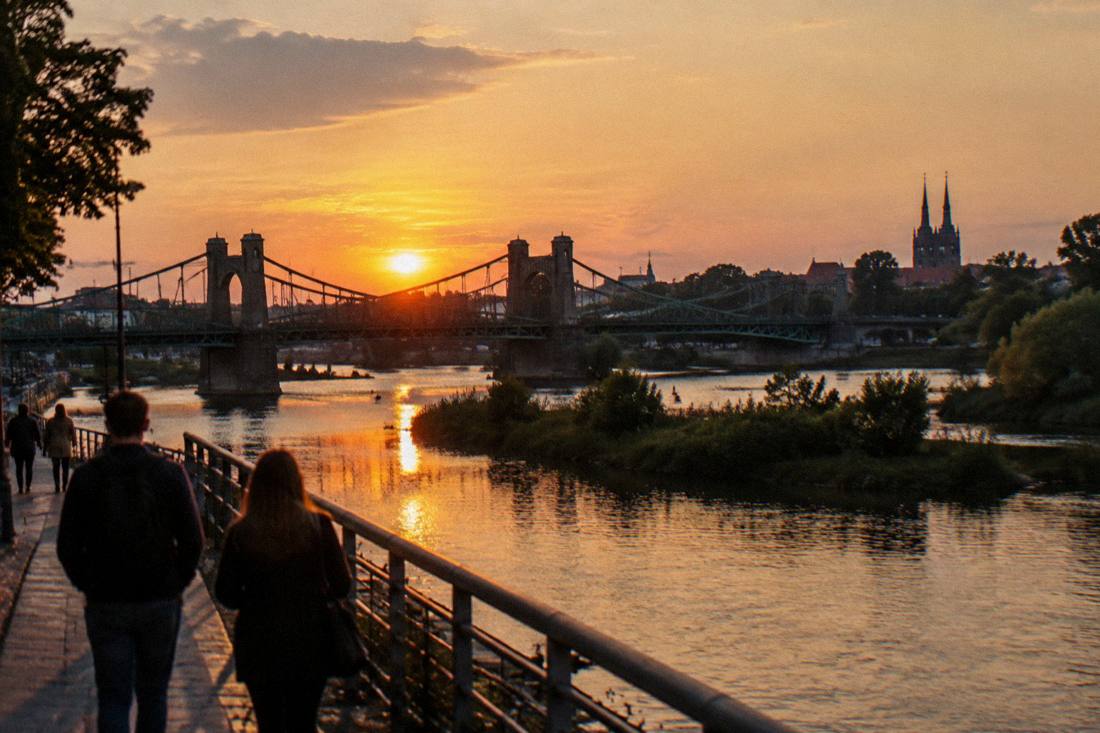
For timing within the day, early morning and the last hour of daylight are the two windows photographers should claim. The bridge's towers and the cathedral spires to the north-west catch low light, and the lamplighter on Ostrow Tumski works at dusk, which means a route that crosses Grunwaldzki Bridge in the late afternoon and drifts on to the cathedral island ends with one of the most atmospheric half-hours in the city. No permit is needed for ordinary photography from public ground; commercial or drone work is a different matter, covered in the photography permits and drones guide.
How Does Grunwaldzki Bridge Fit Into A Wroclaw Walking Route?
Grunwaldzki Bridge works best as the hinge of a loop: start on the Old Town side, cross into the island chain via Sand Island or Ostrow Tumski, walk the riverside paths east, and return across the Odra with the bridge's towers ahead of you, a shape that links the Market Square, the Aula Leopoldina, the botanical garden, the cathedral and Slodowa Island into one coherent day. The one day in Wroclaw itinerary follows this exact logic.
The Wroclaw walking tour route guide sets out the full route with stops and timings, and the two days in Wroclaw itinerary splits the islands from the Old Town for a slower pace. In outline, the island portion of the walk runs from the Market Square north to the university and the Aula Leopoldina, past the botanical garden, onto Sand Island, across to Ostrow Tumski for the cathedral and the lamplighter's lanes, then along the riverbank paths to Slodowa Island and back over Grunwaldzki Bridge or one of the neighbouring crossings. Every segment of that loop is public pavement, free to walk, and flat.
One detail worth folding in: Wroclaw's bronze dwarfs, the small statues scattered across the city, turn up along the river and islands as well as in the Old Town, and hunting them is a ready-made game for children on a bridge-and-island walk. The Wroclaw dwarfs guide explains where the main clusters are and how the tradition started, and the Wroclaw with kids itinerary builds a family day around it. For solo travellers the islands are among the easiest places in the city to be alone comfortably; the Wroclaw for solo travelers guide has the wider picture, including the free and tip-based walking tours that make the river area easy to see with a group and a guide.
Which Tours Pair Well With Grunwaldzki Bridge?
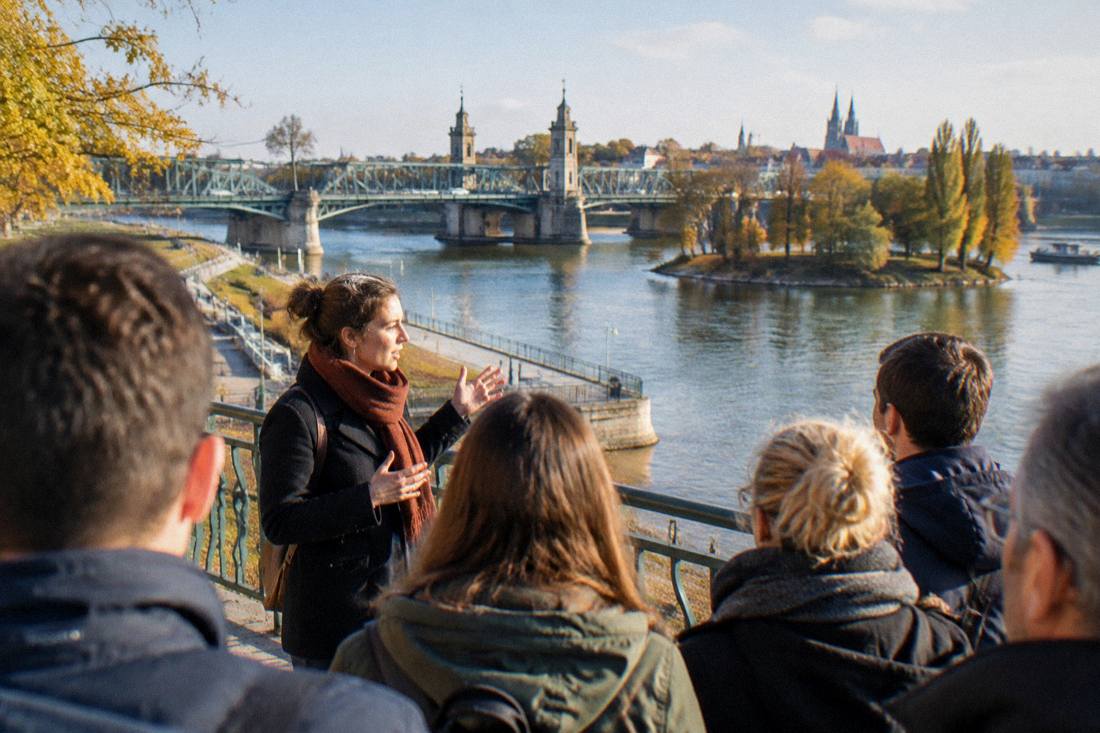
For the bridge and islands themselves, the natural tour options are Wroclaw's free, tip-based walking tours, including the Old Town Wroclaw walk by Walkative on GuruWalk and the free "Wroclaw Through Ages" Old Town and Cathedral Island walk, plus paid private walking tours for travellers who want a dedicated guide; for days beyond the river, Ksiaz Castle and the Church of Peace in Swidnica are the classic paired excursions, reachable on organised day tours from Wroclaw.
Starting with the free layer, because it genuinely is free: the city-guide tradition of pay-what-you-feel walking tours is strong in Wroclaw. "Old Town Wroclaw by Walkative!", a free, tip-based walk of roughly two and a half hours run on the GuruWalk platform, is the best-established of them, and its guide is named here because free walks work on tips, not commissions, and deserve honest credit. The same platform carries "Legends of Wroclaw: Free Tour Around Ostrow Tumski & Market Square", a free legends walk of an hour and three quarters that covers exactly the cathedral island ground this article describes, "Wroclaw Through Ages: Old Town & Cathedral Island Walking Tour", a free walk, and "Tour in Wroclaw Given by a Historian", a free historian-led walk of about two and a half hours. None of these carries a printed price here because there is none to print; the tip is your decision on the day, and meeting-point details live on each walk's own listing.
For a paid, private option in the city, the private Jewish heritage guided tour is the strongest thematic fit with the river quarter's history, and it links well with a second, more ambitious day out. The half-day Ksiaz Castle and Church of Peace tour covers the two big Lower Silesian sights in one organised trip from Wroclaw, which matters because the castle's own cennik, effective 6 May 2026, prices the castle with audioguide and terraces at 72 zl adult and 62 zl reduced, with the terraces open only from 15 April to 30 September, a seasonal detail that catches out many summer-late and autumn visitors.
The UNESCO-listed Church of Peace in Swidnica is the other half of that pairing. It is one of the Churches of Peace in Jawor and Swidnica, inscribed by UNESCO in 2001, and its own tariff lists adult entry at 18 zl, reduced 15 zl, children and youth 10 zl, and a family ticket at 45 zl. Ksiaz Castle itself is owned by the Walbrzych municipality and operated by a municipal company, not a private owner, a fact confirmed on the operator's own site, so any tour that frames it as a private estate is starting from the wrong story. The dedicated Ksiaz Castle day trip guide and Church of Peace Swidnica guide carry the full detail on both.
For travellers weighing Wroclaw against Poland's other major cities before committing days to it, the honest size comparison is this: Krakow is the larger city, 816,614 to Wroclaw's 672,601 at 31 December 2025 per GUS, and it also has the larger main market square, roughly 4 hectares against Wroclaw's roughly 3.6 to 3.8. Wroclaw's claim is not size but shape: the islands, the bridges and the compactness of a river city you can cross on foot. The Wroclaw vs Krakow comparison works through the trade-offs in full, and the free things to do in Wroclaw guide confirms how much of the island experience, including the bridges, riverbanks and Ostrow Tumski's lanes, costs precisely nothing.
Common Questions About Grunwaldzki Bridge And The Oder Islands
Is Grunwaldzki Bridge In Wroclaw Free To Cross?
Yes. Grunwaldzki Bridge is a public road and tram bridge over the Odra in Wroclaw, Poland, and pedestrians and cyclists cross it free at any time, with no ticket, gate or toll. The only costs in the area are the indoor attractions, such as the National Museum at 20 zl adult or the Panorama Raclawicka at 50 zl adult, while the islands, riverbanks and Old Town streets themselves are all free public space.
Can You Walk From Grunwaldzki Bridge To Ostrow Tumski?
Yes, Ostrow Tumski, the cathedral island, is within an easy riverside walk of Grunwaldzki Bridge, and the whole island chain, including Sand Island and Slodowa Island, links up along the Odra's banks as one continuous pedestrian route. The Ostrow Tumski guide covers the cathedral, the lamplighter who still lights the island's gas lamps by hand each evening, and the best order to see it all.
What Currency Do You Need Around Grunwaldzki Bridge?
The zloty (PLN), abbreviated zl. Poland is in the EU and the Schengen area but does not use the euro, and every till price in this guide, from the 4.60 zl base tram ticket to the 50 zl Panorama Raclawicka ticket, is in zloty. The Wroclaw currency and tipping guide covers cards, cash and tipping norms in detail.
Which River Islands Should You Visit First Near Grunwaldzki Bridge?
Start with Ostrow Tumski for the cathedral and the oldest streets, then Sand Island for the Gothic church of the Blessed Virgin Mary on the Sand, then Slodowa Island for the riverside park mood, in that order. That sequence moves from the most historic ground to the most social, ends near the university quarter, and loops back over the bridge to the Old Town. The one day in Wroclaw itinerary uses the same order.
Is There A Wroclaw City Pass Covering The Attractions Near The Bridge?
No. There is no all-inclusive Go City-style tourist pass currently sold for Wroclaw, and none covering museum admission exists. The closest thing is the Panorama Raclawicka ticket, which the Panorama's own information page says also covers the National Museum's permanent exhibitions, the Ethnographic Museum and the Four Domes Pavilion within 3 months; UrbanCard is a transport fare card, not a sightseeing pass, and should not be bought as one.
Are The Oder Islands Good For Families With Children?
Yes, the islands are flat, traffic-light and full of open grass, and the dwarf statues scattered across Wroclaw give children a treasure hunt to run along the riverbanks. The zoo, where the Afrykarium is included in the standard ticket rather than sold separately, adds a full-family day out nearby, and the Wroclaw with kids itinerary builds the whole day around them.
Grunwaldzki Bridge is, in the end, the most practical kind of landmark: a piece of the city's daily life that happens to be one of its best views. Cross it at golden hour, walk the island chain it anchors, spend a handful of zloty at the museums only if the weather asks for them, and the river quarter of Wroclaw will feel fully seen.