Studying In Wroclaw: A Visitor's Guide To The University
Wroclaw, the largest city in Lower Silesia in southwestern Poland, is one of the country's great university towns, and its campus doubles as one of its most visitable historic districts. Here is how to explore it like a student: what to see, what it costs, and how to spend a day around the university quarter.
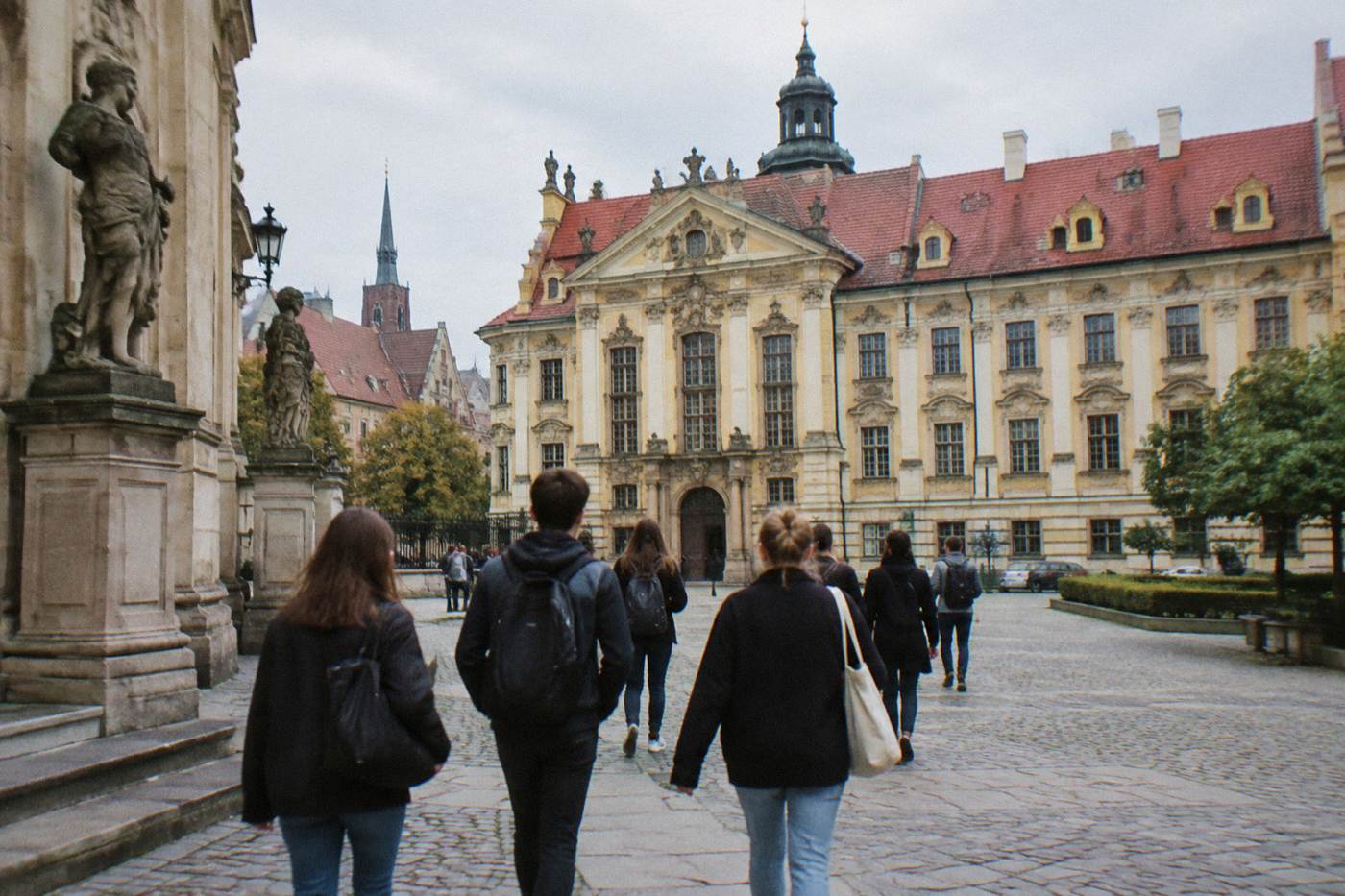
Short answer
Wroclaw's university quarter sits on and around the Odra river islands in the Old Town. Visitors can tour the baroque ceremonial hall, walk Cathedral Island, use the city's cheap MPK transport (a 15-minute ticket is 4.60 zl), eat at milk bars, and join free GuruWalk walking tours. The National Museum is free on Saturdays and 20 zl otherwise.
Wroclaw, the largest city in Lower Silesia (Dolnoslaskie voivodeship) in southwestern Poland, is a university town in the most literal sense: a huge share of its city center lives, studies, and drinks within walking distance of the Odra river islands. GUS data puts the city's population at 672,601 as of 31 December 2025, and a large slice of that number is made up of students. For a visitor, that changes the whole texture of a trip. The bars are cheaper and earlier, the cafés fill with laptops by mid-morning, and the historic university buildings sit right beside the Old Town rather than behind a campus gate in a suburb.
This guide treats the university quarter the way a visiting friend of a local would experience it. It covers what you can actually see of the university, what the museums around it cost, how to move through the city on student-priced transport, where students eat, and how the academic calendar reshapes the city across the year. One honest note on sourcing: everything priced below comes from official Polish sources, the city's own portal, or museum sites, so the figures are what the institutions themselves publish, not estimates.
Why Is Wroclaw Such A Big University City For Visitors To Notice?
Wroclaw's student population is so visible in the city center that visitors encounter it constantly, from the cafés and milk bars around the Old Town to the nightlife districts on the Odra islands, and the university's main buildings sit inside the historic core rather than in a distant campus. The city's 672,601 residents include tens of thousands of students, and their presence shapes opening hours, prices, and the whole rhythm of central Wroclaw.
You notice it first in the crowd. Around the Market Square and on the Sand and Cathedral islands, a big proportion of the people on the street are in their early twenties, often in university-branded hoodies, often carrying books. You notice it again at lunch, when the milk bars fill, and in the evening, when the nightlife on Slodowa Island starts early and runs late. The University of Wroclaw's ceremonial hall is one of the city's headline sights, and it is a five-minute walk from the Market Square, not an excursion.
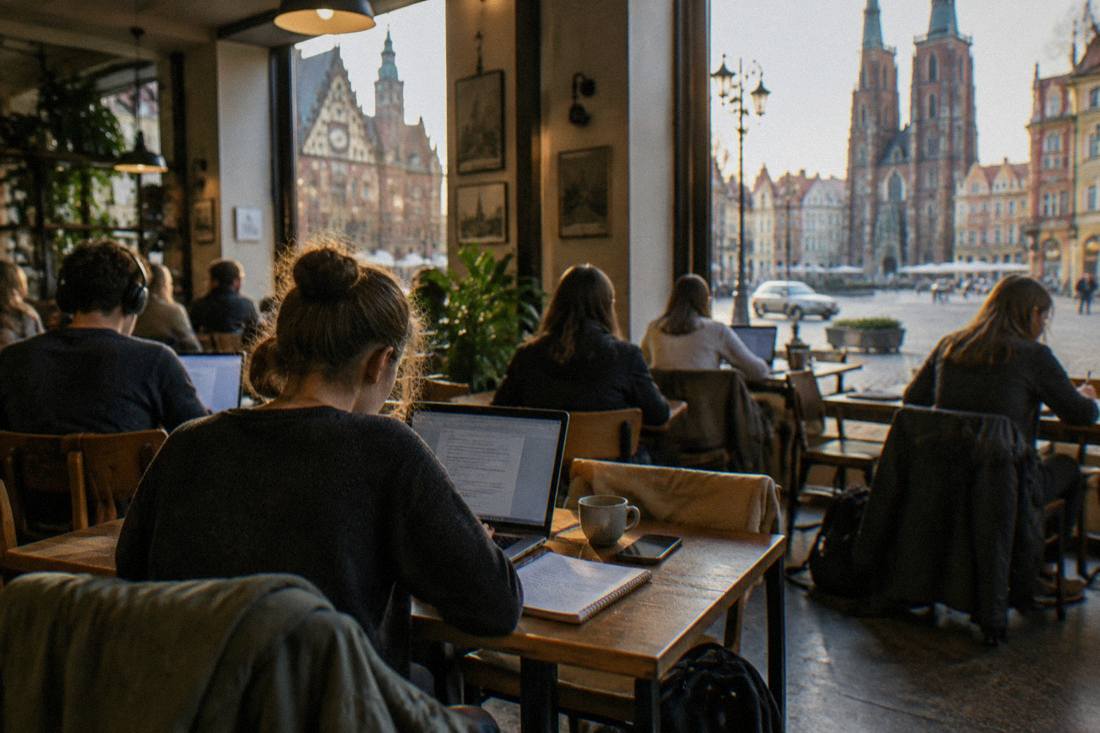
For a fuller picture of what the institution is known for academically, see the site's answer on what Wroclaw University is known for. For visiting purposes, the practical point is simpler: the university is not a detour from a Wroclaw trip, it is woven into the itinerary. A day in the Old Town will pass the university's main building whether you planned for it or not.
There is also a seasonal effect worth planning around. During term, the central cafés are full from mid-morning and the student nightlife districts are busy midweek. During holidays and exam periods in late January and early June, the center quietens noticeably. If your main interest is the city's student atmosphere rather than its architecture, come in term time.
What Can You See Around The University Quarter In Wroclaw?
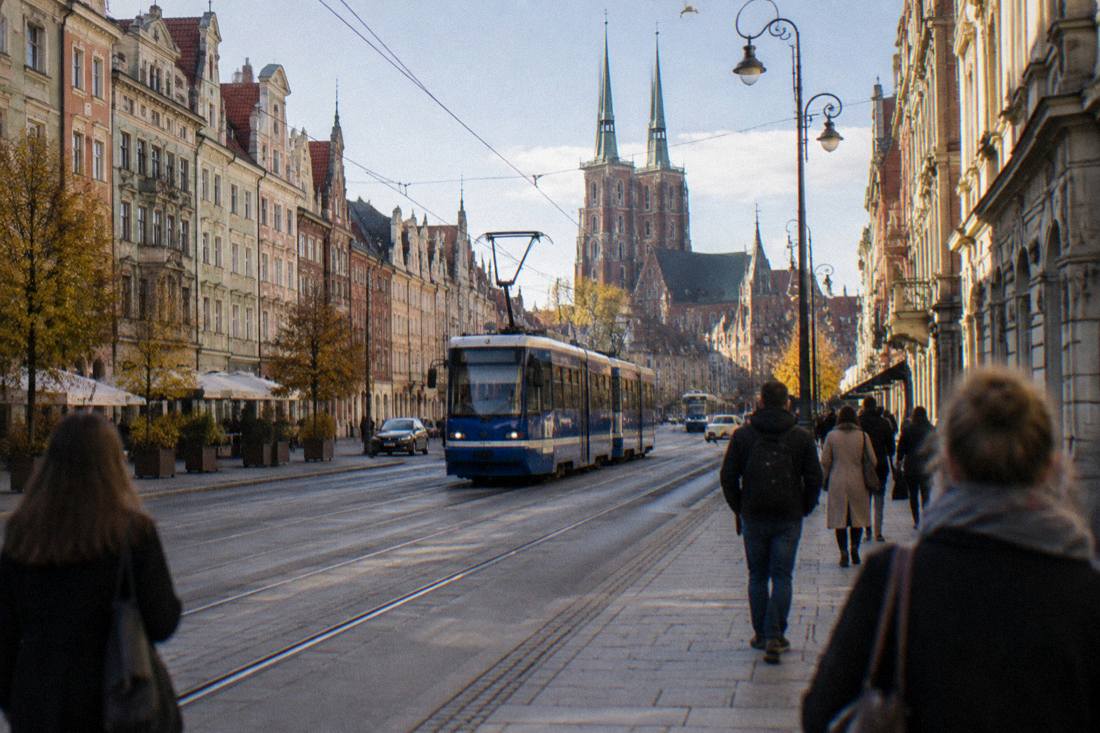
The core student-visitor route runs from the University of Wroclaw's main building and its baroque ceremonial hall, across to Cathedral Island (Ostrow Tumski) with its cathedral and riverside walks, and back over the Odra via the Sand Bridge to the Old Town's Market Square, all within roughly two hours of easy walking. Most of it is free to see from the outside.
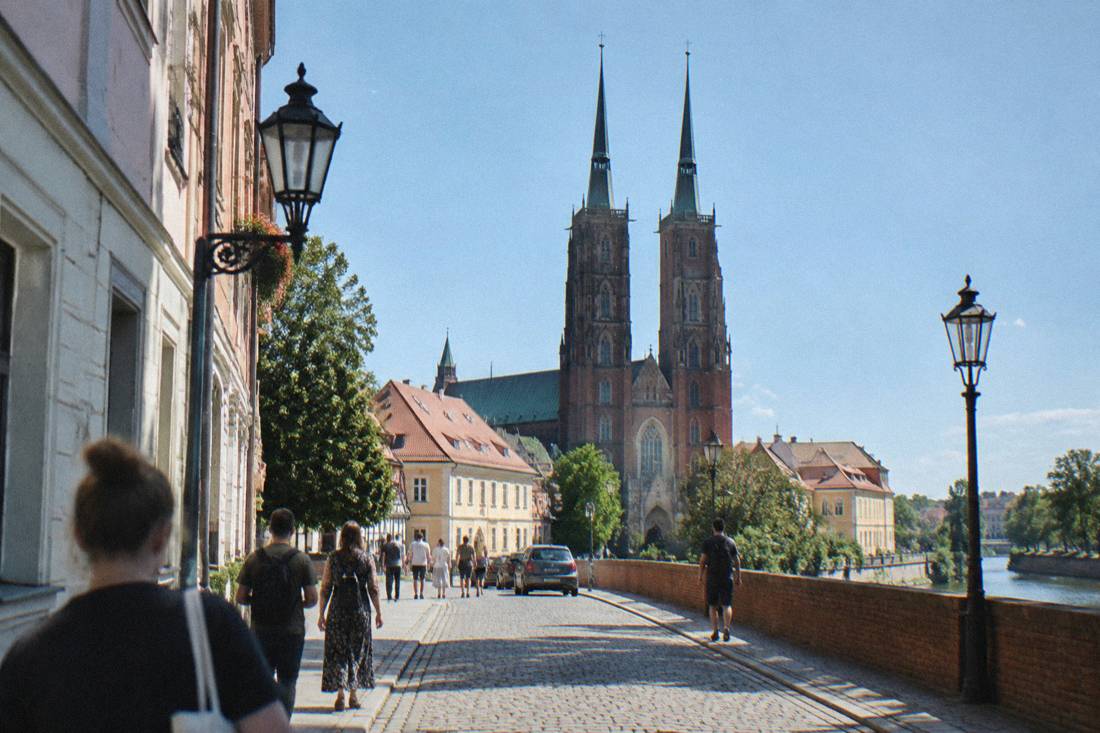
The university quarter is compact. The main building complex sits at the edge of the Old Town, close to where the Odra splits into its channels around the islands. Cathedral Island, the oldest part of the city, is a short walk north and is the calmest corner of the center, cobbled, largely car-free, and full of gas-lamp-era streetscapes. The Ostrow Tumski guide on this site covers the island in detail, and the Old Town guide covers the Market Square end.
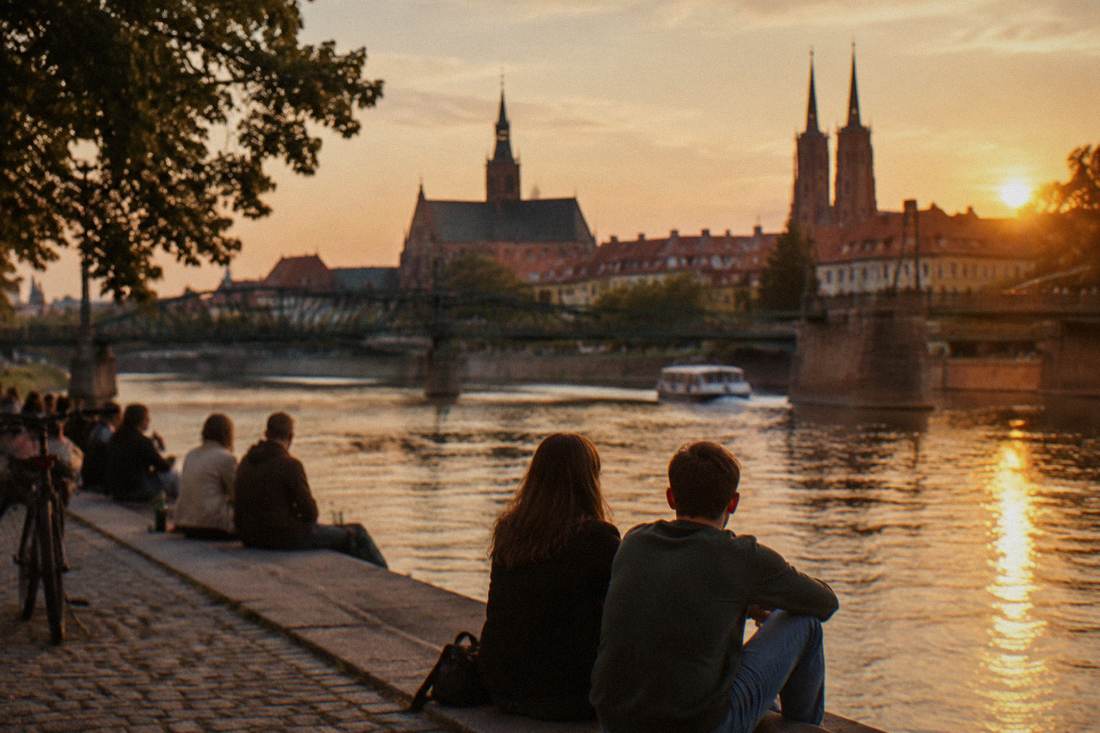
What surprises most first-time visitors is how much of the student city is outdoors and free. The riverside embankments between the islands are where students actually spend their afternoons in warm months, sitting on the concrete ledges with drinks from nearby shops. The bridges themselves, including the Grunwaldzki Bridge, are sights in their own right. And the dwarfs, Wroclaw's famous bronze figurines, pop up all over the quarter, including several near the university buildings; the dwarf hunting guide lists where to find them.
A guided walk stitches these together efficiently. The Hidden Gems of Wroclaw Tour, this site's featured walk for the university theme, covers the courtyards and corners that students use daily, and the operator's live listing carries the current price and availability:
How Much Do Wroclaw's Museums Cost For Visitors On A Student Budget?
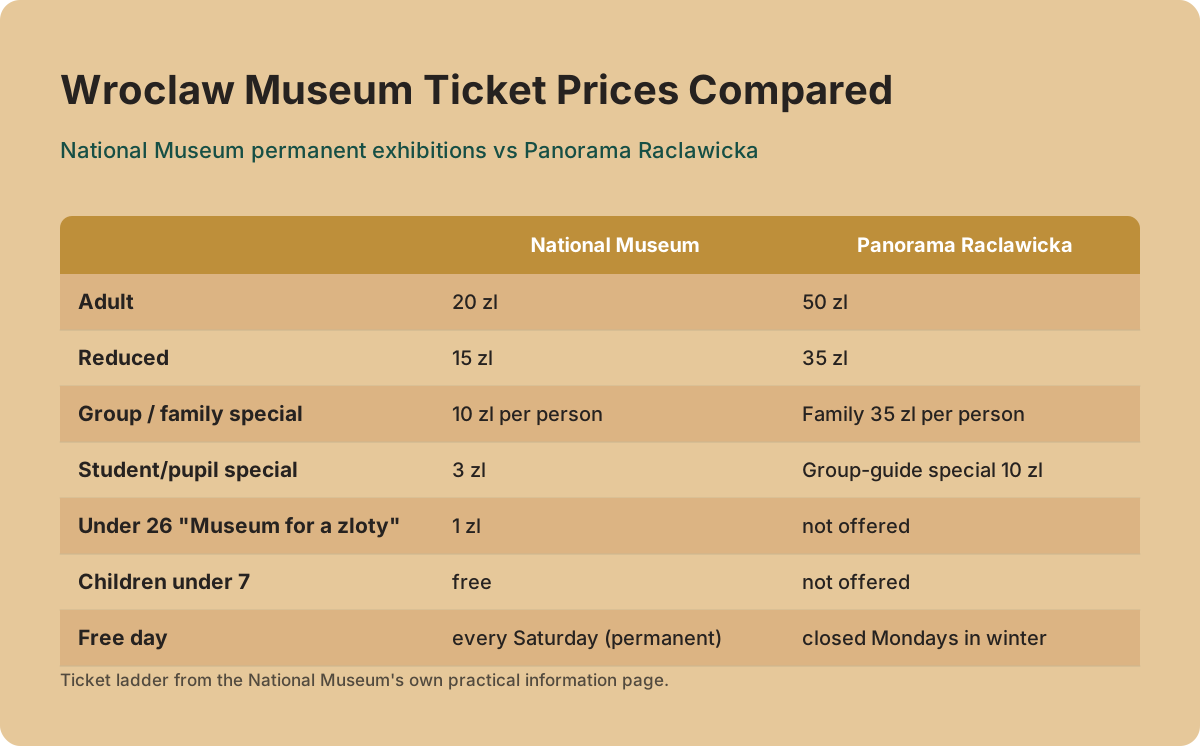
The National Museum in Wroclaw charges 20 zl for adults and 15 zl reduced for its permanent exhibitions, with free entry every Saturday, while the Panorama Raclawicka charges 50 zl adult and 35 zl reduced for its 30-minute screening, and one Panorama ticket also covers the National Museum, the Ethnographic Museum and the Four Domes Pavilion within three months.
The pricing here is genuinely student-friendly, and the two headline museums are close together. The National Museum's own practical information page lists the full ticket ladder, including a 1 zl "Museum for a zloty" option for students and pupils under 26 and free entry for children under 7. Saturday free entry applies to the permanent exhibitions.
| Ticket | National Museum (permanent) | Panorama Raclawicka |
|---|---|---|
| Adult | 20 zl | 50 zl |
| Reduced | 15 zl | 35 zl |
| Group / family special | 10 zl per person | Family 35 zl per person |
| Student/pupil special | 3 zl | Group-guide special 10 zl |
| Under 26 "Museum for a zloty" | 1 zl | not offered |
| Children under 7 | free | not offered |
| Free day | every Saturday (permanent) | closed Mondays in winter |
The Panorama is a different kind of visit: a giant cylindrical painting viewed from a rotating platform, with a 30-minute screening. Its own tickets page states that the same ticket covers the National Museum's permanent exhibitions, the Ethnographic Museum and the Four Domes Pavilion, valid for three months from the visit date, which makes it the best-value single purchase for a longer stay. The Panorama Raclawicka guide and the National Museum guide on this site cover both in depth.
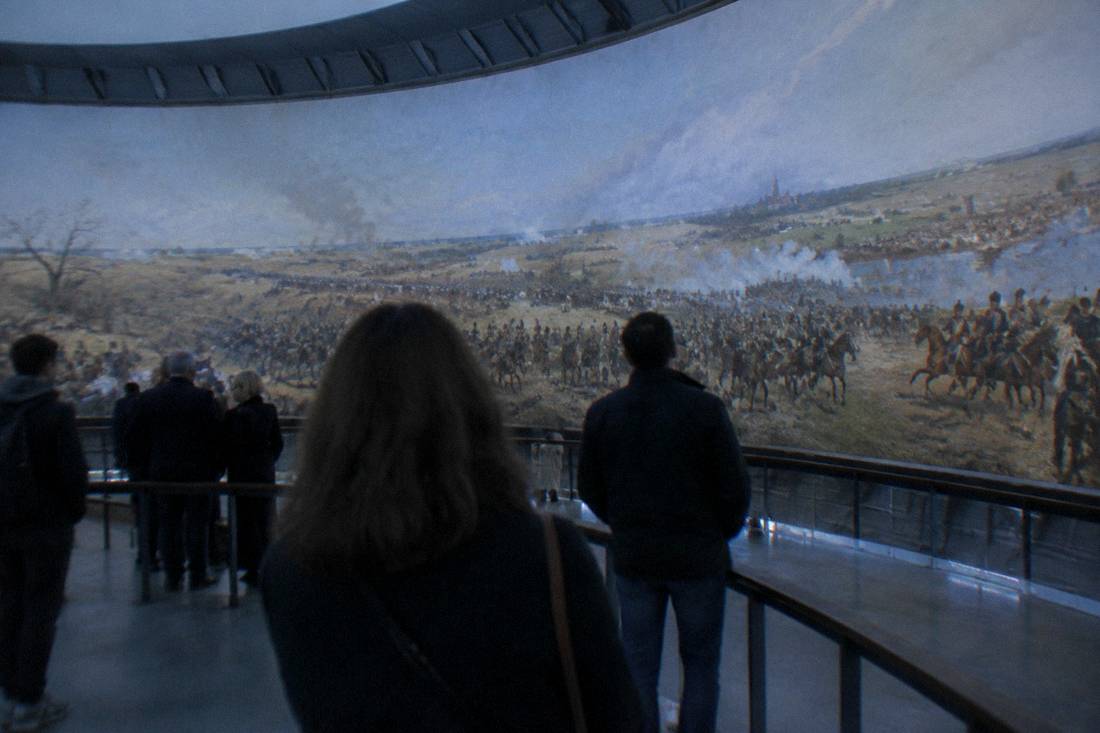
Opening hours follow a winter/summer split at both institutions. The National Museum is closed Mondays year-round; in winter (1 October to 31 March) it runs Tuesday to Friday 10:00-16:00 and weekends 10:00-17:00, and in summer (1 April to 30 September) Tuesday to Friday 10:00-17:00 and weekends 10:30-18:00. The Panorama in winter (1 November to 31 March) is closed Monday and runs Tuesday to Friday 9:30-16:00, Saturday 9:30-17:00, Sunday 9:30-16:00; in summer (1 April to 31 October) it is open daily 8:30-19:00. Both ticket offices close 30 minutes before the museum itself.
How Do You Get Around Wroclaw Without A Car?
Wroclaw's MPK network sells a 15-minute ticket for 4.60 zl normal fare (2.30 zl reduced), with longer timed tickets rising through a 30-minute tier at 7.00 zl and a roughly 24-hour city ticket band around 15.00 zl, and the whole central university quarter is walkable on foot, so transit is only needed for outlying sights.
The city of Wroclaw's official fares page publishes the full ladder, and the figures above are its own. Trams and buses share the same tickets. For a visitor staying anywhere central, the honest answer is that you will walk most of the time: the distance from the Market Square to the university main building, to Cathedral Island, and to the riverside islands is a few minutes each on foot.
| MPK ticket tier | Normal fare | Reduced fare |
|---|---|---|
| 15-minute | 4.60 zl | 2.30 zl |
| 30-minute | 7.00 zl | 3.50 zl |
| Up to 24-hour city ticket band | ~15.00 zl | ~7.50 zl |
| Multi-day band (higher tiers) | 26/32/54 zl | 13/16/27 zl |
Two cautions from the site's own research. First, there is no all-inclusive Go City-style tourist pass sold for Wroclaw; the UrbanCard is a transport-focused fare card aimed at residents, not a sightseeing pass, so do not let anyone sell you one as museum access. The Wroclaw city pass guide explains the honest state of play. Second, if you plan to use bikes, the city has a live bike-share map, and availability varies hour to hour, so check the live feed rather than assuming.
The wider getting around Wroclaw guide covers tram lines, ticket machines and airport transfers in detail, and the airport guide covers arrival. If your trip continues to Krakow, the Wroclaw to Krakow train guide explains why fares and times are best checked live rather than from a static figure.
Where Do Students Eat Cheaply In Wroclaw?
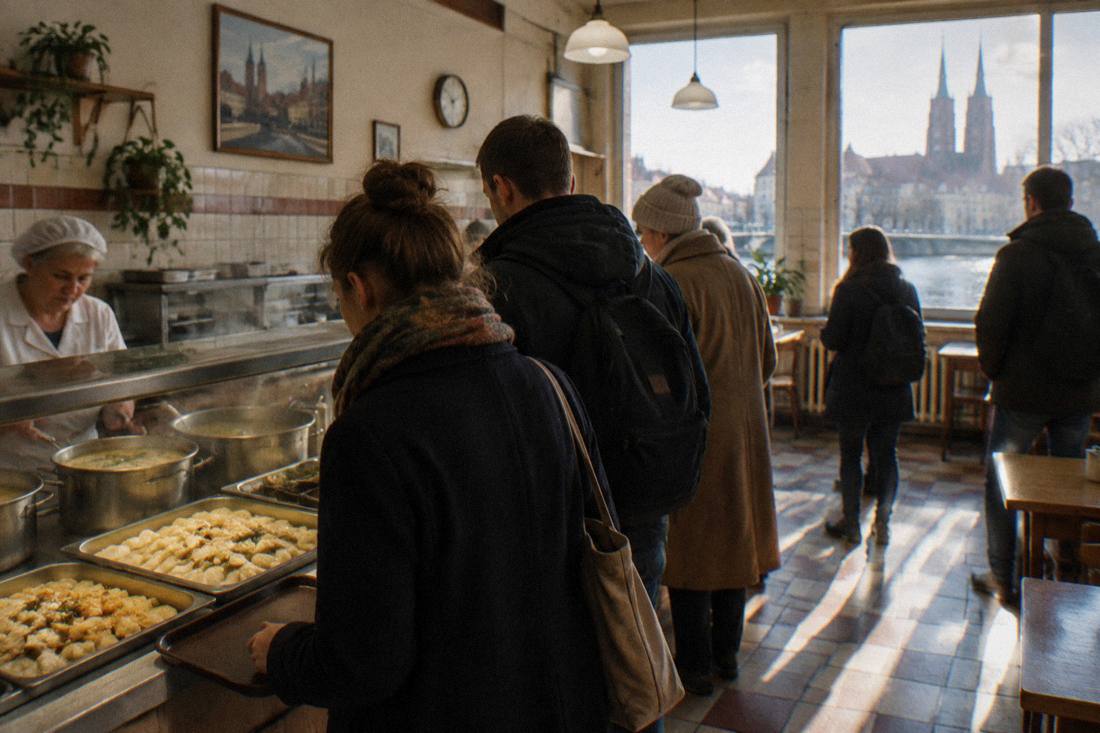
Wroclaw's classic budget eating is the milk bar (bar mleczny), a no-frills canteen serving pierogi, soups and dumpling plates for a few zloty, supplemented by the street-food windows and student cafés around the Market Square and the university buildings, where a filling lunch costs less than a single museum ticket at the National Museum's 20 zl adult price.
Milk bars are the institution to know. They are self-service, busy at lunch, and totally unglamorous, and they are where a large share of the city's students eat on weekdays. The milk bars guide lists the reliable central ones and explains the ordering system, which can trip up first-timers. The pierogi guide and street food guide cover the other staples.
The café layer matters too. Student Wroclaw runs on long-sitting cafés, and the best cafés guide covers the ones where a laptop and one coffee will get you a table for two hours. For evenings, the restaurants guide and craft beer guide cover everything from cheap to celebratory, and the nightlife guide maps the student-heavy districts on and around the islands.
The honest budget framing: this site does not publish invented meal-price bands, because a number nobody sourced is worse than no number. What the figures do show is the scale of the gap: a full day of museum visits costs more than a day of eating at the places students use, which is exactly the trade-off the students themselves make.
What Is Day-To-Day Student Life Like In Nadodrze And Around Wroclaw?
Student life in Wroclaw clusters in the Old Town and the riverside islands for nightlife, in the café streets around the university for daytime studying, and increasingly in the Nadodrze district just north of the center, a revitalized former working-class quarter now known for community murals, courtyard art projects and cheap bars, which the city itself promotes as a creative district.
Nadodrze is the district worth knowing about beyond the obvious. Recent reporting, including TVP World's coverage of the area, describes how its courtyards, Roosevelt Street among them, were transformed by resident-led mural and revitalization projects into what is now widely called Wroclaw's art district. It is a short walk or tram ride from the university quarter and it is where a good deal of the city's student and creative energy actually lives now, away from tourist-priced Old Town.
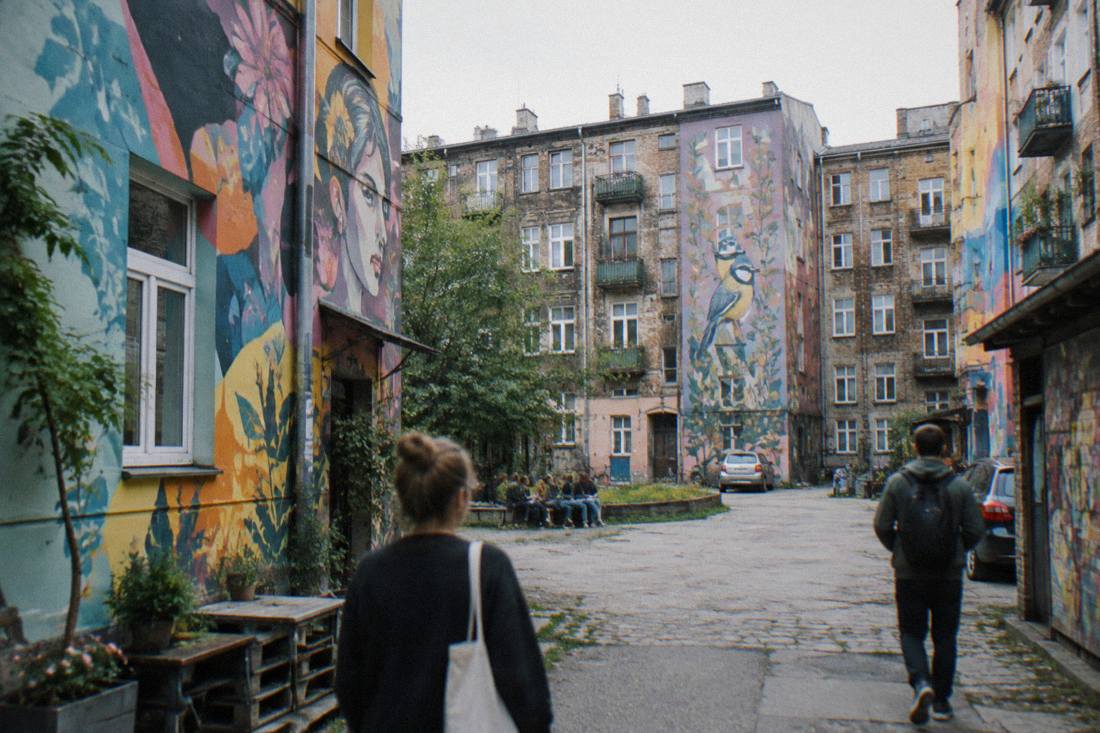
The Nadodrze guide on this site covers the street-art locations courtyard by courtyard. For a sense of the student city at its loudest, the nightlife district around Slodowa Island is the classic gathering point in warm months, with crowds on the embankments until late; the Slodowa Island guide covers it. The Wroclaw safety guide addresses the sensible precautions, and the honest summary is that the central student districts are busy and well-trafficked rather than risky.
A visitor note on pop culture: the city's stretch of the Odra has drawn film attention in recent years, and the site's piece on whether Netflix's High Water is based on a true story covers the real events behind the drama without spoiling them. For the students who fill the quarter now, the same embankments are simply the best free seating in the city on a warm evening, which is its own measure of how the center reads today.
When Is The Best Time To Visit Wroclaw's University District?
The best months for a student-flavored visit to Wroclaw are May through September, when the IMGW 1991-2020 climate normals show means of 14.3C in May rising to 19.7C in July and back to 14.5C in September, the riverside islands are in full use, and term is in session, though July means the heaviest rainfall of the year at 91.4 mm and some students have left for the summer.
The climate data comes from IMGW's official 1991-2020 normals for the Wroclaw station. The table below is the full monthly picture.
| Month | Mean temperature (C) | Precipitation (mm) |
|---|---|---|
| Jan | 0.0 | 28.3 |
| Feb | 1.1 | 25.6 |
| Mar | 4.3 | 35.0 |
| Apr | 9.7 | 31.2 |
| May | 14.3 | 59.6 |
| Jun | 17.7 | 65.4 |
| Jul | 19.7 | 91.4 |
| Aug | 19.3 | 59.5 |
| Sep | 14.5 | 48.4 |
| Oct | 9.6 | 37.6 |
| Nov | 4.8 | 31.4 |
| Dec | 1.1 | 27.9 |
Two honest readings of that data. July is the warmest month and also the wettest by a wide margin, so summer visitors should plan at least one indoor fallback; the rainy day guide exists for exactly this. And December, despite the modest 27.9 mm rainfall total, is a dark, cold month (1.1C mean) redeemed mainly by the Christmas market, which the Christmas market guide covers, and which is also when the student city is thinnest, since most students go home for the holidays.
The best time to visit guide and the month-by-month weather guide go deeper, and the events calendar lists the festivals that reshape the city, including the New Horizons film festival, which fills the city with film audiences each summer.
What Free Walking Tours Show You Wroclaw's Campus And Old Town?
Wroclaw has four verified free, tip-based walking tours on the GuruWalk platform, covering the Old Town and Cathedral Island from historical, legendary and general-audience angles, each lasting from just under two hours to up to four, and all led by local guides whose walks are free upfront with tips at the end, which is the standard student-budget way to see the quarter.
GuruWalk is named here because these are the platform's walks, not this site's products, and honesty requires saying so. The four verified live options are Tour in Wroclaw Given by a Historian, Legends of Wroclaw: Free Tour Around Ostrow Tumski and Market Square, Wroclaw Through Ages: Old Town and Cathedral Island Walking Tour, and Old Town Wroclaw by Walkative. The Walkative Old Town walk is the longest-running of the group and carries over a thousand reviews on the platform, and the Wroclaw Through Ages walk runs up to four hours, the longest of the four.
| Free GuruWalk walk in Wroclaw | Route focus | Stated length |
|---|---|---|
| Tour in Wroclaw Given by a Historian | City overview with a historian guide | 2.5 hours |
| Legends of Wroclaw Free Tour | Ostrow Tumski and Market Square, legends | 1 hour 45 minutes |
| Wroclaw Through Ages | Old Town and Cathedral Island, history | up to 4 hours |
| Old Town Wroclaw by Walkative | Old Town core, general walk | 2.5 hours |
As an example of the real listings, the Legends of Wroclaw free tour around Ostrow Tumski and the Market Square can be booked at See This Free Tour On GuruWalk. These walks are free to join and tipping is at your discretion at the end, which is why this site never prints a price for them.
The best walking tours guide compares the free and paid options, and the self-guided walking route exists for visitors who would rather not join a group at all. For students and visitors alike, the free walks are also a social shortcut: they end where the guides suggest a drink, and that suggestion is usually correct.
How Much Does A Student-Style Trip To Wroclaw Actually Cost?
A student-style Wroclaw trip is built on the figures in this guide: a 4.60 zl tram hop, 20 zl National Museum entry or free on Saturdays, a 50 zl Panorama ticket that doubles as a three-month museum pass, and free tip-based walking tours, with the site's full trip-cost guide as the honest calculator.
The Wroclaw trip cost guide is the site's dedicated calculator, and it follows the same rule: no invented bands, no guessed averages. What can be stated here with sources is the attraction layer, assembled from the figures.
| Attraction or transport | Adult price | Notes |
|---|---|---|
| National Museum permanent exhibitions | 20 zl | free every Saturday |
| Panorama Raclawicka | 50 zl | covers 3 more museums within 3 months |
| Wroclaw Zoo (online) | from 69 zl | at the gate 99 zl, Afrykarium included |
| Wroclaw Zoo (reduced, online) | from 59 zl | at the gate 89 zl |
| MPK 15-minute ticket | 4.60 zl | reduced 2.30 zl |
| Free GuruWalk tours | free, tip-based | four verified walks |
The zoo figures come from the zoo's own price table, which also confirms that the Afrykarium, the zoo's oceanic pavilion, is included in the standard ticket rather than a separate charge, a detail many visitors get wrong. The zoo and Afrykarium guide covers planning a visit.
For a longer stay that mixes the city with the region, the Jewels of Lower Silesia day tour pairs the university city with the castles and churches beyond it:
What Should Student-Age Visitors Know Before Arriving In Wroclaw?
Arriving visitors should know that Wroclaw's airport is open and served 4,473,945 passengers in 2024, its latest full-year official figure, that Poland uses the zloty rather than the euro, that the city center is walkable and safe by normal big-city standards, and that practical arrival details, from Sunday shopping closures to step-free routes, are covered in this site's dedicated guides.
The airport figure comes from the airport's own 2024 announcement. Wroclaw's airport was never permanently closed; a temporary full closure for renovation ran from late October to early December 2025 and finished ahead of schedule, and the airport guide covers current arrivals and transfers. Poland is in the EU and Schengen, but the currency is the zloty, so visitors arriving from eurozone cities still need to change money.
Three practical guides fill the remaining gaps. The Sunday shopping guide explains Poland's trading-Sunday restrictions, which genuinely matter to a student-budget traveler counting on supermarket dinners. The accessibility guide covers step-free routes through the Old Town and university quarter. And for stays longer than a weekend, the parks and suburbs guide covers the green spaces where students escape exam season, from the Botanical Garden's Japanese Garden to the further reaches of the botanical garden itself.
If the schedule only has room for one paid experience, the Hidden Gems walk is the one this site pairs with this guide: it covers the same courtyards and corners this article describes, and a local guide is the fastest way to tell the student city from the tourist one.
Common Questions About Studying In Wroclaw
Is Wroclaw A Good City For International Students And Visitors?
By every measure a visitor can see, yes. The city of 672,601 people has a large student population, a walkable historic center where the university's main buildings sit beside the Old Town, cheap milk bars and transit (a 15-minute MPK ticket is 4.60 zl), free Saturday entry at the National Museum, and four verified free GuruWalk tours. The city was also a European Capital of Culture in 2016.
Can You Visit The University of Wroclaw Buildings As A Tourist?
Yes, the ceremonial hall is one of the city's headline sights and has its own visitor entry; this site's guide to the Aula Leopoldina covers tickets and opening hours. The surrounding university quarter, including the courtyards and Cathedral Island, is fully walkable and free to explore from the outside.
How Much Does It Cost To Visit Wroclaw's Museums?
From the institutions' own pages: the National Museum is 20 zl adult, 15 zl reduced, free every Saturday, with a 1 zl under-26 option. The Panorama Raclawicka is 50 zl adult, 35 zl reduced, and the same ticket covers the National Museum's permanent exhibitions, the Ethnographic Museum and the Four Domes Pavilion within three months. The zoo is from 69 zl online, 99 zl at the gate, Afrykarium included.
Is Wroclaw Expensive Compared To Other Polish Student Cities?
The figures suggest it is manageable on a student budget: a 4.60 zl tram hop, 20 zl museum entry with a free day each week, milk-bar lunches that cost less than a museum ticket, and free tip-based GuruWalk walking tours. This site does not publish invented price bands, so the trip-cost guide sticks to figures the official sources actually state.
When Should You Visit Wroclaw To See Student Life At Its Best?
May to June and September to October, when term is in session and the IMGW 1991-2020 normals show means of 14.3C in May and 14.5C in September. July and August are the warmest months (19.7C and 19.3C) but much of the student population leaves for summer, and July is also the wettest month at 91.4 mm.
Do You Need To Speak Polish To Enjoy Wroclaw's University Quarter?
No. The city's student population is heavily international, museum signage and tour offerings include English, and all four verified free GuruWalk walks operate in English-friendly formats. A few phrases help at milk bars, and the site's Polish phrases guide covers the useful ones, but the central quarter works fine in English.
A student's Wroclaw and a visitor's Wroclaw turn out to be the same city seen at two budgets, and the honest figures here, 4.60 zl tram rides, 20 zl museum Saturdays, free walks on GuruWalk, let you pick whichever budget suits the day without guessing at a single number. Wroclaw Travel Guide keeps every figure on this page tied to the official source that published it.