Wroclaw In Winter
Winter strips the crowds out of Wroclaw's Rynek, drops real admission prices on the table, and turns a walk across Ostrow Tumski into something quietly cinematic. Here is how to plan the cold months in Wroclaw.
Short answer
Wroclaw in winter runs on averages of 0.0C in January and 1.1C in December and February (IMGW 1991-2020 normals), so pack for near-freezing days rather than deep cold. The Market Square, the dwarfs, Panorama Raclawicka, the National Museum and the zoo's Afrykarium all stay open, and the Christmas market anchors December.
Wroclaw, the largest city in Lower Silesia (Dolnoslaskie voivodeship) in southwestern Poland, is a city of 672,601 people (GUS, 31 December 2025) built across the islands of the Odra river. Winter changes its rhythm rather than closing it down: the Rynek empties of tour groups, the panorama painting and museums run their low-season hours, and the Christmas market fills December with the smell of grilled sausage and mulled wine. This guide lays out what the season actually looks like here, what stays open, what it costs, and which day trips still work when the temperature sits around zero. Every temperature below comes from IMGW's 1991-2020 climate normals for the Wroclaw station, and every admission price from the venue's own published tariff.
Is Wroclaw Worth Visiting In Winter?
Yes, and for reasons that are specific to the season: shorter queues at Panorama Raclawicka and the National Museum, zoo admission that includes the indoor Afrykarium, a Christmas market in December, and a white-dusted Rynek that photographs better with fewer people in it. The trade-off is real, though. Days are short, the wind off the Odra can be biting, and Krakow, not Wroclaw, is Poland's larger tourist magnet, so winter is when this city feels most like a place lived in rather than performed for visitors. If you want warmth, come in summer. If you want the city to yourself with its prices and hours intact, winter delivers.
The honest framing is this: Wroclaw's winter appeal rests on indoor density. Within a short walk of the Rynek you have the National Museum, the Panorama Raclawicka rotunda, the Old Town's dwarf sculptures, and enough cafes to thaw in every few hundred meters. Farther out, the zoo's Afrykarium is a large heated aquarium complex included in the standard zoo ticket, which makes it one of the best cold-day family options in the city.
What winter does not deliver here is alpine scenery. Wroclaw sits on a river plain. For snow-covered mountains you head to the Giant Mountains (Karkonosze) as a day trip, covered below. For the city itself, the season is about atmosphere and low-season logistics, not landscape.
For how a fuller stay can be structured once the days warm up, see three days in Wroclaw, and for a shorter cold-weather version of this plan, one day in Wroclaw still works in winter with indoor substitutions.
How Cold Does Wroclaw Get In Winter?
IMGW's 1991-2020 climate normals for the Wroclaw station put January at a mean of 0.0C, February at 1.1C, December at 1.1C and November at 4.8C, with an annual mean of 9.7C across the whole year. Those are averages, not guarantees: a January afternoon can sit above freezing under grey cloud, and a clear night can drop well below. What the normals do establish is that Wroclaw's winter is among the mildest of Poland's major synoptic stations, so the planning baseline is "near freezing, damp, occasionally snowy," not "Siberian."
| Month | Mean temperature | What it means for planning |
|---|---|---|
| November | 4.8C | Coats, not thermal layers; most cafe terraces close |
| December | 1.1C | Real winter wear; Christmas market evenings feel cold |
| January | 0.0C | Full winter kit; icy bridges and pavements possible |
| February | 1.1C | Similar to January; days lengthen noticeably |
Two practical notes follow from this. First, the Odra's bridges and the cobblestones of the Old Town can be slippery after freezing rain, so footwear with real tread matters more than it does in summer. Second, precipitation in this city is not dramatic: the IMGW normals table this site carries shows July as the wettest month at 91.4 mm, with winter months well below that, so a winter visit is more likely grey and dry than grey and drenched.
Sunrise-to-sunset planning matters too. Short December days mean you should front-load outdoor sightseeing (the Rynek, Ostrow Tumski, the dwarf hunt) before mid-afternoon and keep museums, the zoo's indoor pavilions, and restaurants for the dark hours. The month-by-month weather guide carries the full normals table for the rest of the year.
There is no single best winter month here. December trades the coldest statistics for the Christmas market. January and February give you the emptiest streets and the lowest prices, at the cost of short days. Pick according to which of those you value more.
What Are The Best Things To Do In Wroclaw In Winter?
The winter core of Wroclaw is the Market Square and its dwarfs, Ostrow Tumski's cathedral island, the Panorama Raclawicka painting, the National Museum, and the zoo with its included Afrykarium aquarium, all of which run through the cold months on published low-season hours. Add Slodowa Island for a bleak-but-beautiful river walk, and the whole list stays within the city's compact center. Snow rarely closes anything here; it just changes what you photograph.
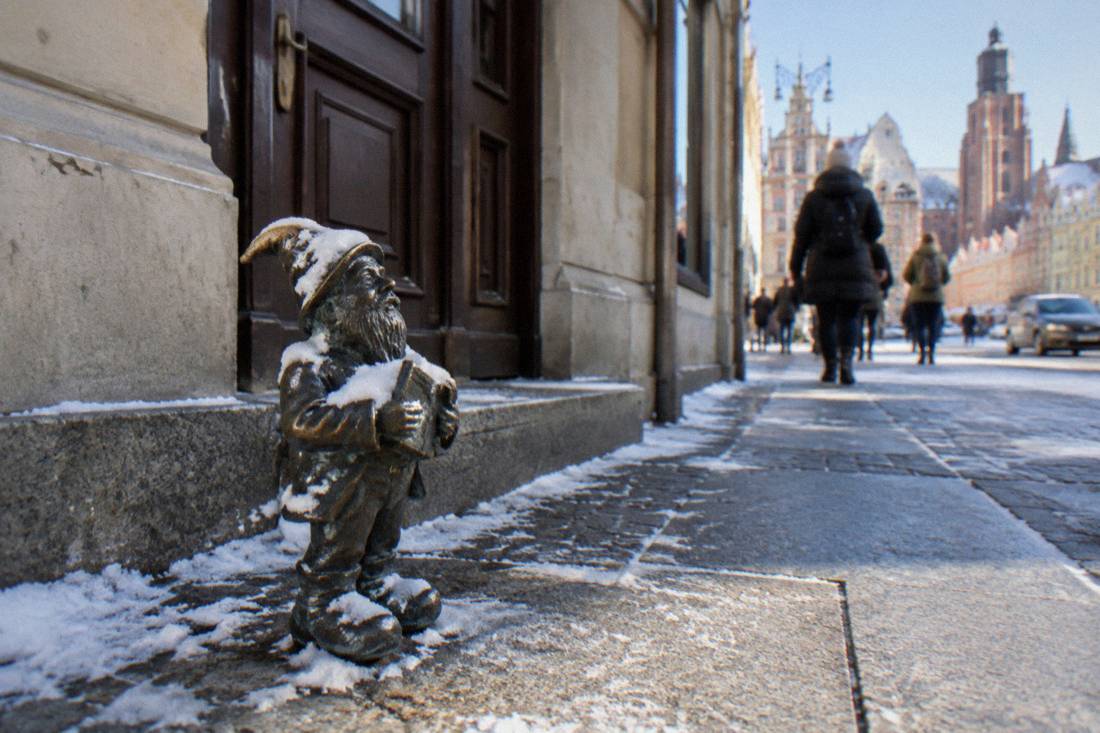
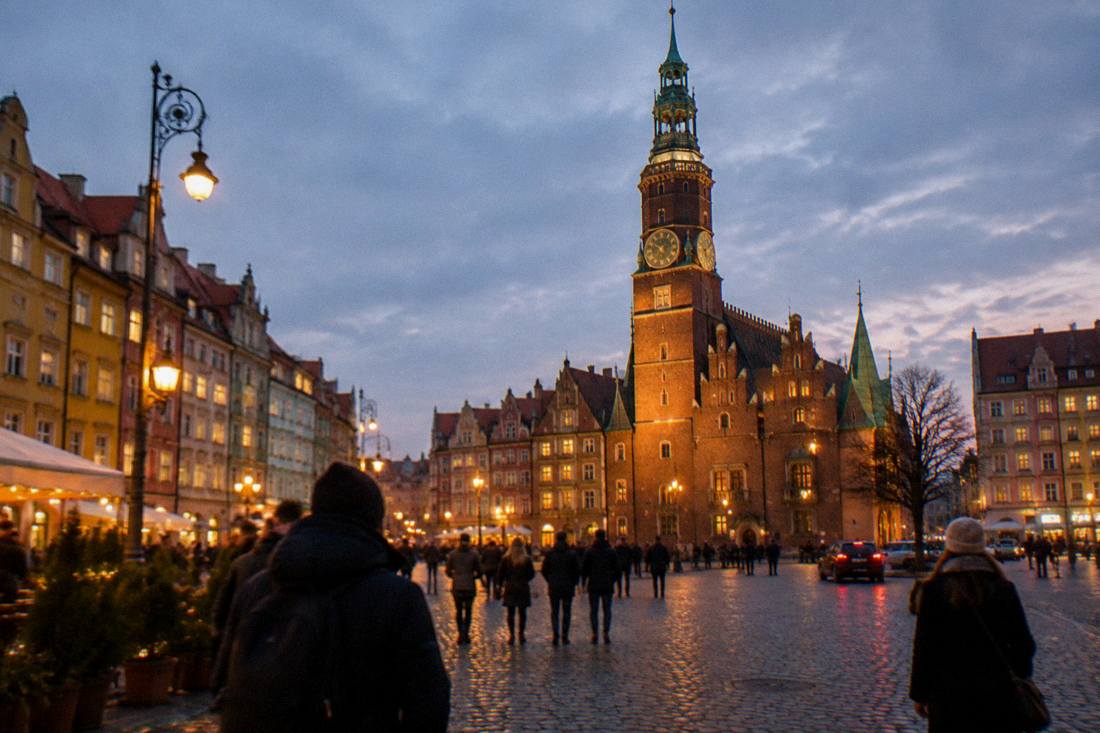
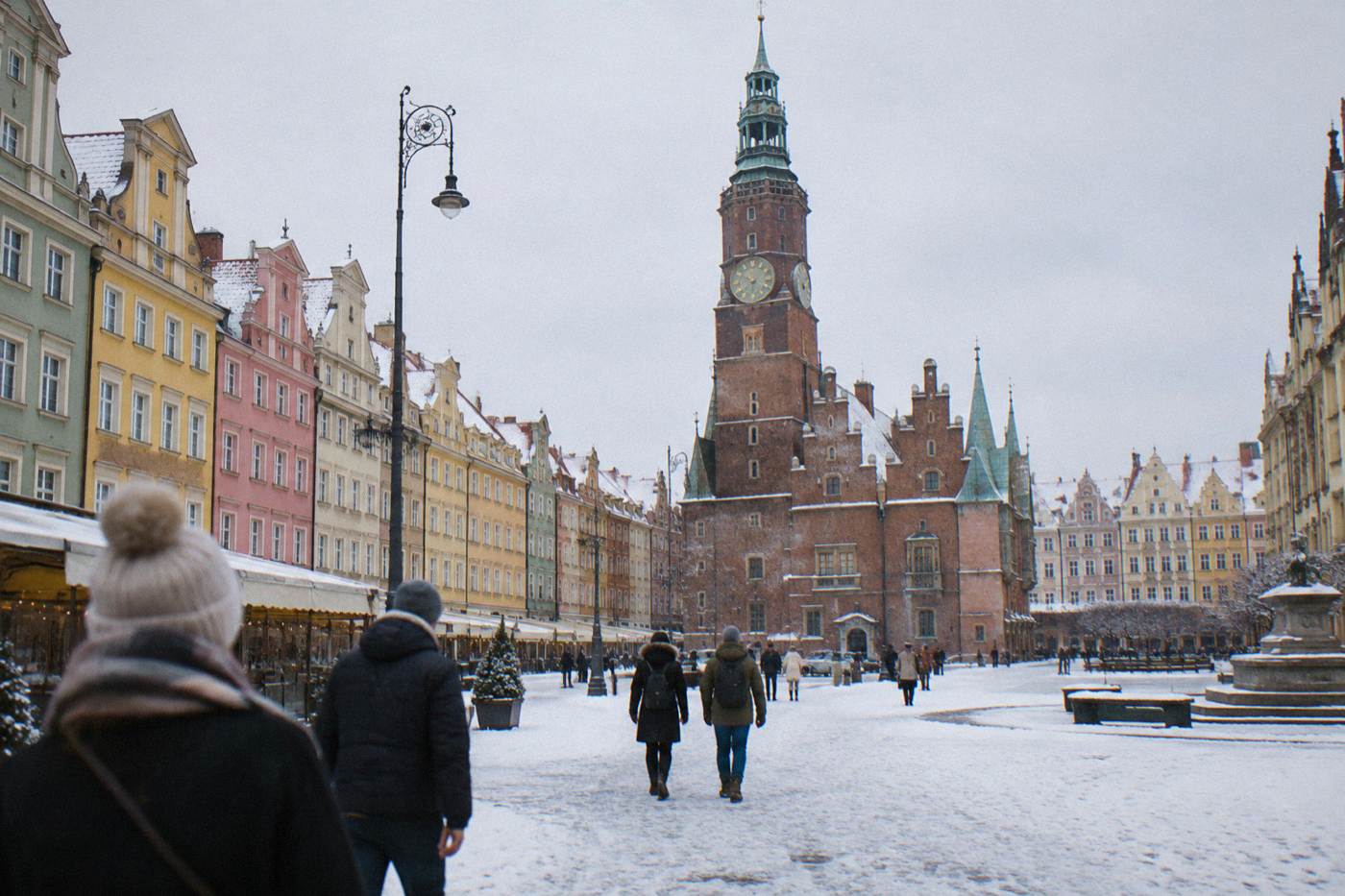
Start with the Wroclaw Market Square. The Rynek is the city's living room, ringed by merchant houses, and in winter its emptiness is the point: you can shoot the Old Town Hall's facade without twenty strangers in the frame. The square's eastern side opens onto streets where the hunt for the bronze dwarfs begins. Several hundred of the little statues hide around the city center, and looking for them is an outdoor activity that naturally segments into warm-up cafe stops. It is the single best winter activity for children here, and it costs nothing.
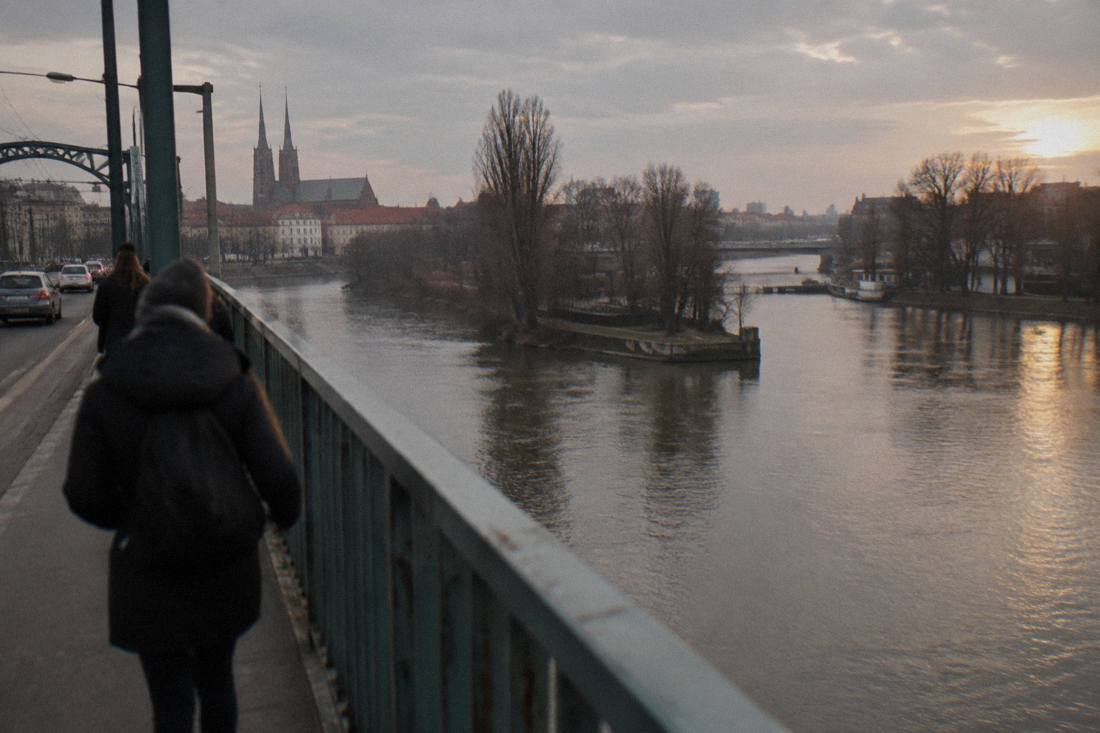
Ostrow Tumski, the cathedral island, is the second essential. Its cobbled lanes and riverside edges are at their most atmospheric under a low winter sky, and its churches are open, heated interiors. Cross onto the island late afternoon, when the streetlamps come on and the light goes blue, and you get the city's most photogenic fifteen minutes of a winter day.
For a structured version of this circuit in the cold, a guided walk keeps the pace up and the commentary coming, which matters when standing still is the enemy. The Old Town Wroclaw Walking Tour is the small-group option, and Check availability for the private Jewish heritage walk if you want the quarter's history rather than its facades.
The private option suits a colder day well for one simple reason: a private guide adjusts the route, so a half-hour indoors at the Jewish Cemetery or a longer stop somewhere heated replaces a fixed schedule that would have you shivering on a corner waiting for a group to regroup. Bring the questions you actually want answered, because on a private walk you set the depth.
A Three-Day Winter Itinerary For Wroclaw
| Day | Morning | Afternoon | Evening |
|---|---|---|---|
| 1 | Market Square and Old Town Hall exterior | Dwarf hunt through the Old Town | Dinner in the Old Town area |
| 2 | Panorama Raclawicka screening | National Museum permanent exhibitions | Mulled wine at the Christmas market (December) |
| 3 | Ostrow Tumski and the cathedral | Zoo and Afrykarium, or a cafe crawl | Riverside walk and dinner |
This pacing assumes winter daylight, roughly 8:00 to 16:00 in December, and front-loads everything outdoor. If snow is falling, swap day two's museum block with day one's square time and let the flakes improve your photographs.
What Are The Best Indoor Activities In Wroclaw In Winter?
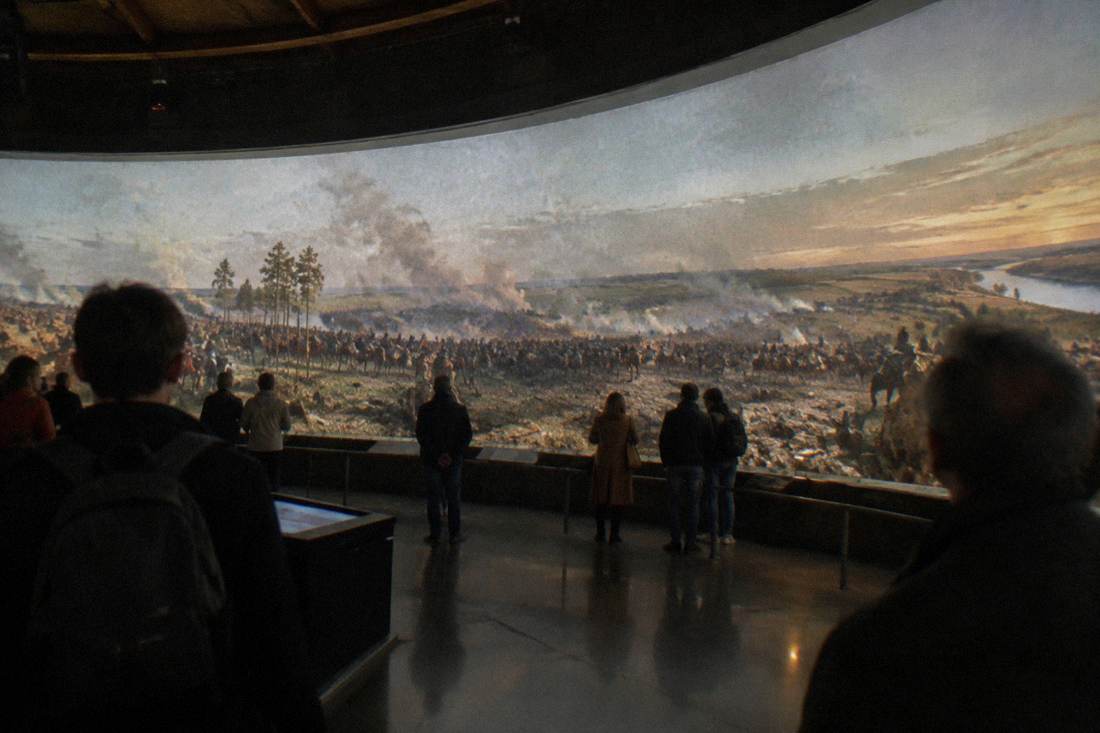
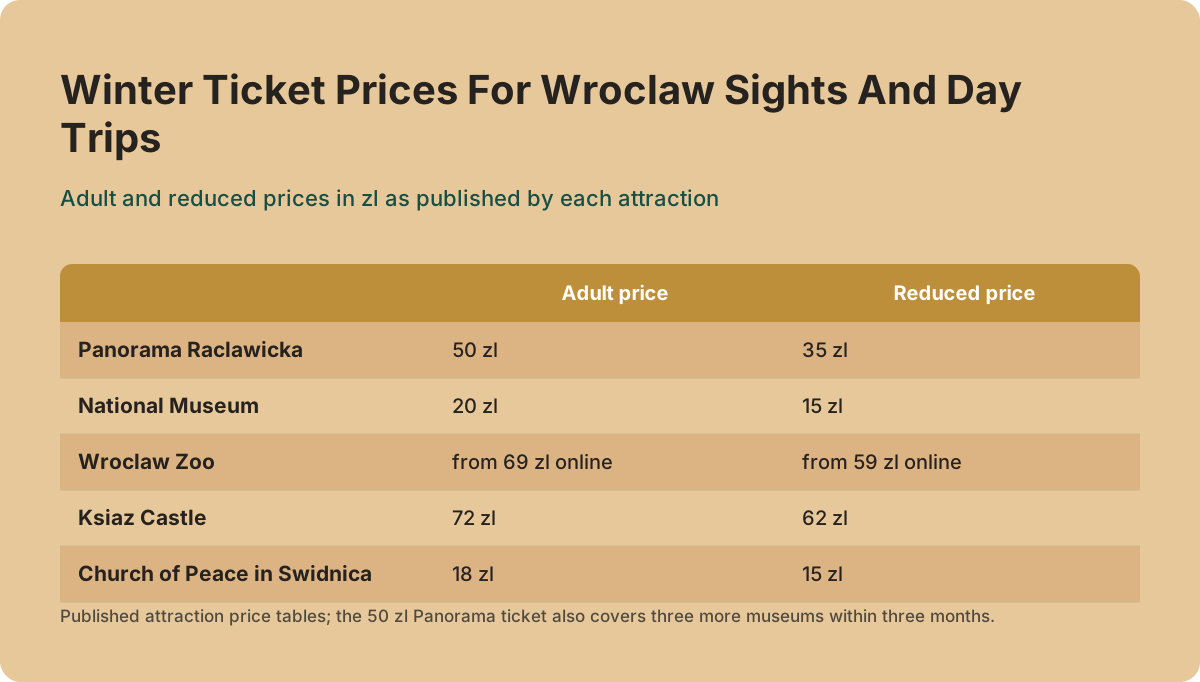
The indoor anchors are the Panorama Raclawicka (adult 50 zl, reduced 35 zl, a 30-minute screening), the National Museum (adult 20 zl, reduced 15 zl, free every Saturday), and the Afrykarium at Wroclaw Zoo (included in the standard zoo ticket, which runs from 69 zl online against 99 zl at the gate for an adult). All three are large, heated, and close enough to one another to chain into a single cold day. Their winter hours matter more than their prices, so check the table below before you build your day.
| Attraction | Adult price | Reduced | Winter hours (verified) |
|---|---|---|---|
| Panorama Raclawicka | 50 zl | 35 zl | Closed Mondays; Tue-Fri 9:30-16:00, Sat 9:30-17:00, Sun 9:30-16:00 (Nov-Mar) |
| National Museum | 20 zl | 15 zl | Closed Mondays; Tue-Fri 10:00-16:00, Sat-Sun 10:00-17:00 (Oct-Mar); free Saturdays |
| Wroclaw Zoo | from 69 zl online | from 59 zl online | Grounds open daily 9:00-16:00 (Nov-Dec); Dec 24 and 31 shortened to 9:00-14:00 |
The Panorama's own practical-information page carries a detail most first-time visitors miss: the 50 zl ticket also covers the National Museum's permanent exhibitions, the Ethnographic Museum and the Four Domes Pavilion within three months of the visit date. That converts a single rotunda visit into a multi-museum pass, and in winter, when you want a reason to stay indoors, it is the best-value ticket in the city. Book the panorama early in your trip and use the museum access later. Everything else covered here is indexed on Wroclaw Travel Guide.
The zoo deserves a specific winter note. Its own price table states the standard ticket includes the Afrykarium, and its published November-December hours run 9:00-16:00 daily, with 24 and 31 December shortened to 9:00-14:00. In cold months many visitors come specifically for the Afrykarium's heated halls and treat the outdoor animals as a bonus. Buy online: the zoo's own price table shows a 30 zl gap between the online and gate adult price.
Beyond these, the Centennial Hall (UNESCO-inscribed since 2006, architect Max Berg, built 1911-1913, capacity up to 10,000) anchors a winter afternoon on its own when an event fills it, and the Four Domes Pavilion of contemporary art rides on the panorama ticket. The Jewish Cemetery on ulica Slezna is an open-air option that suits a cold, clear day, and the Jewish heritage guided tour is the way to see it with its history explained rather than guessed at.
For the full cold-and-wet contingency list, the rainy day Wroclaw guide covers the same indoor core with more depth on each venue.
Is Wroclaw's Christmas Market Worth The Trip?
Yes, if you time December right: Wroclaw's Christmas market fills the Market Square with wooden stalls, mulled wine and grilled food, and it is the single best reason to choose December over January or February for a winter visit to this city. The market turns the Rynek into the city's heated outdoor living room, and it sits directly on top of everything else in this itinerary, so nothing needs rearranging to include it. The city's Christmas itinerary carries the details of stalls, opening rhythm and what to eat.
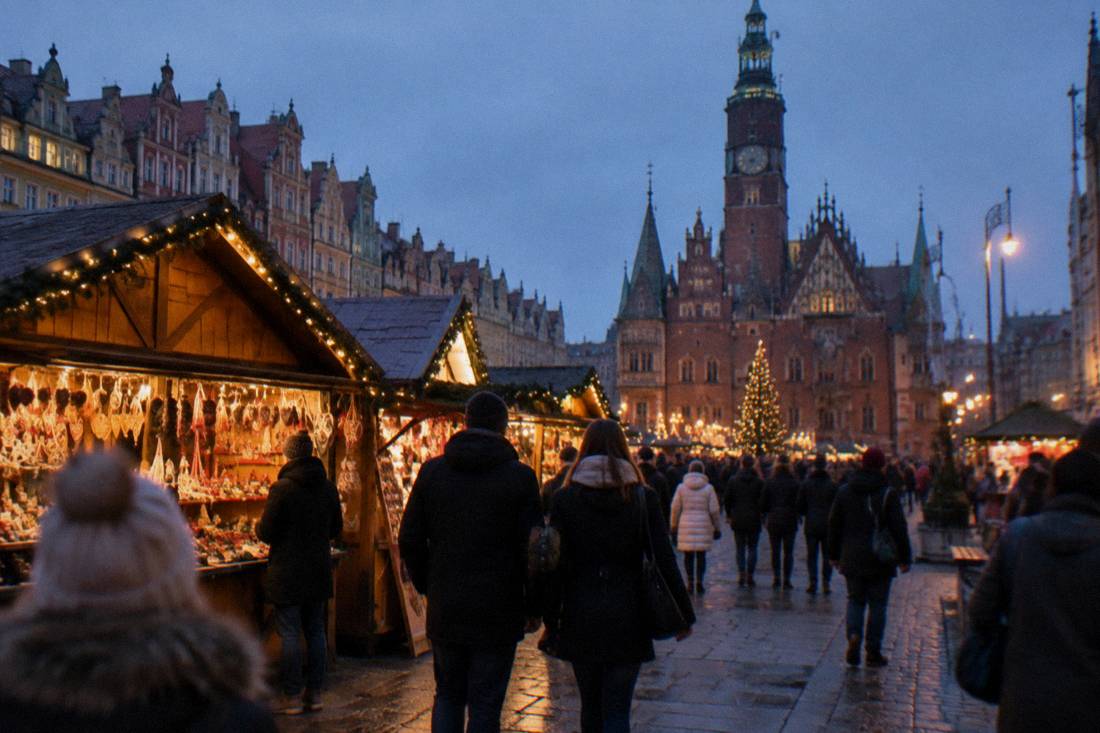
The market pairs naturally with the Christmas itinerary and the weekend itinerary, which is the shape most December visitors end up with: two days of square, dwarfs, Ostrow Tumski and one museum, anchored on the market each evening. Budget in zloty, not euros: Poland keeps the zloty (PLN) even inside the EU and Schengen, and market stalls are cash-and-card like everywhere else in the city.
One honest caveat. If your December trip hinges entirely on the market being open on a specific day, confirm that day against the city's own event calendar before booking flights, because the market's annual dates can change from year to year, and a stall layout or opening day is not something to guess at. The Christmas market guide keeps the sourced detail.
For the rest of winter, Wroclaw's calendar runs on indoor culture rather than outdoor festivals, and the events calendar is where to check what fills the National Forum of Music and the opera house in a given week.
Which Winter Day Trips Work From Wroclaw?
The winter day trips that genuinely work from Wroclaw are Ksiaz Castle (open year-round, castle with audioguide and terraces at 72 zl adult, 62 zl reduced, though the terraces themselves only open 15 April to 30 September), the Church of Peace in Swidnica (adult 18 zl, reduced 15 zl), the Giant Mountains for snow, and, for a long day, Prague. Each one is a different animal: a heated castle interior, a UNESCO timber church, real mountains, or a full other country. Choose one per day; none of them rewards rushing.
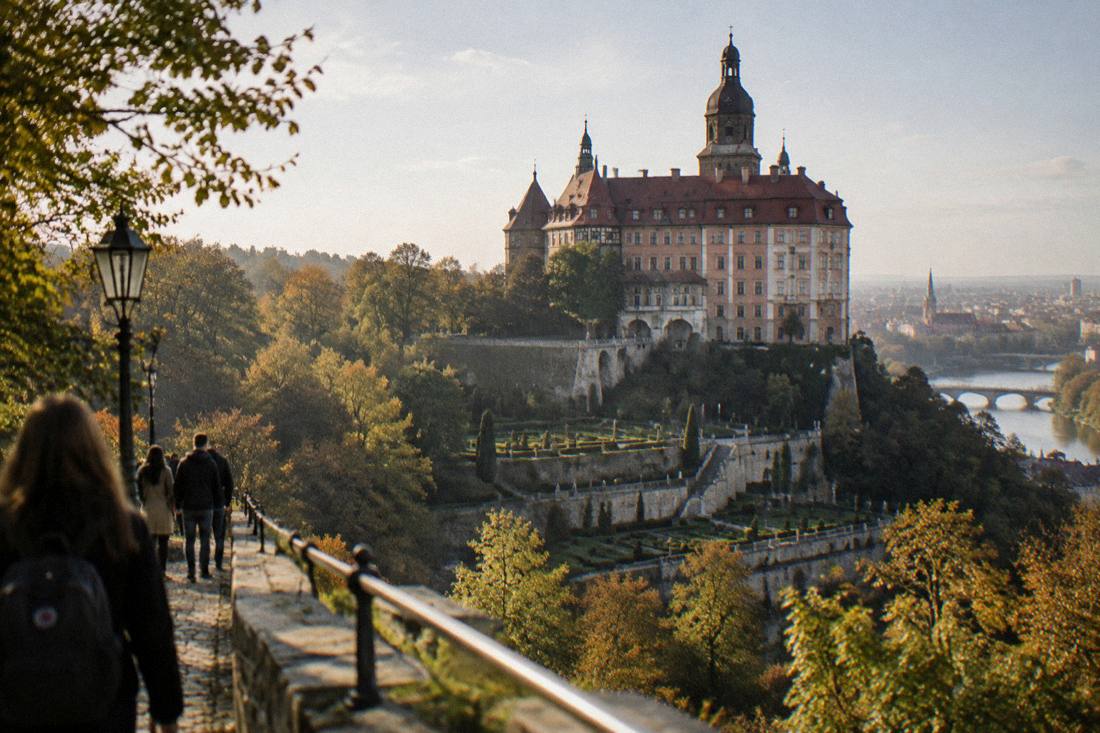
Ksiaz Castle is the headline. The municipal operator's tariff, effective 6 May 2026, prices the castle with audioguide and terraces at 72.00/62.00 zl, the version adding the underground tour at 92.00/82.00 zl, and the All Day Ticket covering castle, underground, Palm House, stud farm and mausoleum at 104.00/94.00 zl. Winter hours run Mon-Fri 9:00-18:00 and Sat-Sun 9:00-19:00. In the cold months you do the interiors, and the underground route, rather than the terraces, which the castle's own tariff page restricts to 15 April-30 September. Access is commonly by regional train to Walbrzych plus a bus or taxi connection.
| Day trip | Key verified figure | Winter note |
|---|---|---|
| Ksiaz Castle | Castle + audioguide + terraces 72/62 zl | Terraces closed 1 Oct - 14 Apr; interiors open |
| Church of Peace, Swidnica | Adult 18 zl, reduced 15 zl, family 45 zl | UNESCO-listed 2001, timber interior, fully enclosed |
| Giant Mountains (Karkonosze) | Covered in the Karpacz guide | Poland's winter snow destination |
| Prague | Reached by long-distance coach or train | A 12-13 hour round trip at touring pace |
The Church of Peace in Swidnica, a UNESCO World Heritage site since 2001 under the "Churches of Peace in Jawor and Swidnica" listing, is arguably the best pure winter day trip of the set: it is a single, enormous timber-framed church interior, and its whole value is indoors. Its own visiting page prices adults at 18 zl, students and seniors at 15 zl, children and youth at 10 zl, and a family ticket at 45 zl.
Combined Ksiaz-plus-Swidnica tours are the efficient version of that pairing, covering both sites in one cold-day package with the driving done for you. That matters more in winter than in any other season: the connection between the castle and the church is the part of the day you least want to solve on icy pavements with a stroller or a tired child in tow.
For snow specifically, the Giant Mountains and Karpacz guide covers Poland's proper winter mountain area. And if the mountains are the main point of your trip rather than a side trip, read summer in Wroclaw for the season when the trails and the city both peak.
How Do You Get Around Wroclaw In Winter?
Wroclaw's trams and buses run all winter on the MPK network, with a 15-minute ticket at 4.60 zl normal (2.30 zl reduced), a 30-minute ticket at 7.00/3.50 zl, and 24-hour and multi-day bands above that, so a walkable center plus a couple of tram hops covers a normal winter visit. The city's official fare page lists the tiers by duration, not as one flat fare, and the 4.60 zl figure is the base short-hop price to keep in mind for one-off journeys.
| MPK ticket | Normal | Reduced | Best used for |
|---|---|---|---|
| 15-minute | 4.60 zl | 2.30 zl | A single tram hop to the zoo or the university |
| 30-minute | 7.00 zl | 3.50 zl | A cross-city ride with a transfer |
| 24-hour | approx. 15.00 zl | approx. 7.50 zl | A packed day of hopping between districts |
Winter ridership is where this matters. When the pavement is glazed, the tram is not just cheaper than a taxi, it is safer, and the main sights are strung along tram lines that run from the main station past the Rynek toward the zoo and Szczytnicki Park. There is no all-inclusive Go City-style tourist pass sold for Wroclaw, so do not build a plan around one; the city's own transport guidance centers on standard tickets and resident fare cards, and this site's city pass explainer covers what does and does not exist.
Flying in? Wroclaw Airport handled 4,473,945 passengers in 2024, and after a completed 2025 renovation closure it is operating normally, with records set in 2026. The airport guide covers the transfer options into the center. One planning note: no stable public rail time or fare could be confirmed for Wroclaw-Warsaw or Wroclaw-Krakow journeys, so check any intercity train plan live on the operator's own booking site rather than trusting a round number quoted anywhere else.
What Should You Pack For Wroclaw In Winter?
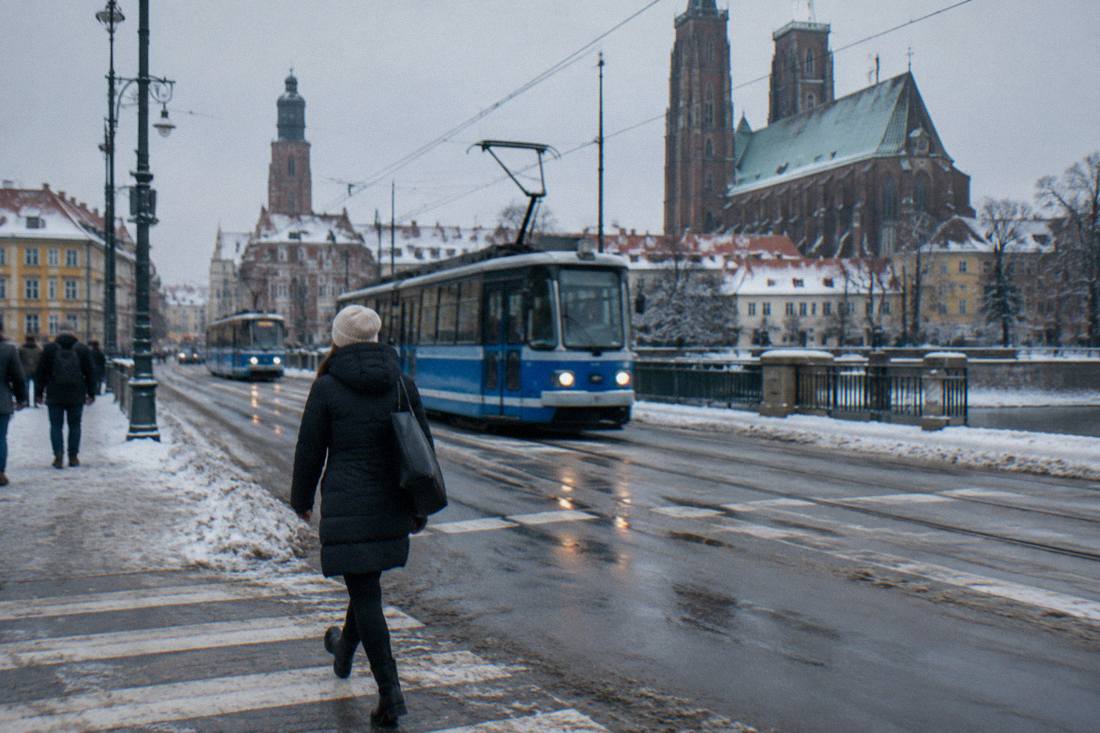
Pack for a mean of 0.0C to 4.8C with wind off the Odra: a real insulated coat, waterproof footwear with tread for icy cobbles, gloves and a hat, and layers you can shed inside heated museums and put back on within minutes of stepping back outside. The IMGW normals say the cold here is moderate for Poland, but the daily reality includes damp air and standing-still time in squares, which is what actually chills you. The safety guide covers icy-pavement and general city practicalities.
| Item | Why it earns its place here |
|---|---|
| Insulated, windproof coat | River wind amplifies a 0.0C January mean |
| Boots with real tread | Bridge decks and Old Town cobbles glaze after rain |
| Hat and gloves | Dwarf hunting and Ostrow Tumski mean long outdoor standing |
| Small daypack | Shed layers indoors; museums check larger bags |
| Cash card and some zloty | Poland uses PLN, not the euro, and small stalls prefer cash |
Electric comfort worth knowing: Polish cafes are generous with seating in winter, and the milk-bar tradition makes a hot, cheap lunch a five-minute detour from anywhere central. The milk bars guide and the best restaurants list carry the warm refuges for mid-thaw meals.
Common Questions About Wroclaw In Winter
Does it snow in Wroclaw in winter?
It can, but heavy sustained snow is not the norm. IMGW's 1991-2020 normals put January at a mean of 0.0C, December and February at 1.1C, cold enough for snow but often hovering near the freezing point where rain, sleet and snow alternate. Expect occasional white days, not a guaranteed snowpack in the city itself.
Is the Wroclaw Christmas market open in January?
No. The market is a December event centered on the Market Square. January and February instead give you empty streets, low-season hours at museums, and the quietest version of the city. If the market is the reason for your trip, come in December and confirm the year's exact dates against the city's event calendar.
Are Wroclaw's museums open in winter?
Yes, on reduced winter hours. The National Museum and Panorama Raclawicka both close Mondays in the cold season, and the zoo runs grounds from 9:00 to 16:00 in November and December. The full verified hours are in the table above.
Is Wroclaw cheaper in winter than in summer?
City costs such as museum admission do not change with the season: the National Museum's 20 zl adult ticket and the panorama's 50 zl are year-round prices. What changes is demand, and winter's low season is the time to find the softest hotel rates.
Is Ksiaz Castle open in winter?
Yes. The castle interiors, underground tour and Palm House run through winter, with Mon-Fri hours of 9:00-18:00 and Sat-Sun 9:00-19:00 in the tariff structure the operator publishes. The terraces are the exception: the castle's own tariff states they open only 15 April to 30 September, so a winter visit is interiors only.
What is the coldest month in Wroclaw?
January, with a 1991-2020 mean of 0.0C at the Wroclaw station, and that figure is among the mildest of Poland's major synoptic stations. December and February average 1.1C. For planning, treat all three as near-freezing months with damp wind.
Winter in Wroclaw is a low-season trade: you accept short grey days and near-freezing means, and you get the city's squares, museums and river islands without the crowds. Bring the right boots, buy the panorama ticket that doubles as a museum pass, keep one guided walk in the plan for the coldest afternoon, and the season stops being an obstacle and becomes the reason to come.