A Self-Guided Wroclaw Walking Tour Route
Wroclaw's compact historic core makes it one of Poland's best cities to explore on foot. This route strings the Market Square, the dwarfs, the cathedral island and the great museums into one walkable day.
Short answer
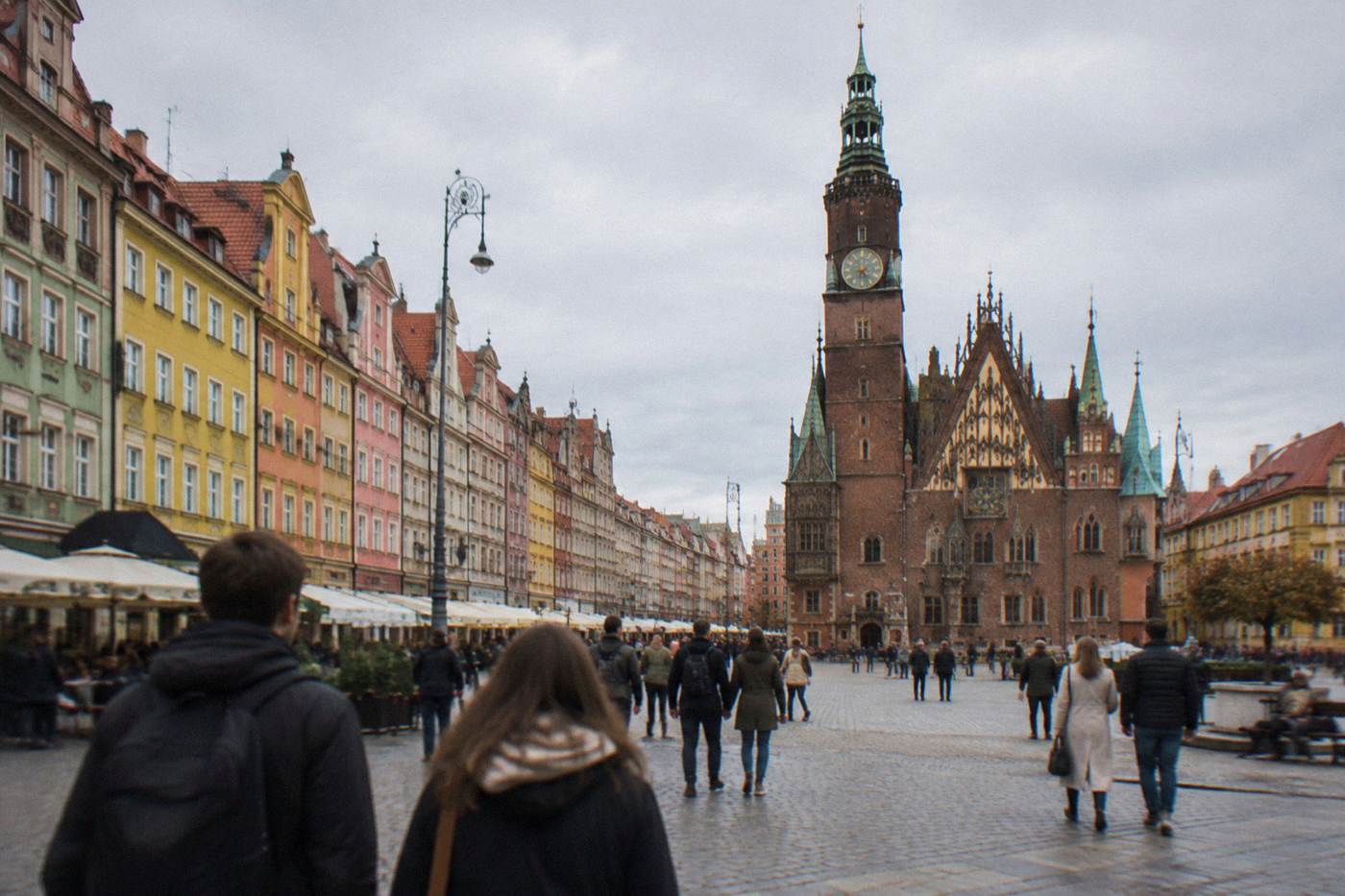
Start on the Market Square, hunt dwarfs through the Old Town lanes, cross to Ostrow Tumski and the cathedral, then loop back past the National Museum and the Panorama Raclawicka. The core route fits a single day, and every stop is reachable on foot or one short tram hop.
Wroclaw, the largest city in Lower Silesia in southwestern Poland, is built for walking. The historic center is compact, flat and stitched together by bridges over the Odra river, so a well-planned route can take in the Market Square, the cathedral island of Ostrow Tumski, the dwarf statues scattered through the lanes and two of the country's best museums without ever needing a car. This page lays out that route stop by stop, with verified admission prices, transit fares and climate data so you can plan the day properly.
Where Should A Self-Guided Wroclaw Walking Tour Route Begin And End?
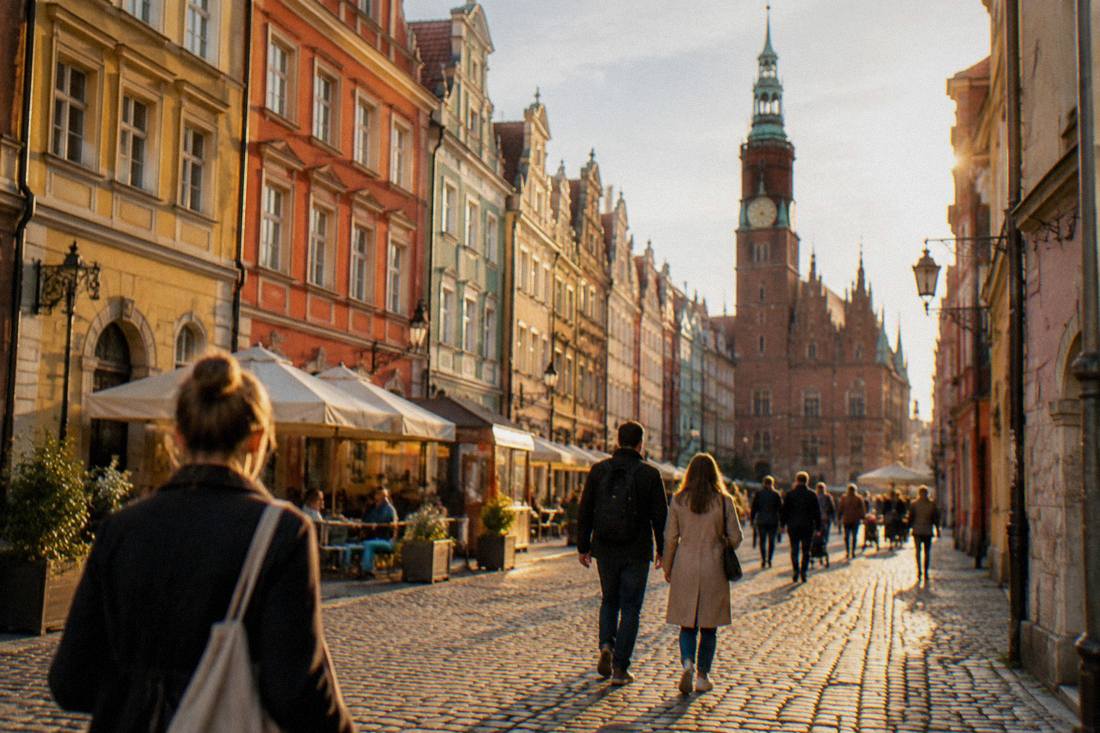
The best self-guided Wroclaw walking route begins on the Market Square (Rynek), works north through the Old Town lanes toward the Odra, crosses onto Ostrow Tumski for the cathedral, then returns south along the river past the National Museum and the Panorama Raclawicka, ending back at the square. The loop keeps almost everything on footpaths and public bridges, and it ends where it started, which matters for lunch, luggage and trams.
The Market Square is the natural anchor. It is one of the largest city squares in Poland, though Krakow's Rynek Glowny is larger, and nearly every tram line in the city stops within a short walk of it. Starting here means you can break the route at any point and rejoin it later. The Old Town area around the square holds most of the headline sights, so a loop from the square never leaves you stranded far from transport or food.
Ending back at the square also gives the route a natural evening. Wroclaw's Market Square itself fills with cafe tables in summer and a Christmas market in December, and the best-lit town hall facade comes alive after dark. Walkers who prefer a linear route can end on Ostrow Tumski instead, where the lamplighter still lights the historic gas lamps by hand each evening, one of the few cities in the world where this survives.
Here is the full route in table form, with what each stop is known for and what admission costs where a charge applies. Note that Centennial Hall sits farther east beyond the core loop and is listed here only as an optional extension.
| Stop | Known For | Admission |
|---|---|---|
| Market Square (Rynek) | Gothic town hall, burgher houses, central square of the Old Town | Free public space |
| Old Town lanes and dwarfs | Hundreds of small bronze dwarf statues hidden on streets and doorsteps | Free |
| Ostrow Tumski | Cathedral island, historic gas street lamps lit by hand | Free public space |
| National Museum in Wroclaw | One of Poland's major art museums, on the route back south | Adult 20 zl, reduced 15 zl |
| Panorama Raclawicka | Monumental circular panoramic painting in a purpose-built rotunda, 30-minute viewing | Adult 50 zl, reduced 35 zl |
| Centennial Hall (optional east extension) | UNESCO-listed 1911-1913 concrete hall by Max Berg, capacity up to 10,000 | Check current arrangements on site |
How Hard Is The Wroclaw Walking Route, And How Many Days Does It Need?
The core Wroclaw walking route is easy: the terrain is flat, the distances between the Market Square, the Old Town lanes and Ostrow Tumski are short, and the whole loop fits comfortably inside a single day at a relaxed pace. A second day lets you add the museums properly, and a third opens the east-bank extensions like Centennial Hall and the zoo. Nothing on the core route involves hills, stairs beyond bridge ramps, or any need for a vehicle.
That ease is the main reason this city rewards walkers. If you only have one day, follow the loop and pick one paid interior, either the Panorama Raclawicka or the National Museum, rather than rushing both. The one-day plan is laid out in detail on the one day in Wroclaw itinerary, and there are fuller two day options for slower trips.
Families and anyone with reduced mobility should note that the surfaces are mostly cobbles, which is harder work than it looks with a stroller or wheelchair. The city's accessibility profile is covered elsewhere on this site, but in route terms, the Market Square itself and the main riverside paths are the flattest, smoothest stretches, while the oldest Ostrow Tumski lanes are the most uneven.
If the self-guided plan appeals but you would rather have the route narrated, a guided walk over the same ground is worth comparing before you commit. The tours below cover the identical core territory, plus two day-trip options for after the walk is done.
What Will You See On Wroclaw Market Square?
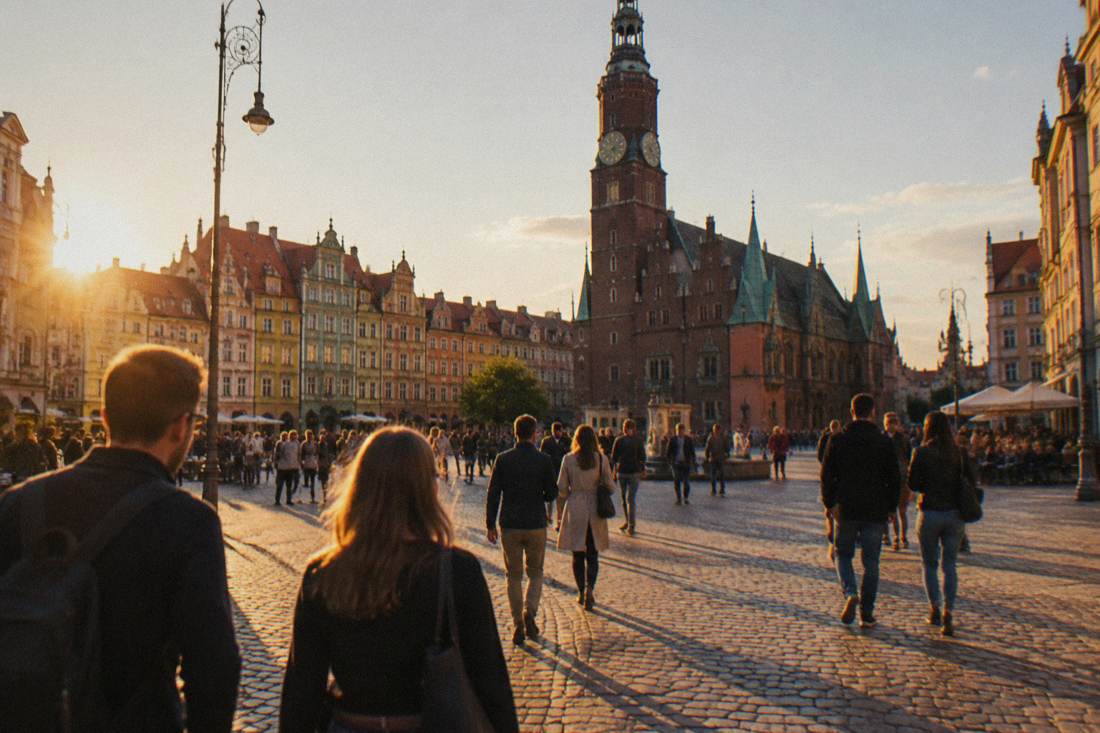
The Wroclaw Market Square delivers the Gothic town hall, one of the grandest civic buildings of its kind in Central Europe, rows of narrow colorful burgher houses, and street-level dwarf statues hiding in plain sight around the edges. The square is free public space, open around the clock, and it functions as the city's living room rather than a museum piece.
Spend time on the details. The town hall's facade is a catalog of late Gothic ornament, and the houses around the square each carry their own name and story, from the golden-hued facades on the north side to the plainer rebuilds that stand among them. The square is also where the city's dwarf hunt begins, because several of the most famous dwarfs sit within sight of the town hall doors.
Timing matters less here than anywhere else on the route: the square is worth seeing early, at midday and after dark, and most walkers pass through it several times naturally. For the best light and thinnest crowds, morning is the quiet window, before the cafe tables and tour groups fill the space.
Where Are Wroclaw's Famous Dwarfs Hiding On The Route?
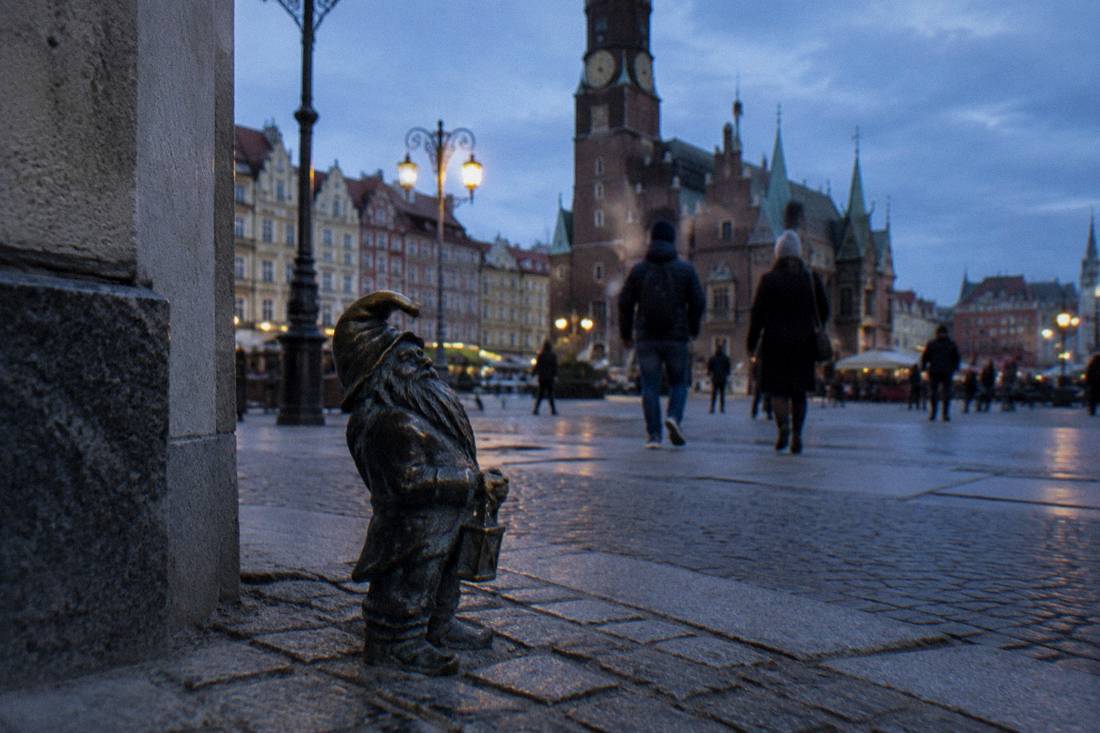
Wroclaw's dwarfs are small bronze statues, scattered by the hundreds across the city, and the densest cluster sits directly on this walking route: around the Market Square, along Swidnicka street, near the university and by the river bridges. They cost nothing to find, they are outdoors at all hours, and hunting them turns the walk between the headline sights into its own attraction rather than dead transit time.
The dwarfs began as an art-activist symbol tied to the anti-communist Orange Alternative movement and grew into a citywide collection, with new figures added by businesses, institutions and organizations over the years. No official total needs quoting here: the honest way to put it is that there are hundreds, and nobody finds them all in one visit.
The practical advice is simple. Pick a loose area rather than a list, so the Market Square first, then Swidnicka street toward the old city moat, then the university quarter. Children treat this as the best game in Poland, and the dedicated dwarfs page maps the most famous figures in more detail. A dwarf hunt also fits neatly into the transitions on this route, since the dwarfs cluster exactly where you are walking anyway.
Why Is Ostrow Tumski The Highlight Of The Walk?
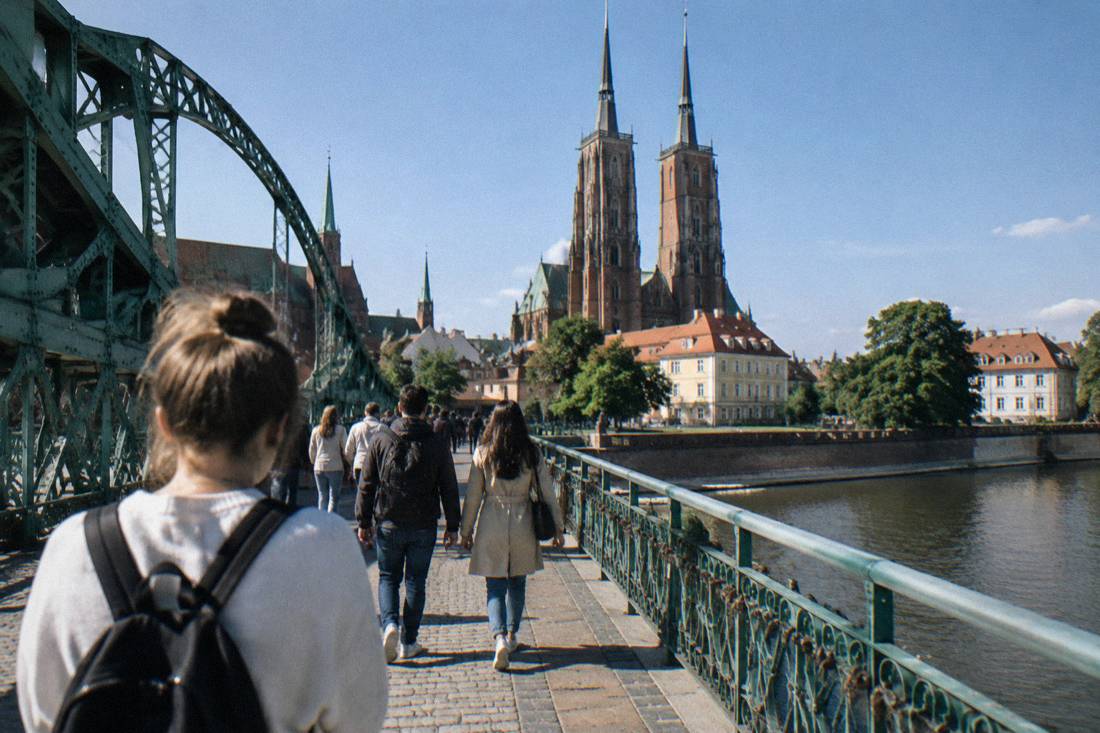
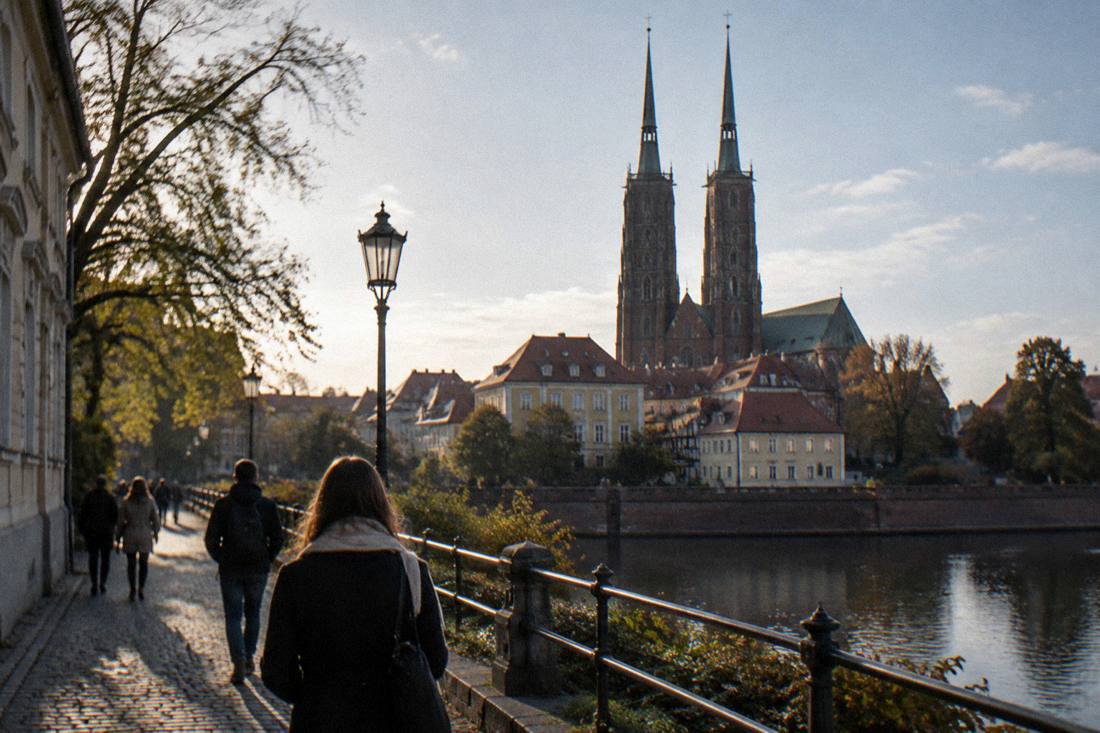
Ostrow Tumski, Wroclaw's cathedral island, is the oldest part of the city and the emotional high point of the route: a quiet district of cobbled lanes, the twin-spired Cathedral of St. John the Baptist, historic churches and hand-lit gas street lamps. It sits on its own island in the Odra, reached by pedestrian bridges, and its atmosphere shifts completely from the busy Market Square to something closer to a village.
Cross the bridges slowly. The change is immediate: less traffic, older stone, and lamps that a city lamplighter still lights by hand each evening, a tradition Wroclaw keeps alive when almost every other European city has switched to electricity. The cathedral's towers dominate the skyline from across the river, and the interior rewards the walk inside.
Ostrow Tumski is also where the guided tours earn their keep, because the stories layered on this island are the ones a plaque will not explain. The full background on the district, its churches and the lamplighter is on the Ostrow Tumski guide, which pairs naturally with this route. Walkers with a second day often return here at dusk specifically for the lamplighting.
Which Museums And Sights On The Route Charge Admission?
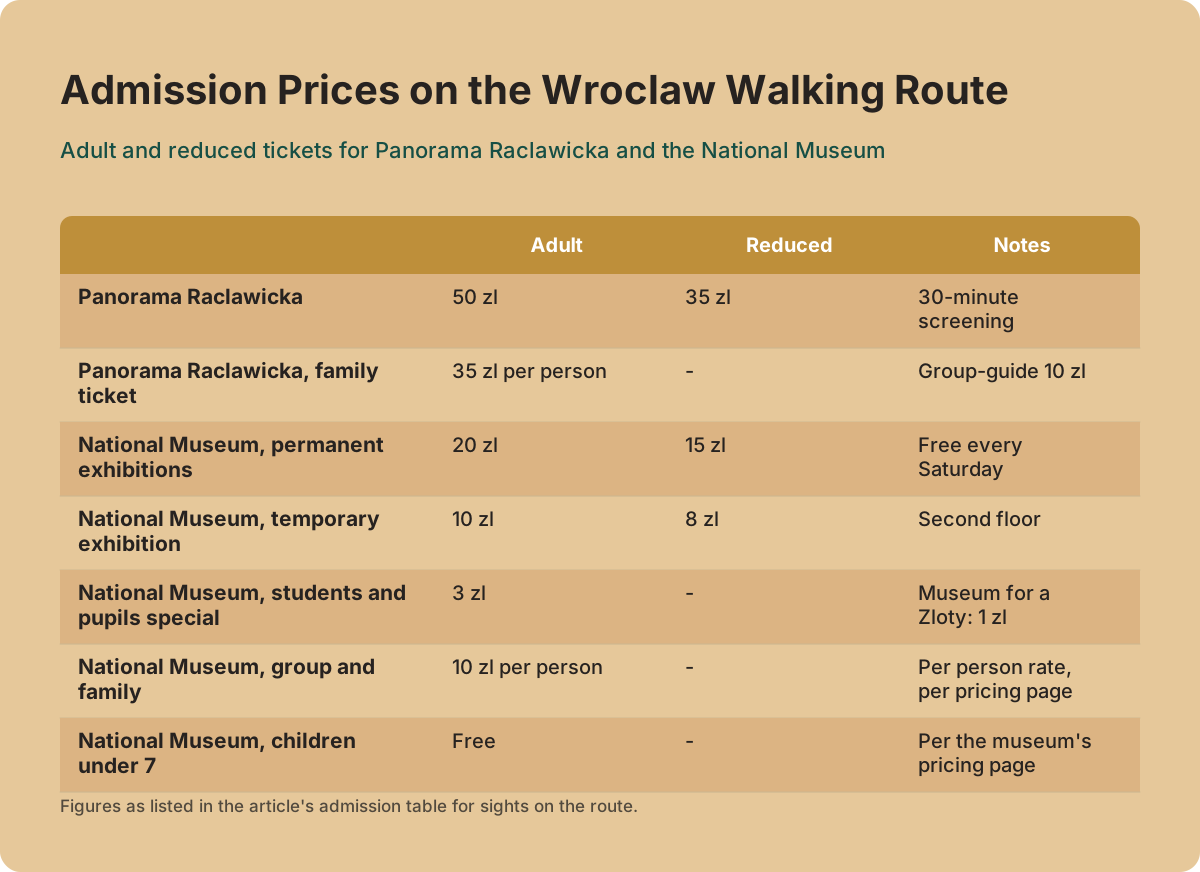
Two headline museums sit directly on this route: the National Museum in Wroclaw, whose standalone permanent-exhibition ticket costs 20 zl adult and 15 zl reduced, with free entry to permanent exhibitions every Saturday, and the Panorama Raclawicka, at 50 zl adult and 35 zl reduced for a 30-minute viewing. A Panorama ticket also covers the National Museum's permanent exhibitions, the Ethnographic Museum and the Four Domes Pavilion within 3 months of the visit date.
That 3-month rule is the single most useful ticket fact in the city, and most first-time visitors never notice it. The National Museum's own pricing page lists the details, including group and family tickets at 10 zl per person, a 3 zl student and pupil special, a 1 zl "Museum for a Zloty" ticket for students and pupils under 26, and free entry for children under 7. Temporary exhibitions on the second floor cost 10 zl adult and 8 zl reduced.
The Panorama's hours follow a seasonal pattern: in winter, from 1 November to 31 March, it closes on Mondays, and in summer, from 1 April to 31 October, it opens daily from 8:30 to 19:00. The National Museum closes on Mondays year-round. Plan the walking route accordingly, because Monday is the day both headline interiors are shuttered, and the walk becomes an outdoor-only affair.
| Sight | Adult | Reduced | Notes |
|---|---|---|---|
| Panorama Raclawicka | 50 zl | 35 zl | 30-minute screening; family 35 zl per person; group-guide 10 zl |
| National Museum, permanent exhibitions | 20 zl | 15 zl | Free every Saturday; group and family 10 zl per person |
| National Museum, temporary exhibition | 10 zl | 8 zl | Second floor |
| National Museum, students and pupils special | 3 zl | - | "Museum for a Zloty" under 26: 1 zl |
| Children under 7, National Museum | Free | - | Per the museum's pricing page |
Where Should You Eat Along The Wroclaw Walking Route?
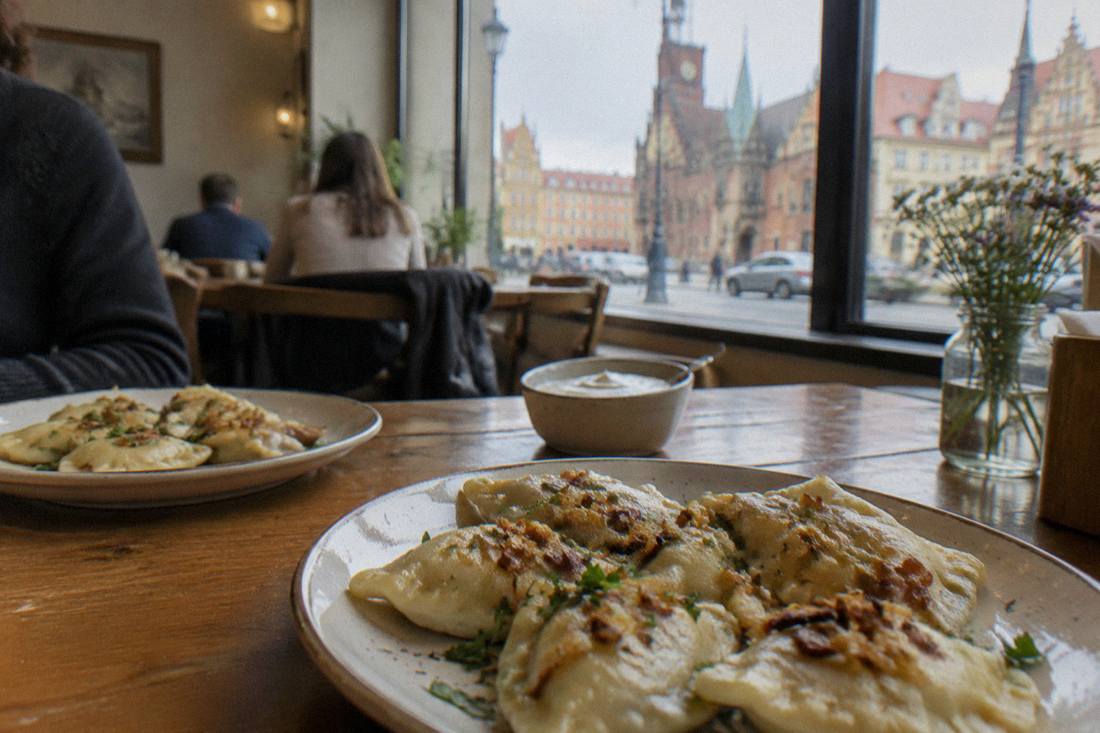
Eating well on this route requires almost no detours: the Old Town lanes between the Market Square and the river hold the densest concentration of restaurants, milk bars and pierogi spots in the city, and the square itself is ringed with cafe tables. The best kitchens sit exactly where this walk goes, so lunch and the route reinforce each other rather than competing for time.
The dedicated roundup of the best restaurants in Wroclaw shows how tightly the good tables cluster inside this same loop, from Old Town dining rooms to cafeteria-style milk bars a few lanes away. The honest budget note is that the square-side tables carry the premium you would expect from any European square, and the side streets just off the square are where the same kitchen traditions cost less. Milk bars, the Polish cafeteria institutions, sit within the Old Town and serve pierogi and daily mains at prices closer to what locals pay. This site has dedicated pages on pierogi, milk bars and street food for the full picture.
Timing your lunch matters on a walking day. The museum stretches of the route, the Panorama and the National Museum, close in the late afternoon and shut entirely on Mondays, so a sensible order is sights in the morning, a long lunch in the Old Town, then the riverside walk and Ostrow Tumski in the softer afternoon light. Evening is for the square again, or a rooftop view of the lit town hall.
When Is The Best Time Of Year To Walk Wroclaw?
The best months for this walking route are May through September, when IMGW's 1991-2020 climate normals for the Wroclaw station show mean temperatures from 14.3C up to the July peak of 19.7C, with June at 17.7C and August at 19.3C. April and October, at 9.7C and 9.6C means, are workable for walkers who like cool air, while January's 0.0C mean makes winter a different kind of trip altogether.
The precipitation pattern matters less than most guides imply. The normals show July as the wettest month at 91.4 mm and the shoulder months drier, but rain in Wroclaw is rarely a day-ruining event; it is a reason to check the forecast and carry a layer. The monthly detail, including what each month means for crowds, daylight and events, is broken down on the Wroclaw weather by month page.
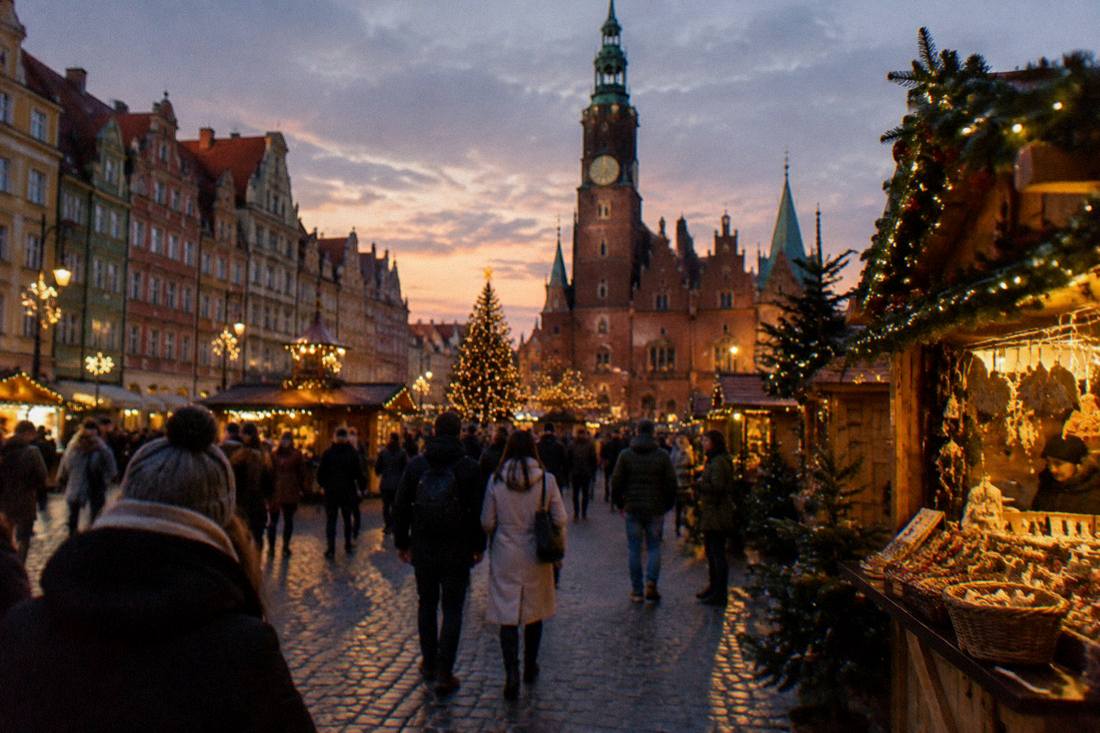
Winter walking has a real payoff: the Christmas itinerary covers the market season, when the square fills with wooden stalls and the whole route gains a layer of atmosphere that summer cannot copy. The trade is short daylight and cold means, so winter walkers compress the same loop into fewer hours. Summer walkers get the riverside and island evenings instead, covered on the Wroclaw in summer page, while the colder option is detailed in Wroclaw in winter.
| Month | Mean Temperature (C) | Precipitation (mm) | Walking Verdict |
|---|---|---|---|
| January | 0.0 | 28.3 | Cold; compress the route, plan indoor stops |
| February | 1.1 | 25.6 | Quiet streets, wrap up warm |
| March | 4.3 | 35.0 | Shoulder season, thin crowds |
| April | 9.7 | 31.2 | Good; museums and squares both comfortable |
| May | 14.3 | 59.6 | Prime walking month |
| June | 17.7 | 65.4 | Long evenings, full route easily |
| July | 19.7 | 91.4 | Warmest month; watch for showers |
| August | 19.3 | 59.5 | Peak comfort on the riverside stretches |
| September | 14.5 | 48.4 | Excellent balance of warmth and calm |
| October | 9.6 | 37.6 | Crisp, golden, fewer visitors |
| November | 4.8 | 31.4 | Diminishing light, museum weather |
| December | 1.1 | 27.9 | Christmas market season on the square |
What If It Rains Or Snows On Your Wroclaw Walk?
A rainy day does not kill this route, it reorders it: the Panorama Raclawicka's 30-minute screening, the National Museum's permanent exhibitions and the Four Domes Pavilion are all indoors, and the Panorama ticket covers all four institutions within 3 months, so wet hours convert directly into museum hours. The bridges and Ostrow Tumski are still walkable in light rain, but the dwarf hunt loses most of its charm in a downpour.
The city's rainy-day playbook is broader than the route itself, and it is laid out in full on the rainy day Wroclaw itinerary. In route terms, the trick is sequencing: do the outdoor core, the square and Ostrow Tumski, in whatever dry window the forecast offers, and hold the museums as the flexible middle. Monday remains the day to avoid, since both headline museums close then regardless of the weather.
Snow changes the walk rather than stopping it. Ostrow Tumski under snow, with the gas lamps lit in the late afternoon, is one of the most photogenic city scenes in Poland, and the winter itinerary pages cover that version of the city in detail. Just budget for the cold: January's 0.0C mean is the floor of the year, and the wind off the Odra is real.
Guided Or Self-Guided: Which Wroclaw Walking Tour Should You Book?
Walkers who want stories, not just stops, are better served by a guided Old Town walk covering this same core route: a professional guide runs the Market Square-to-Ostrow Tumski territory and supplies the narrative the plaques never carry, while self-guided walkers lose nothing on the sights themselves and gain total flexibility on pace and lunch. The honest split is narrative versus freedom, not coverage.
Both approaches see the same city. What a guide adds is context that plaques do not carry, from the Orange Alternative backstory behind the dwarfs to the reconstruction story of the Old Town's houses. What self-guiding adds is the ability to linger an hour on a bridge or detour for a dwarf that a group schedule would skip. The site's best walking tours in Wroclaw roundup compares the full field, including free, tip-based walks and private options.
For a guided version of this exact route, the Wroclaw Old Town Guided Walking Tour page carries the full tour description and verified details in one place, and live dates can be checked here: Check availability.
Can You Extend The Route Beyond Wroclaw City Center?
Yes, and the two classic extensions are day trips rather than walks: Ksiaz Castle, one of Poland's largest castles, beyond the city toward Walbrzych, and the Giant Mountains (Karkonosze) with the Karpacz area to the south. Both are covered by guided tours from Wroclaw, and both reward walkers who have finished the city loop and want the region's bigger landscapes. Staying closer in, Centennial Hall and the zoo sit east of the center across the Odra.
Ksiaz Castle deserves the planning attention. The castle's own cennik, effective 6 May 2026, prices the castle with audioguide and terraces at 72 zl adult and 62 zl reduced, with a full All Day Ticket, covering castle, terraces, underground tour, Palm House, stud farm and mausoleum, at 104 zl adult and 94 zl reduced. The terraces open only from 15 April to 30 September, which makes late spring through early summer the sweet spot for that extension. The full breakdown, including how to get there, is on the Ksiaz Castle day-trip page.
| Ksiaz Castle Ticket Option | Adult (zl) | Reduced (zl) |
|---|---|---|
| Castle with audioguide + terraces | 72.00 | 62.00 |
| Castle + terraces + underground tour | 92.00 | 82.00 |
| Castle + terraces + stud farm | 79.00 | 69.00 |
| All Day Ticket (castle, terraces, underground, Palm House, stud farm, mausoleum) | 104.00 | 94.00 |
| Underground tour alone | 45.00 | 39.00 |
| Mausoleum alone (open 1 Apr-15 Oct) | 13.00 | 8.00 |
| Palm House alone | 27.00 | 21.00 |
A guided Ksiaz day trip removes the transfer puzzle entirely, since the castle is commonly reached by regional train to Walbrzych plus a bus or taxi connection, and a booked tour bundles castle entry and travel into a single planned day. A variant of the same outing pairs the castle with the UNESCO-listed Church of Peace in Swidnica, whose individual adult ticket is 18 zl, reduced 15 zl, part of the "Churches of Peace in Jawor and Swidnica" World Heritage inscription of 2001.
South of the city, the Giant Mountains and Karpacz day trip swaps castle halls for mountain trails and the Valley of Palaces, and it is the natural third move for a walker who has done both the city route and Ksiaz. That option is also bookable as a guided tour from Wroclaw, and again the live listing carries the current price and dates.
Back inside the city, the east-bank extension past Centennial Hall leads to the zoo, whose own price table lists adult tickets online from 69 zl and at the gate at 99 zl, reduced 59 zl online and 89 zl at the gate, with the Afrykarium aquarium included in the standard ticket rather than sold separately. From April to September the grounds run 9:00-18:00 Monday through Thursday and 9:00-19:00 from Friday through Sunday and on holidays, while November through February brings 9:00-16:00 daily, so the zoo pairs naturally with a long summer evening but not with a December afternoon.
How Do You Use Wroclaw Public Transport If Your Legs Give Out?
Wroclaw's MPK network uses time-based tickets, and the cheapest tier, a 15-minute ticket, costs 4.60 zl normal and 2.30 zl reduced per the city's official 2026 fare page, with a 30-minute ticket at 7.00 zl and 3.50 zl and a 24-hour city ticket band around 15.00 zl and 7.50 zl. Every tram and bus uses the same ticket system, so one purchase covers any line, and the network reaches every stop on this walking route.
The practical use on a walking day is bail-out insurance rather than a full transit plan. If the weather turns or feet complain, a short-hop tram ride from the river back to the square costs the base fare, and multi-day tiers exist at 26/13, 32/16 and 54/27 zl for longer stays. There is no all-inclusive Go City-style sightseeing pass currently sold for Wroclaw, so do not plan around one; the UrbanCard is a transport fare card, not an attraction pass.
Getting into the city in the first place is covered on the Wroclaw airport guide, which explains the airport-to-center options, the current state of the airport after its 2025 renovation closure, and where to pick up transit tickets on arrival. Wroclaw Airport is open and operating normally today, having handled 4,473,945 passengers in 2024.
| MPK Ticket Tier | Normal (zl) | Reduced (zl) | Best Use On This Route |
|---|---|---|---|
| 15-minute | 4.60 | 2.30 | Emergency tram hop back to the square |
| 30-minute | 7.00 | 3.50 | Crossing the center with one change |
| 24-hour city band | ~15.00 | ~7.50 | A walking day with several bail-outs |
| Multi-day tier 1 | 26 | 13 | Two-day itinerary stays |
| Multi-day tier 2 | 32 | 16 | Three-day itinerary stays |
| Multi-day tier 3 | 54 | 27 | Week-long visits |
For a weekend built around this walk, the Wroclaw weekend itinerary and the three days in Wroclaw plans slot this route into a fuller stay, and safety notes for evening walking, including the Ostrow Tumski lamplighting, are on the Wroclaw safety guide.
Common Questions About The Wroclaw Walking Tour Route
Can You Walk All Of Central Wroclaw In One Day?
Yes. The core loop from the Market Square through the Old Town lanes and dwarf clusters to Ostrow Tumski and back past the National Museum is flat, compact and comfortably done in a single relaxed day, with time for one paid museum interior and a long lunch. Add a second day if you want both the Panorama Raclawicka and the National Museum properly, or the east-bank extension to Centennial Hall and the zoo.
What Is The Best Starting Point For A Wroclaw Walk?
The Market Square is the best start, because nearly every tram line stops close to it, it sits at the center of the historic core, and a loop from there ends where it began. Starting there also means the dwarf hunt, the first lanes of the Old Town and the riverside walk toward Ostrow Tumski all unfold in a natural order without backtracking.
Are Wroclaw's Museums Open On Mondays?
No. The National Museum in Wroclaw closes on Mondays year-round, and the Panorama Raclawicka closes on Mondays during its winter season from 1 November to 31 March. In summer the Panorama opens daily from 8:30 to 19:00. Monday is the day to keep the route outdoors, on the square, the bridges and Ostrow Tumski.
Does The Panorama Ticket Cover Other Museums?
Yes. A Panorama Raclawicka ticket, 50 zl adult and 35 zl reduced, also covers the National Museum's permanent exhibitions, the Ethnographic Museum and the Four Domes Pavilion within 3 months of the visit date. That makes the Panorama the most efficient single purchase on the route if you plan more than one museum.
Is The Wroclaw Walking Route Good For Kids?
Yes, largely because of the dwarfs. Hundreds of small bronze figures hide around the Market Square and Old Town, and children treat finding them as a citywide game that runs along the exact route adults want to walk anyway. The main caution is cobblestones: the surface is uneven in places, which matters for strollers.
What Should You Do If It Rains On The Walking Day?
Reorder the route rather than cancel it. The Panorama Raclawicka's 30-minute screening, the National Museum's permanent exhibitions and the Four Domes Pavilion are all indoors and all covered by the same ticket within 3 months, so wet hours become museum hours. Keep the Ostrow Tumski and river bridge stretches for whatever dry window the forecast offers.
Wroclaw rewards exactly this kind of slow, foot-powered visit: one square, one island, two riverside banks and a few hundred dwarfs, all inside a walkable loop that ends where it began. The rest of Wroclaw Travel Guide picks up from there, with itineraries for every season and the day trips that carry the walk beyond the city.