Best Photo Spots In Wroclaw
Wroclaw, the largest city in Lower Silesia in southwestern Poland, packs a medieval market square, a cathedral island, a dozen river bridges and a UNESCO-listed concrete dome into one compact, walkable frame.
Short answer
The best photo spots in Wroclaw cluster around the Market Square, Ostrow Tumski, the Odra river bridges and the Nadodrze street-art quarter, with ticketed viewpoints at the Panorama Raclawicka, the National Museum and the zoo's Afrykarium.
Wroclaw, the largest city in the Lower Silesia (Dolnoslaskie) voivodeship of southwestern Poland, is a city built to be photographed. It spreads across the Odra river in a lattice of islands and bridges, centers on one of the largest market squares in the region, and keeps a UNESCO-listed reinforced-concrete dome within tram reach of the Old Town. IMGW's 1991-2020 climate normals for the Wroclaw station show a city with mild extremes for Poland, a 0.0C January mean and a 19.7C July mean, which means usable light in every month of the year. This guide walks through the frames worth planning a day around, the ones that need a ticket, and the ones that only work at a particular hour.
Where Are The Best Photo Spots In Wroclaw Old Town?
The best photo spots in Wroclaw Old Town are the Market Square with the Old Town Hall, the narrow streets around Świętego Widzenia and Oławska, the Prusa and Pomarańczowa courtyards, and the rear facades of the tenement houses on Kurzy Targ, all within a ten-minute walk of one another in the city center of southwestern Poland.
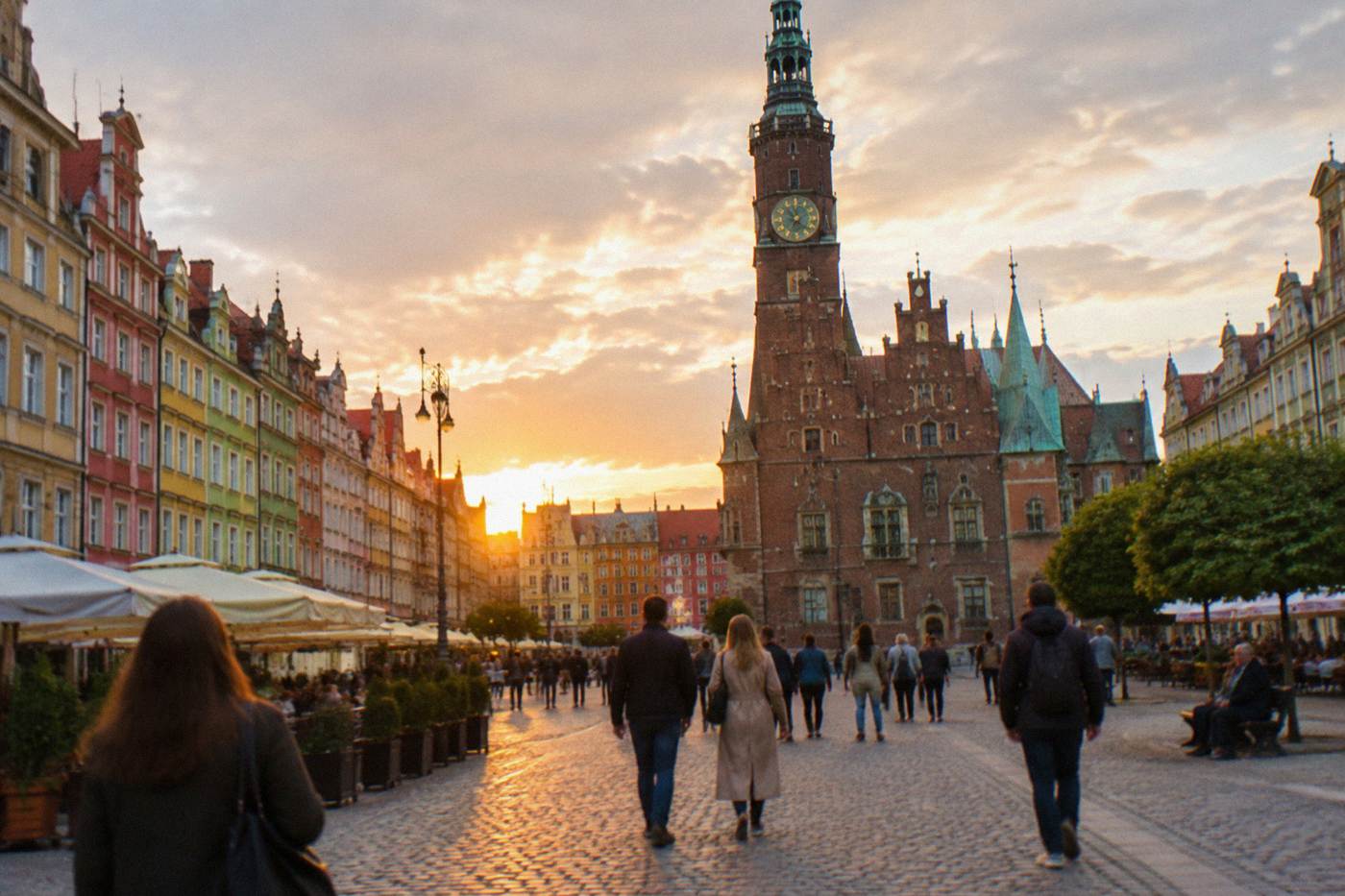
The Rynek is the anchor. The facts pack puts Wroclaw's main square at roughly 3.64 to 3.79 hectares, smaller than Krakow's Rynek Glowny at about 4 hectares, and that smaller footprint is a photographic advantage: you can walk its full perimeter several times as the light changes without exhausting a shoot. The Old Town Hall's east facade catches the first warm light of the afternoon, while the colored tenements on the east side of the square, the painted house fronts visitors come specifically to shoot, are best framed in the morning before the terrace umbrellas fill the foreground.
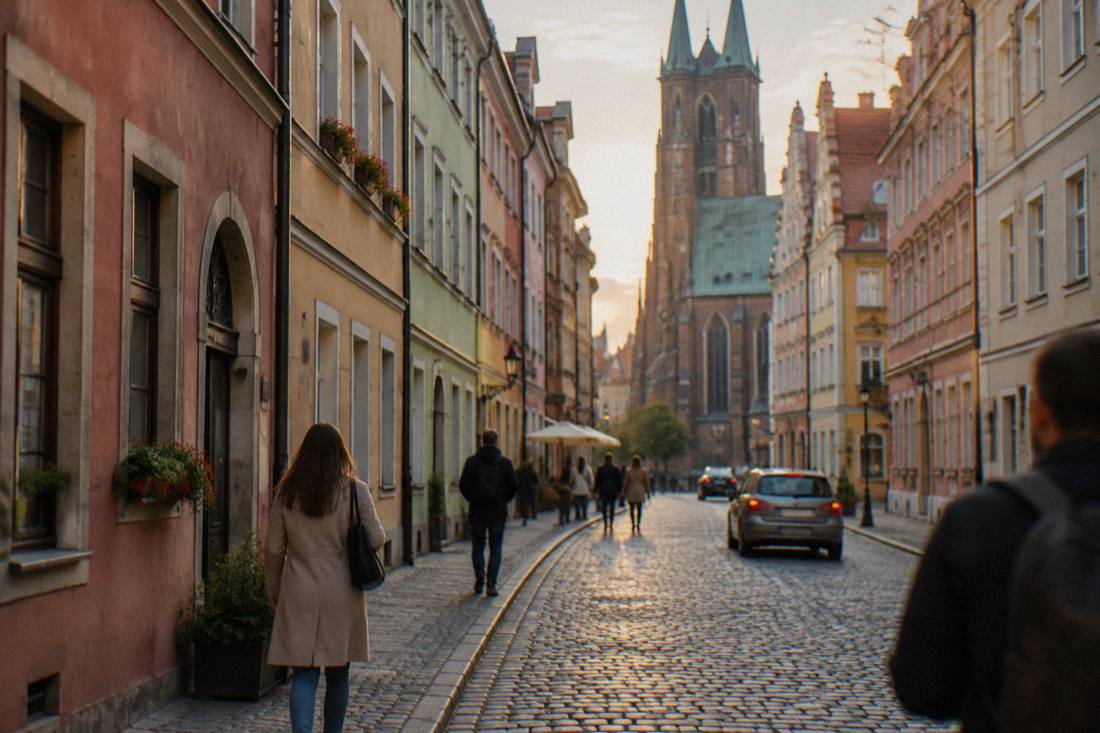
Two streets away, the streets behind the square give you depth and leading lines that the open Rynek cannot. Wroclaw's street photographers gravitate to the passage ways and alleys off the square for those compressed, layered shots where three eras of architecture stack into one frame. For anyone planning the logistics of a full day around these streets, the getting around Wroclaw guide covers the tram and the base 4.60 zl MPK short-hop fare that connects the Old Town to the eastern districts.
| Old Town spot | Signature shot | Why it works |
|---|---|---|
| Rynek (Market Square) | Old Town Hall east facade at golden hour | Gothic architecture against warm stone light |
| Kurzy Targ | Tenement rear facades and lanes | Layered depth, fewer people than the Rynek |
| Świętego Widzenia street | Narrow street leading to a church tower | Natural leading lines and compressed perspective |
| Oławska street | Tram wires and storefront geometry | Street-photography texture in the city center |
When Is The Best Light For Photographing Wroclaw Market Square?
The best light for photographing Wroclaw Market Square falls in the last two hours before sunset, when the low western sun warms the east-facing tenement facades and the Old Town Hall's Gothic east front, and again in the first hour after sunrise when the square is nearly empty of people and the terraces are still stacked away.
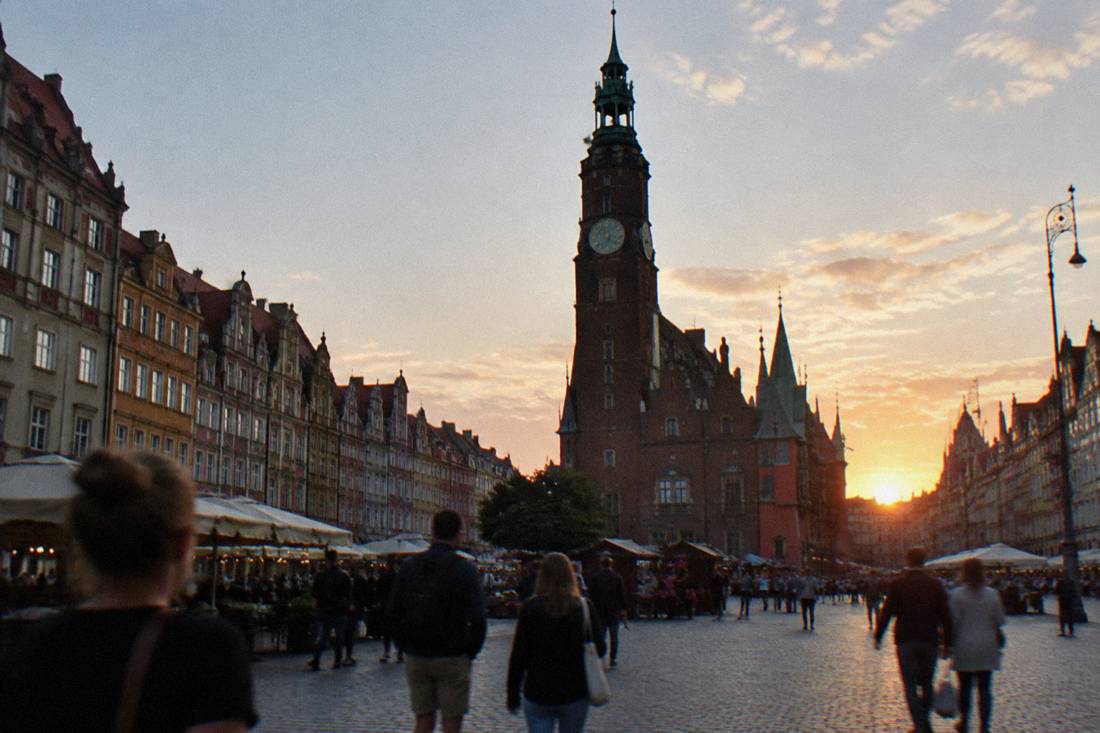
The square changes character by the hour. In the middle of the day, especially from May through August when IMGW's normals show monthly means of 14.3C to 19.7C, the Rynek is busy, the light is flat and high, and the terraces are in full operation, which puts chairs and umbrellas into the bottom third of almost every wide shot. Late afternoon and early evening, the square shifts: the terrace lights come on, the facade colors deepen, and the Old Town Hall's tower becomes a silhouette subject once the sun drops behind the western townhouses.
Season matters as much as hour. In December, with a mean of 1.1C and the Christmas market stalls in place, the square takes on a night-photography character where the stalls' lights do the work the sun cannot. The Wroclaw weather by month guide pairs the full IMGW table with what each month does to the light. If your trip can flex, the best time to visit Wroclaw and the Wroclaw Christmas market guide cover the two windows photographers usually compete over: the long summer evenings and the December market glow.
Which Wroclaw Photo Spots Need A Ticket?
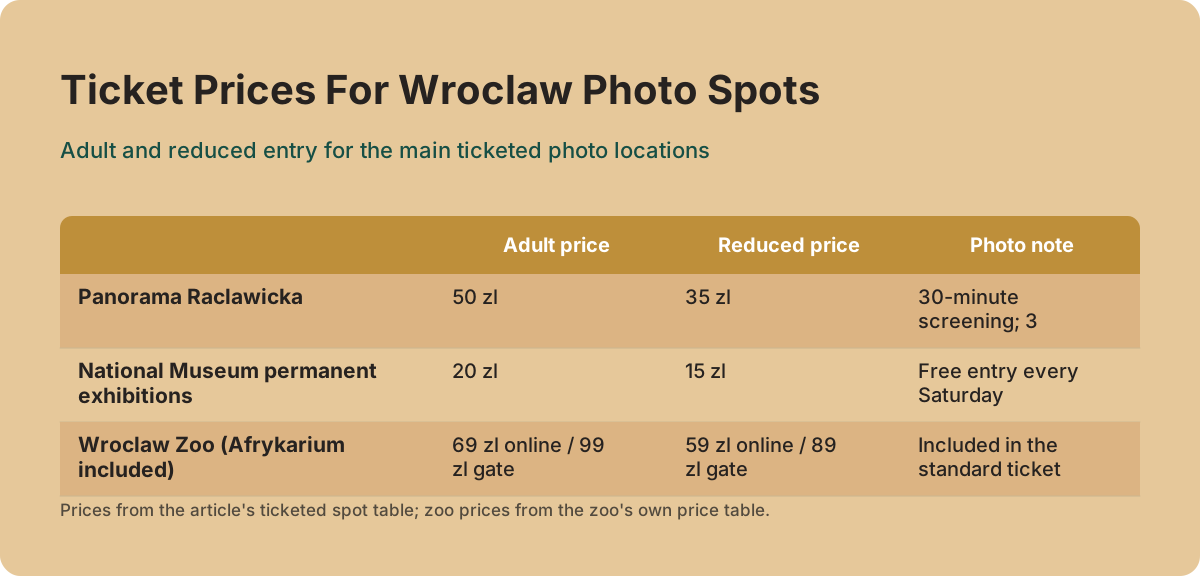
The photo spots in Wroclaw that need a ticket are the Panorama Raclawicka (50 zl adult, 35 zl reduced, a 30-minute screening), the National Museum's permanent exhibitions (20 zl adult, 15 zl reduced, free every Saturday), the Wroclaw Zoo with its included Afrykarium (from 69 zl online, 99 zl at the gate for adults), and the interiors of Ksiaz Castle and the Church of Peace in Swidnica outside the city.
Each of these adds a different kind of frame. The Panorama Raclawicka is a rotunda housing a cylindrical painting, and the facts pack notes one ticket also covers the National Museum's permanent exhibitions, the Ethnographic Museum and the Four Domes Pavilion within three months, a combination that effectively builds a multi-day museum photography itinerary from a single purchase. The National Museum's own pricing page lists a Saturday free-entry day for permanent exhibitions, which matters for trip budgets: the savings on two adult tickets roughly equals a day of MPK fares at the 4.60 zl short-hop tier.
The zoo is a different brief entirely. The zoo's own price table gives adult tickets from 69 zl online and 99 zl at the gate, and states plainly that a standard ticket includes the Afrykarium, the oceanarium-style pavilion that is the single most photographed animal interior in the city. Buy online: the 30 zl difference between the online and gate adult prices is the largest single saving in this table.
| Ticketed spot | Adult price | Reduced price | Photo note |
|---|---|---|---|
| Panorama Raclawicka | 50 zl | 35 zl | 30-minute screening; ticket also covers 3 more museums for 3 months |
| National Museum permanent exhibitions | 20 zl | 15 zl | Free entry every Saturday |
| Wroclaw Zoo (Afrykarium included) | 69 zl online / 99 zl gate | 59 zl online / 89 zl gate | Afrykarium included in the standard ticket |
Museum interiors often restrict flash and tripods, so check the room before setting up. If a guided angle appeals for the outdoor half of the day, the walk below is the site's featured option, and a gnome-hunt walk doubles as a scavenger route to the small bronze subjects scattered across the city.
What Are The Best Photo Spots On Ostrow Tumski And The Odra Islands?
The best photo spots on Ostrow Tumski and the Odra islands are the Cathedral of St. John the Baptist's twin spires from the Most Tumski bridge, the gas-lit lanterns of the island's streets at dusk, and the sandbar beaches and student crowds of Slodowa Island, all connected by footbridges that give a riverside foreground to nearly every frame.
Ostrow Tumski, the cathedral island, is the oldest part of the city and the one that rewards two visits rather than one. The facts file does not carry an exact founding date for the island's churches, so this guide will not invent one, but the cathedral's gothic towers are the vertical anchor of every riverside composition in this quarter, and the bridge views toward them are the classic postcard. The island is one of the few places anywhere where lamplighters still light street lamps by hand at dusk, a detail the site covers in its piece on cities that still have lamplighters, and the flame-lit lanterns make the dusk window the whole point of the visit.
Slodowa Island, the student island downstream, is the counter-frame: open, flat, social, and best shot in the long May and June evenings when the mean temperature sits at 14.3C and 17.7C and the riverside crowds are out. For an evening that ends with a camera and a pint, the Wroclaw craft beer guide maps the island-adjacent options, and the Wroclaw nightlife guide covers what happens after dark further afield.
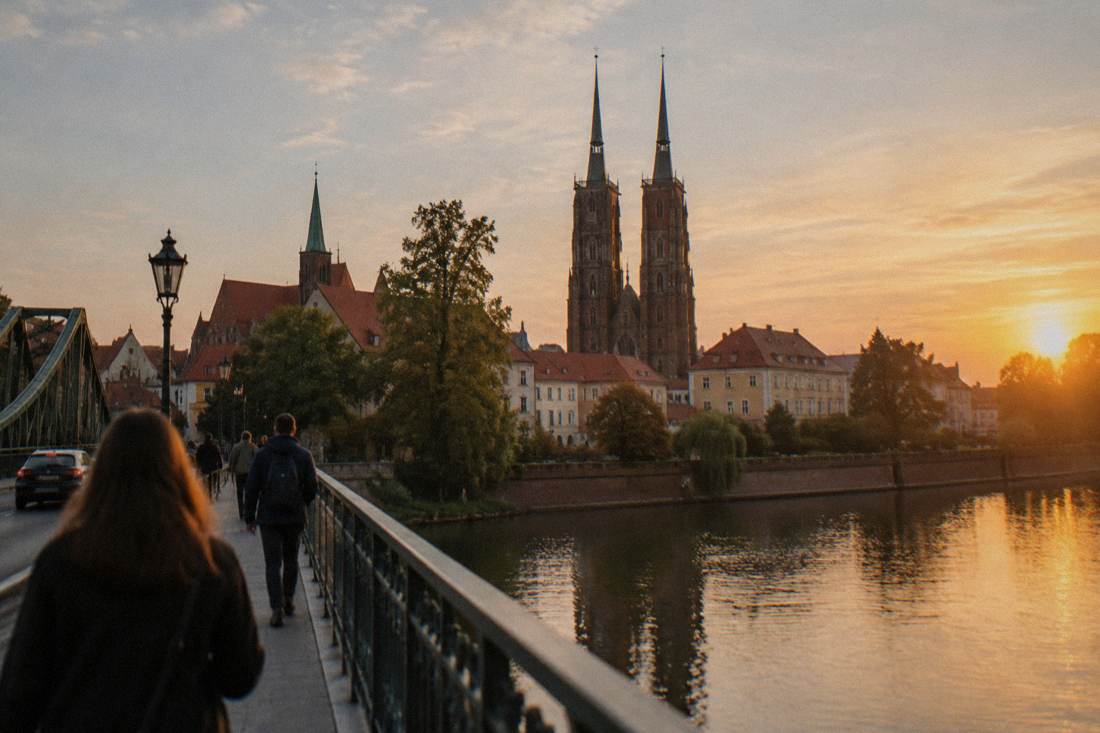
The bridges themselves are subjects. Each crossing of the Odra gives a different compression of water, island and tower, and shooting them in sequence, one bridge to the next, is a natural half-day route that the city's compact scale makes realistic.
Where Can You Photograph Wroclaw's Dwarfs?
Wroclaw's dwarfs, the small bronze statuettes scattered across the city center in the spirit of the Orange Alternative protest movement, can be photographed throughout the Old Town, and a gnome-hunt walk with a local guide turns the search into a structured photo route, with the option to link a two-hour guided hunt through the site's featured tour.
The dwarfs are the city's smallest and most persistent photo subject. They sit on lampposts, peer out of doorways and lurk near ATMs, and because each one is an individual figure with its own prop and pose, they work as a themed series: same lens, same framing discipline, dozens of distinct frames. The practical difficulty is that they are small, low and often in shadow, which makes an overcast day, when the light is even and there are no hard shadows under the figures' faces, better than harsh midday sun. More of these guides are collected on Wroclaw Travel Guide.
A structured hunt solves the "where do I even start" problem. The garden gnome hunt with a local guide is this site's featured route for the theme, and a local guide's knowledge of which figures sit where turns a random walk into a curated set. If the group prefers wheels to walking, the electric-car dwarf hunt covers the same theme from a vehicle. Check availability
The dwarf theme also connects to the city's broader Old Town guide, which maps the quarter most of the figures live in.
Is Wroclaw Good For Night And Street Photography?
Wroclaw is a strong night and street photography city because its lit Old Town, lamplit cathedral island, neon-tinged nightlife quarter and river-reflection viewpoints sit inside a compact center that IMGW's mild-for-Poland climate normals make walkable in most months, from a 0.0C January mean to a 19.7C July mean.
The night palette is varied. The Rynek's terrace lights and facade washes give the classic warm-wide-shot hour. Ostrow Tumski's hand-lit gas lanterns give something rarer. And the riverside railings along the Odra give long-exposure water and bridge-light reflections that hold up in any season. Street photographers get the student crowds around the market square and Slodowa Island, the market traders of the daily stalls, and the everyday texture of a city of 672,601 people (GUS, 31 December 2025) going about a Thursday evening.
The evening logistics matter. The Wroclaw safety guide covers night movement in practical terms, and the general answer is that the center is a normal European city center at night: the usual awareness applies. For fuel between shoots, the best cafes in Wroclaw covers the late-open ones, and the best restaurants in Wroclaw and pierogi in Wroclaw guides handle the dinner stop.
| Night spot | Subject | Best approach |
|---|---|---|
| Rynek terraces and facades | Warm-lit old town architecture | Wide lens, early evening blue hour |
| Ostrow Tumski lanterns | Gas-lamp flames, cobbled lanes | Dusk timing to catch lamplight and sky together |
| Odra river railings | Bridge lights reflected in water | Tripod, long exposure |
| Market stalls, late trading | Traders, produce, gestures | Respectful distance, higher shutter speed |
What Camera Gear Works Best For Wroclaw's Compact Photo Spots?
For Wroclaw's photo spots the useful kit is a wide lens for the Market Square and interiors, a short telephoto for compressing the Odra bridges and cathedral spires, and a fast standard lens for the dwarfs, lanterns and night streets, with a tripod reserved for river long exposures and a check of each venue's interior rules before use.
Wroclaw does not demand exotic glass. The square is big enough that a wide frame takes in the Old Town Hall with room for foreground, while the riverside and bridge compositions reward telephoto compression, stacking bridge, water and tower. The dwarfs need nothing more than a standard lens and patience: they are close-range subjects, and the challenge is light, not reach.
Two practical notes. First, museums and the Panorama rotunda commonly restrict flash and may restrict tripods, so confirm at the ticket desk rather than assuming. Second, this is a walking city: the full Old Town-to-islands route is comfortably done on foot, and the Wroclaw accessibility guide covers which parts of these routes work with reduced mobility, which also matters to photographers hauling a bag all day. If a tram hop is needed, the MPK base 15-minute fare is 4.60 zl normal, 2.30 zl reduced, per the city's own fare page.
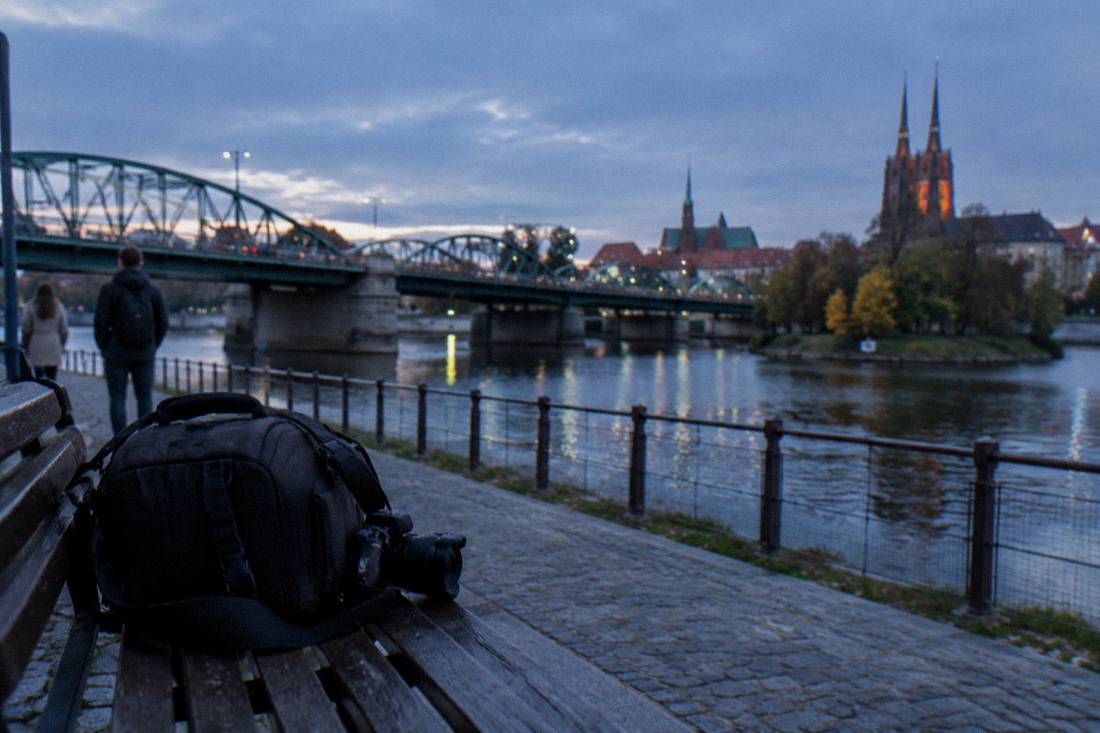
Which Season Gives Wroclaw Its Best Photographic Light?
Wroclaw's best photographic seasons are May through September, when IMGW's 1991-2020 normals for the Wroclaw station show monthly means of 14.3C, 17.7C, 19.7C, 19.3C and 14.5C and the evenings are long enough for blue-hour work, and December, when a 1.1C mean and the Christmas market stalls turn the Market Square into a warm night-lit scene.
The honest read of the climate table is that Wroclaw has no unusable month. January's 0.0C mean is the coldest, and it is also among the mildest Januarys of Poland's major synoptic stations in the IMGW table, which means frost-and-fog frames on the Odra are possible without arctic planning. July, at 19.7C, is the warmest month and carries the year's heaviest rainfall at 91.4 mm, so summer shooters should plan for sudden showers as much as for golden light.
| Month | Mean temp (C) | Rain (mm) | Photo condition |
|---|---|---|---|
| Jan | 0.0 | 28.3 | Frost and river fog possible |
| Feb | 1.1 | 25.6 | Bare trees, clear structural frames |
| Mar | 4.3 | 35.0 | Warming light, thin crowds |
| Apr | 9.7 | 31.2 | Spring blossom, driest month |
| May | 14.3 | 59.6 | Long evenings, terrace season starting |
| Jun | 17.7 | 65.4 | Peak green, latest sunsets |
| Jul | 19.7 | 91.4 | Warmest month, heaviest rain |
| Aug | 19.3 | 59.5 | Warm evenings, stable light |
| Sep | 14.5 | 48.4 | Soft light, quieter square |
| Oct | 9.6 | 37.6 | Autumn color on the islands |
| Nov | 4.8 | 31.4 | Short days, moody gray |
| Dec | 1.1 | 27.9 | Christmas market lights, night work |
The shoulder months deserve a special word. April is the driest month in the table at 31.2 mm, with a mild 9.7C mean, and September's 14.5C mean comes with the year's most forgiving light and a Rynek that is calmer than July. For photographers who hate crowds more than they hate clouds, those are the two months to circle. The Wroclaw events calendar and Wroclaw festivals guide tell you when a festival will fill your frame for free, or fill it with strangers.
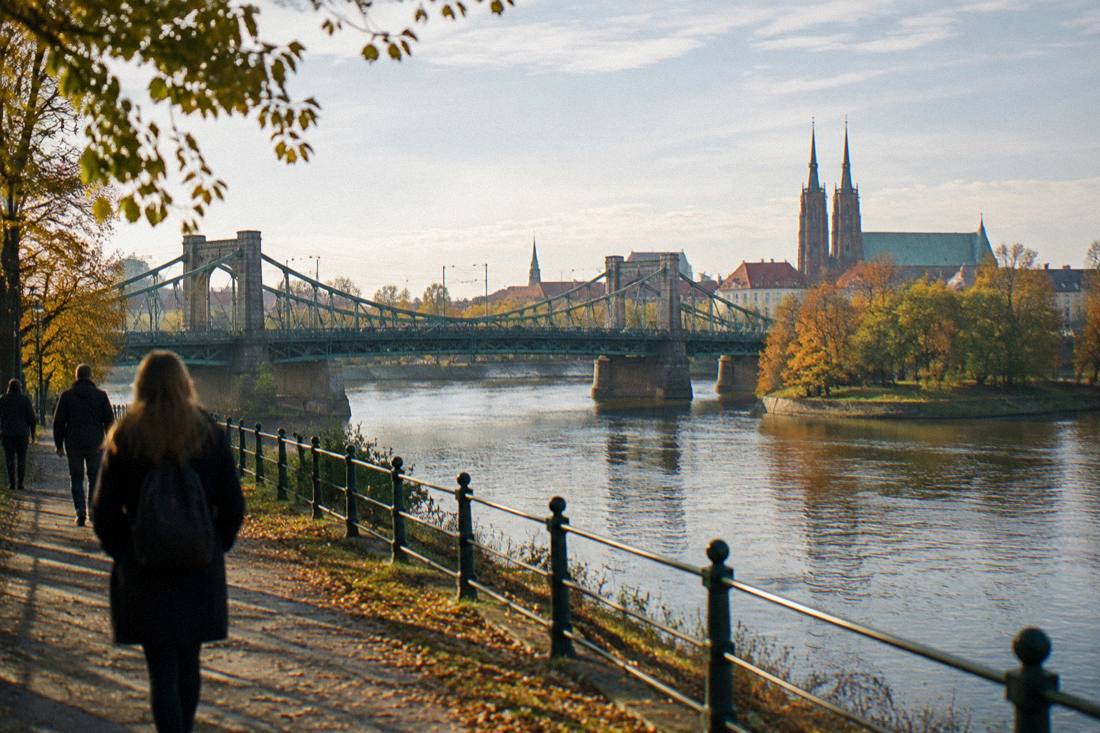
What Are The Best Photo Day Trips From Wroclaw?
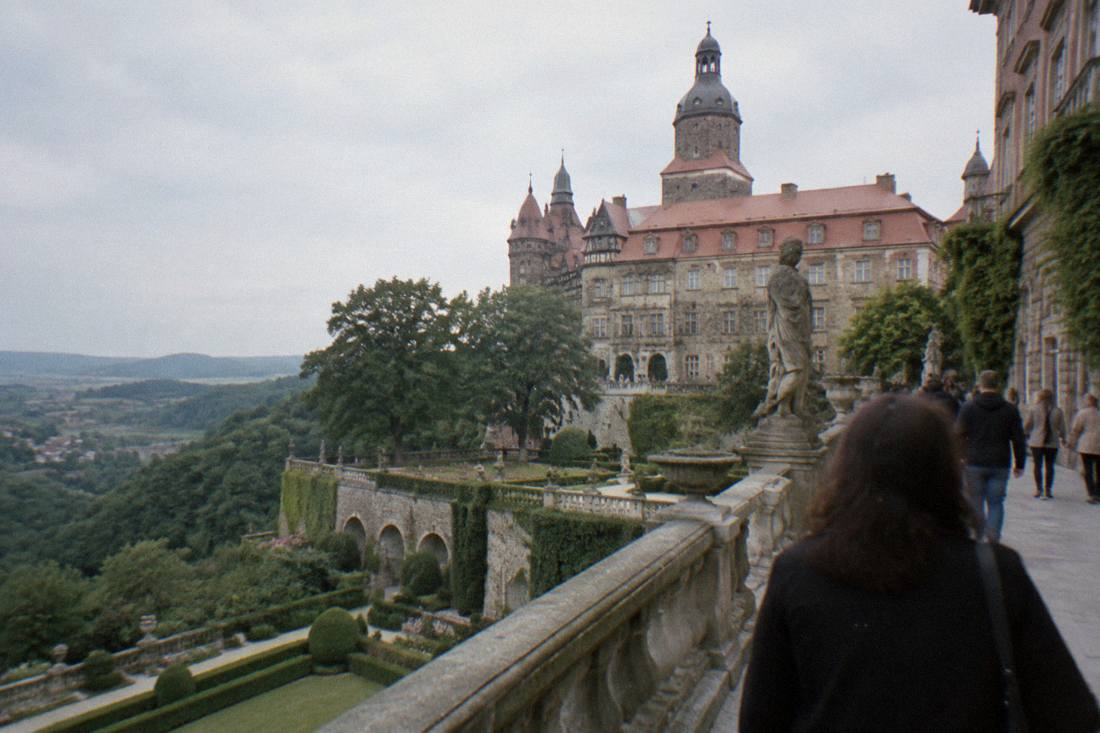
The best photo day trips from Wroclaw are Ksiaz Castle in Walbrzych (castle, audioguide and terraces at 72 zl adult, 62 zl reduced, terraces open only 15 April to 30 September), the UNESCO-listed Church of Peace in Swidnica (18 zl adult, 15 zl reduced), and the Giant Mountains and Valley of Palaces circuit to the south, each reachable on organized day tours from the city.
Ksiaz Castle is the headline. The castle's own tariff, effective 6 May 2026, prices the castle with audioguide and terraces at 72/62 zl, with an All Day Ticket covering castle, terraces, underground, Palm House, stud farm and mausoleum at 104/94 zl. The terraces, the castle's signature exterior photo platform, open only from 15 April to 30 September, which is the single most important date constraint on this whole table: a photographer visiting in March gets the castle but not the terrace frame. The castle is owned by the Walbrzych municipality and operated by its municipal company, a fact the site covers in detail in who owns Ksiaz Castle now, and it is commonly reached by regional train to Walbrzych plus a bus or taxi connection.
The Church of Peace in Swidnica, a timber-framed UNESCO World Heritage church inscribed in 2001 as part of the "Churches of Peace in Jawor and Swidnica," photographs like nothing else in the region: a vast wooden baroque interior built in the structural tradition the listing celebrates. The church's own visitor page prices adults at 18 zl, reduced 15 zl, children 10 zl, families 45 zl.
| Day trip site | Adult admission | Photo signature | Constraint |
|---|---|---|---|
| Ksiaz Castle (castle, audioguide, terraces) | 72 zl | Terraces over the castle grounds | Terraces open 15 Apr to 30 Sep only |
| Ksiaz Castle All Day Ticket | 104 zl | Castle, underground, Palm House, stud farm, mausoleum | Longest day, plan for it |
| Church of Peace, Swidnica | 18 zl | Timber baroque interior | UNESCO site since 2001, check interior rules |
For the underground half of Ksiaz, the Project Riese complex under Osowka adds a tunnel-photography subject the castle itself cannot offer, and it is a reason the private Riese-and-Ksiaz combination tour earns its place in the picks below.
For comparing the city against rivals before committing the trip, the site's Wroclaw vs Krakow, Wroclaw vs Gdansk and Wroclaw vs Warsaw guides put each city's photographic case side by side, including the fact that Krakow, not Wroclaw, is the larger city with the larger main square.
How Do You Plan A Full Photography Day In Wroclaw?
A full photography day in Wroclaw works best as a west-to-east light chase: the Market Square and Old Town lanes in the soft morning, Ostrow Tumski and the Odra bridges at midday when the water glare has softened, Slodowa Island and the riverside in the late afternoon, and a return to the Rynek or the lamplit cathedral island lanes for blue hour and dark, ending wherever the evening crowd is.
The logic is simple: the square's best frames and the island's best frames want different light, and the walking distances between them are short. Morning belongs to the Rynek, empty of terrace furniture and people. Midday belongs to the river, where reflections and bridge geometry tolerate flat light. Dusk belongs to Ostrow Tumski's lanterns and the Rynek's wash lights, in that order, because the lanterns are lit at a specific moment and the square's lights hold all evening.
Two practical closers. If the day runs long and the bag runs heavy, the Wroclaw luggage storage guide matters at both ends of the day. And if the plan extends to a second or third day, the Wroclaw trip cost guide prices the whole exercise, museum tickets and MPK fares included, so the photography day does not blow the budget on day one.
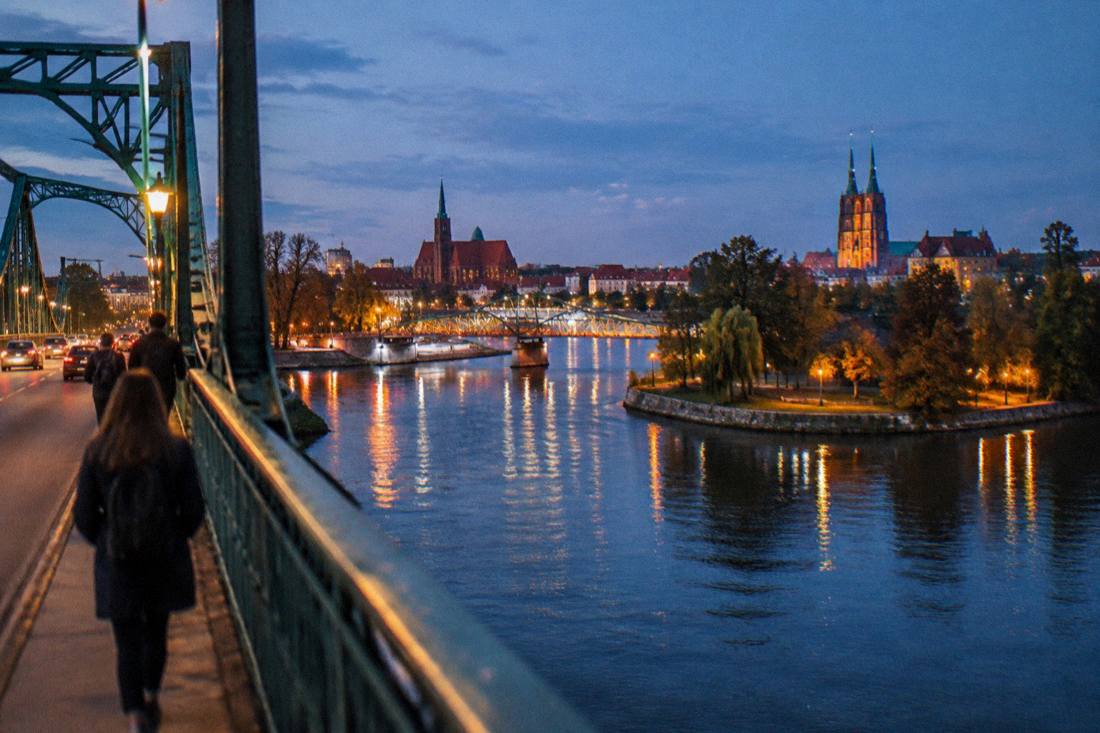
The e-car option below is the shortcut version of the same route, a loop of the dwarf and landmark highlights that works as a scouting run before a day of walking it properly. It pairs naturally with the two picks already on this page: the gnome hunt for the street-level frames and the Riese-and-Ksiaz day trip for the grand ones.
That scouting loop is the last piece of the kit: a cheap way to see the whole core before committing your best light to any single corner of it.
Common Questions About Photographing Wroclaw
What Is The Most Photogenic Spot In Wroclaw?
The Market Square with the Old Town Hall's gothic facade is the most photogenic single spot in Wroclaw, followed closely by the view of the cathedral's twin spires from the bridge onto Ostrow Tumski. Both are free to shoot and within a fifteen-minute walk of each other.
Can You Photograph Inside The Panorama Raclawicka?
The Panorama Raclawicka's 30-minute screening is the attraction itself, and interior photography rules are set by the venue, so confirm at the ticket desk. An adult ticket is 50 zl, reduced 35 zl, and the same ticket also covers the National Museum's permanent exhibitions, the Ethnographic Museum and the Four Domes Pavilion within three months.
Where Can You Shoot Wroclaw's Street Art?
The Nadodrze district, north of the center, is Wroclaw's recognized street-art and creative quarter, with community murals and revitalized courtyards that recent reporting has credited with transforming a formerly neglected area. It is the city's honest answer to the "artsy district" question, alongside its New Horizons film festival and its 2016 European Capital of Culture year.
Is The Wroclaw Zoo Good For Photography?
Yes. The zoo's Afrykarium pavilion is included in the standard ticket, the zoo's own price table gives adult tickets from 69 zl online and 99 zl at the gate, and the zoo is open every day of the year, with April-September grounds hours running to 18:00 on weekdays and 19:00 on weekends and holidays.
Do You Need A Permit To Photograph In Wroclaw's Streets?
For personal, non-commercial photography in Wroclaw's public streets and squares, no permit is required. Rules inside museums, the Panorama rotunda and other ticketed venues are set by each venue, so ask at the ticket desk before setting up a tripod or using flash indoors.
What Is The Best Month For Photographing Wroclaw?
May, June and September are the strongest months: IMGW's 1991-2020 normals show means of 14.3C, 17.7C and 14.5C respectively, with September the calmest of the three. December adds the Christmas market lights on a 1.1C mean for photographers who prefer night work.
Wroclaw rewards a plan, but its scale forgives improvisation: the whole core of this southwestern Polish city fits inside a morning's walk, and the light, from a 0.0C January to a 19.7C July, gives every month a frame worth keeping.